Clodagh Finn: The forgotten Cork woman imprisoned in Nazi concentration camps
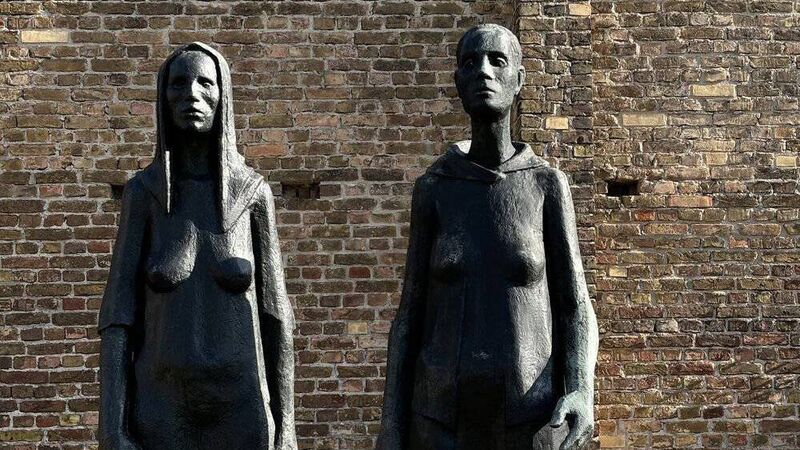
New archival discoveries reveal the story of a Cork woman held in Ravensbrück, and why remembering her matters today
Clodagh Finn: The forgotten Cork woman imprisoned in Nazi concentration camps

The memorial sculpture at Ravensbrück, which is north of Berlin.

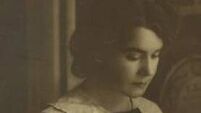
The only image we have of Cork woman Elisabeth Boslooper is the one conjured up in the document filled out when she was imprisoned at Ravensbrück, Hitler’s barbaric concentration camp for women situated some 90km north of Berlin.

It tells us that she was born in Cork on November 11, 1923, and, at the time of her detention, she was a well-built woman of 165cm with brown hair, brown eyes, an oval, full face, and a snub nose.

She spoke English, Dutch, and German, and had been arrested in Rotterdam a few months before, on June 26, 1944, although we don’t know why.

The form goes on to say that some of her teeth were missing and that she had a scar on her right hand, two descriptions that send a chill down the spine. Were those “distinguishing features”, as they are described, due to the mistreatment of this 21-year-old who found herself caught up in the Nazi’s murdering machine?

The only humanising element in the form is the looping signature at the end. Elisabeth called herself Lily, just as her mother did before her, though heavens only knows what must have been going through her mind when she added it to this statement: “I have been informed that my punishment for intellectual document forgery will be carried out if the above information proves to be false.”

HISTORY HUB

If you are interested in this article then no doubt you will enjoy exploring the various history collections and content in our history hub. Check it out HERE and happy reading

Her name later appears on a death list at Dachau concentration camp, but there are two other documents which suggest she survived and was released in November 1944. She disappears from available records after that. Although, thanks to Fiona Forde, the woman behind the genealogical service the Irish Family Detective, we have some more details.

The signature of Elisabeth Boslooper from Cork.

It’s still a sketchy outline, but we know that Elisabeth Boslooper started her life at Sullivan’s Quay in Cork, the third child born to Elizabeth Hayes and Dutch sailor Adrianus Boslooper. She had an elder brother Henry born in 1918 and a sister Mary born in 1920. Another sister, Christine, was born in Wales in 1927, and there may have been others.

Her parents had married in that country — in Cardiff in 1918 — but were back in Cork at the end of the year when Elizabeth gave birth to the couple’s first son in November. Her own mother, Mary (née Murphy), was present at the birth.

Three years later, in 1921, the census tells us that Elisabeth’s father was boarding in the home of Mary Ann Davies, 37 Travis St, Barry, Wales, where he was working as a fireman, although his occupation is described as “part-time seafaring”.

At some point, the family moved to Rotterdam and, in 1944, Elisabeth was arrested. It’s not entirely clear why. She was an Irish citizen who had a Catholic mother, but perhaps she was involved in some kind of resistance work.

The line about “intellectual document forgery” on her arrest form seems to relate to that document only, but was she involved in making fake ID or other papers?

From 1941, all Dutch nationals over the age of 15 had to carry identity cards. Cards held by Jewish people had an obligatory large black ‘J’ printed on both sides, which made that hunted community easier to identify — and arrest.

Having a good forged document could mean the difference between life and death

In France, for instance, one master of the craft, Jewish man and dry cleaner Adolfo Kaminsky, saved countless lives by discovering that the lactic acid he used in his day job could erase information on real identity documents without a trace.

He was then free to repurpose IDs and, in doing so, save lives.

But back to the Boslooper family. There’s one fascinating reference to Elisabeth’s brother Henry from 1944. His name appears on the passenger list of a ship travelling from Casablanca to New York in May.

He is described as a repatriated seaman and, rather touchingly, the document notes that he had a tattoo on his left arm with the word "mother" written inside a heart.

We know too that Elisabeth’s mother stayed on in Rotterdam and died there, aged 63, in 1957. She endured the loss of her oldest daughter two decades before: Mary died in the city in 1937, just before the war.

That loss must have made the arrest of her second daughter a few years later all the more harrowing. It is not at all clear if Elisabeth Boslooper ever returned to the city to join her family but now, at least, we know that this young woman from Cork was held in two concentration camps during the Second World War.

Dubliner Mary Cummins joined the resistance in Brussels and was arrested early in the Second World War. Picture: Courtesy of grand-niece Dorothy Seagrave

Her name — spelt with an ‘s’ in surviving documents — emerged from the records at Ravensbrück last year when the Embassy of Ireland in Berlin held two events to commemorate the Irish women held there during the Second World War.

There were five others. Catherine Crean of Moore St, Dublin, was a Brussels-based governess in her 60s when she joined a resistance network to help downed Allied airmen in the early 1940s. She was betrayed, arrested, and later sent to Ravensbrück where she died of dysentery, aged 65, in April 1945, just weeks before the camp was liberated.

Fellow Dubliner Mary Cummins also joined the resistance in Brussels, and she was arrested early in the war. She spent “four years of a living death” in various “dark precincts of terror” as she described the camps and prisons, including Ravensbrück, where she was held.

She survived the horrors as did resistance members Agnes Margaret Flanagan, from Offaly; Mary O’Shaughnessy, a governess working in France; and Cork nun Sr Kate McCarthy.

I must declare an interest here because their stories were brought to my attention by John Morgan, who has a long-standing interest in the history of Allied Resistance and escape lines in the Second World War.

Together, we wrote The Irish in the Resistance (Gill Books) to shine a light on the courage of these women and the many other Irish people who risked their lives to fight fascism.

But new information is emerging all the time, as the recent discovery of Elisabeth Boslooper illustrates.

'Survived against the odds'

Later this year, historian Cathi Fleming’s long-awaited book The Nun of Ravensbrück on Cork woman Sr Kate McCarthy will be published by Hachette. 

Here’s a line from the back cover: “Her actions have saved hundreds of lives and brought her to the edge of existence. Together with her friends Sylvette and Angèle, they have survived against the odds. But nothing can prepare her for what awaits beyond the Ravensbrück gates. And soon, Kate will face her biggest test yet...”

It sounds like a film — and I hope they make one — but it is also a timely reminder ahead of Holocaust Memorial Day on January 27 that we need to keep telling the stories of the past.

That has never been more urgent given the shocking results of a recent survey which found that almost 10% of young adults in Ireland think the Holocaust was a myth.

By encouraging contrast, some 91% of those questioned in the survey conducted by the Claims Conference (Conference on Jewish Material Claims Against Germany) said it was important to continue teaching about the Holocaust in school.

Maybe someday the bravery of the Irish women of Ravensbrück will be taught in schools too.

Your home for the latest news, views, sports and business reporting from Cork.

More in this section

Revoiced

Newsletter

Sign up to the best reads of the week from irishexaminer.com selected just for you.

Cookie Policy Privacy Policy Brand Safety FAQ Help Contact Us Terms and Conditions

© Examiner Echo Group Limited