Paul Hosford: Dublin Airport cap debate doesn’t justify Michael O’Leary’s swipe at the Taoiseach
Michael O’Leary has a point on Dublin Airport, but attacking Micheál Martin’s travel misunderstands Ireland’s global reality
Paul Hosford: Dublin Airport cap debate doesn’t justify Michael O’Leary’s swipe at the Taoiseach

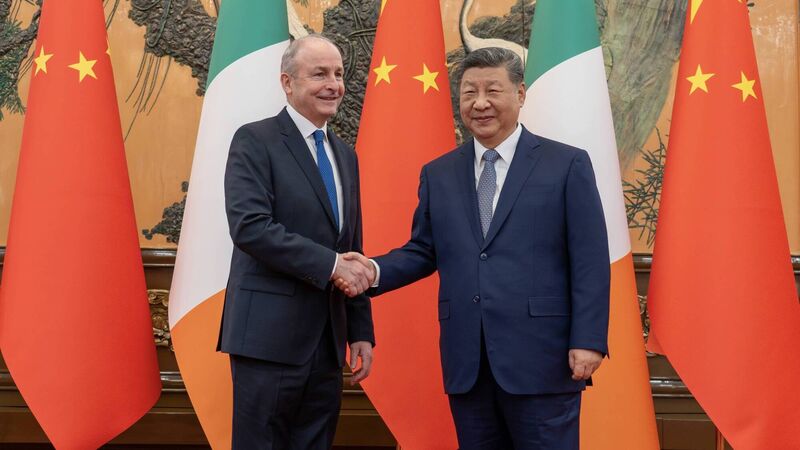
Taoiseach Micheál Martin with China president Xi Jinping in Beijing. Picture: PA

Look, I know.

I know that Michael O'Leary has a job to do as CEO of Ryanair and that getting attention helps him do this.


And I know that in much of what Mr O'Leary says there is a kernel of truth delivered in the most outrageous way possible.

And I know that I should not be giving him the attention he so obviously wants.

But.

This week, the outspoken CEO accused Taoiseach Micheál Martin of “being on tour more than the Chieftains” and laid into his record for travelling outside of the State, saying the Taoiseach should instead be at home ending the passenger cap at Dublin Airport.

“Micheál “Marco Polo” Martin claims his overseas tours deliver jobs — they don’t! All they deliver is more photos of Micheál Martin glad handing world leaders, while nothing is done at home about real job creation, despite his Government’s 20-seat majority,” Mr O’Leary said in a statement.

“Micheál ‘Marco Polo’ Martin promised to scrap this cap “as soon as possible”, yet 12 months later nothing has been done. He’s too busy travelling the world getting his photo taken, while failing to deliver his government programme here at home. 

"It’s time for Micheál Martin to stop touring and start delivering, and a good place to start would be scrapping the illegal Dublin Airport cap before the end of Jan 2026. This will enable the airlines, led by Ryanair and US airlines, to add routes, services, and new jobs for summer 2026, and this might open up even more overseas travel opportunities for ‘Marco Polo’ Martin.”

Again; a kernel of truth, but very much in Mr O’Leary’s interests. He and many others have repeatedly called for the 32m passenger annual cap to be lifted, arguing that growing Dublin Airport to 40m passengers a year is “in line with national aviation policy” and would spur job creation and tourism. They are not substantially wrong.

Ryanair chief executive Michael O'Leary. File picture

The cap was put in place as part of the planning permission granted when Terminal 2 was being constructed. At the time, there were concerns cited about the level of traffic that constructing the new terminal would create on the roads in north Dublin. 

In September, transport minister Darragh O’Brien began the process of removing the cap entirely by reclassifying the airport as national infrastructure for planning purposes, something that it should have been long ago.

The commitment to removing the cap was in the programme for government published last year, but in an interview with The Irish Times over Christmas, Mr O’Brien admitted that his plan had run into resistance from civil servants.

So Mr O’Leary has a point in one respect. A year to even begin to solve a problem which had been in the headlines for two years before the Government was formed is not exactly efficient.

But to suggest that Mr Martin should be staying at home while the issue, for which Mr O’Brien is working on legislation, is both bizarre and wide of the mark.

For a start there is the belief that members of Cabinet are sitting at their desks simply signing off on stacks of paper in their inboxes and calling that work. It is a misunderstanding of the work of politicians which takes in much more than just being a rubber stamp.

Secondly, there’s the question of whether Mr Martin particularly travels too much. In Mr O’Leary’s statement, there is a handy itemisation of the Taoiseach’s travel in the last year:

“He’s visiting China this week, having in the last 12 months been to the COP conference in Brazil, the G20 in South Africa, a “jobs” mission in Angola (which delivered zero jobs), together with multiple trips to Brussels.”

The statement misses the Taoiseach’s visit to Washington DC last year, New York for UN General Assembly week in September which included a night in Ottawa to meet Canadian prime minister Mark Carney and a two-night stay in Copenhagen for the European Political Community meeting.

Which leads us to the question which Mr Martin asked when Mr O’Leary’s comments were put to him in China; which of this travel is deemed expendable?

In China, the Taoiseach met with president Xi Jinping, effectively the second-most powerful man on the planet, along with his two most senior allies before meeting with business leaders in Shanghai and, perhaps up Mr O’Leary’s alley, attended the signing of a partnership between Trip.com and Tourism Ireland which will see the virtues of Irish tourism promoted to 400m members of China’s burgeoning middle class.

You can argue that the Taoiseach might not have attended the Cop climate summit in Brazil, but there he met world leaders from across the globe. 

For the G20, Ireland had been invited by South Africa to attend the conference, the first time Ireland has ever been to a G20, the collection of the world’s most powerful leaders. 

The trip to Angola was tacked on to the end of the South Africa trip and saw the Taoiseach attend an EU-African Union meeting while Brussels is the seat of the EU whose freedom of movement is a fairly large part of the kind of tourism which has made Mr O’Leary very wealthy.

In an increasingly interconnected world, the role of national politicians can no longer be confined within domestic borders. 

For Ireland, a small, open country whose economic, cultural, and political fortunes are deeply tied to international relationships, it is essential that Irish politicians proactively go abroad. 

Active international engagement is not a luxury or a symbolic exercise; it is a strategic necessity. 

By travelling, building relationships, and advocating for Ireland on the global stage, Irish politicians can better protect national interests, strengthen the economy, and ensure Ireland’s voice is heard in decisions that increasingly transcend borders.

Many of the most important issues facing Ireland — climate change, migration, taxation, digital regulation, and security — are shaped by international agreements and institutions. 

Remaining at home while others set the agenda risks leaving Ireland influenced rather than influential.

Critics often argue that politicians who travel abroad are neglecting domestic responsibilities or wasting public money but this misunderstands the purpose and value of international engagement. 

Effective foreign travel is not about prestige or personal benefit; it is about representation and advocacy.

When conducted well, international visits yield long-term returns that far outweigh their costs and Irish citizens benefit when their leaders are informed by global best practice, exposed to new ideas, and able to compare Ireland’s policies with those of other countries. 

Ireland has an outsized voice in the world. 

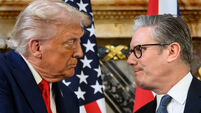
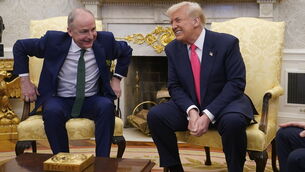
There are few world leaders who will meet the president of the US and the president of China this year. 

Fewer still are also guaranteed time with the leaders of the UK, France, and Germany. 

And not one of those is the leader of a country of just 5.5m.

To suggest that Ireland toss that aside and sit on the bench while the world is in flux is misguided in the extreme.

x

More in this section

Revoiced

Newsletter

Sign up to the best reads of the week from irishexaminer.com selected just for you.

Cookie Policy Privacy Policy Brand Safety FAQ Help Contact Us Terms and Conditions

© Examiner Echo Group Limited