Jennifer Horgan: I’m not imagining it — it’s getting harder to teach a certain type of boy
Plans to train teachers to identify misogyny ignore where the problem really lies — and place yet another burden on schools
Jennifer Horgan: I’m not imagining it — it’s getting harder to teach a certain type of boy

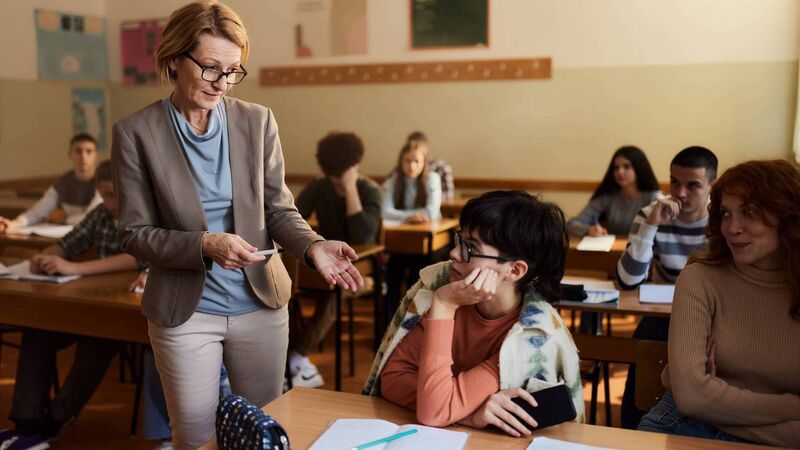
Female teachers are very often the victims of misogyny; they cannot and should not be expected to singlehandedly prevent misogyny too. File photo: iStock

I’m sure people will say I’m imagining the change that’s come into teaching in recent years. It’s so often the first response to a woman sharing a feeling, a sense of things.

Luckily, I trust myself enough to know I’m not imagining it. It is happening.

It’s getting harder to teach a certain type of teenage boy.

Not because of any one big obvious thing. It’s just that increasingly there is that one boy in a group who looks at you with a very particular disdain. There is a certainty there that as a middle-aged woman you have nothing to offer and certainly nothing worthwhile to teach.

It’s possible that age has something to do with my perception of things. I’ve never been a middle-aged woman before. Teaching children or teenagers when you’re in your 20s feels like a wonderfully comfortable fit. You’re young yourself, not yet part of the establishment, not in your head anyway. 

By your 40s you’re still as engaged and possibly even more creative, but you’re somewhere closer to being like a parent to your students. Your connection to young people shifts in a way that can, at times, feel like a loosening.

UK's plans

But there’s something distinctive about the behaviour of this certain teenage boy that has less to do with age and more to do with gender. It’s why I laughed aloud when I heard the UK’s recently announced plans to train teachers to spot misogyny among their students.

The £20m package will include teaching resources on consent and a helpline for teenagers, and most interestingly, schools will send high-risk students to get extra care and support, including courses to tackle their misogyny.

I laughed because it all seems so terribly misdirected. Not all of it — granted. The helpline sounds positive and there are other good ideas in there, but we must start with one hugely significant fact. Around 74% of the UK’s teachers are women. These teachers, I suspect, based on my own experience in British schools, don’t need training in spotting misogyny.

In fact, there is every possibility that these initiatives will work against female teachers, turning more boys away from them, making more boys even more resentful. 

Female teachers are very often the victims of misogyny; they cannot and should not be expected to singlehandedly prevent misogyny too.

Research from the UK makes the abuse of female teachers abundantly clear. A survey conducted in collaboration with UK Feminista in 2024 recorded one in 10 female support staff in secondary schools as saying they had been sexually harassed by male pupils, but also by their male colleagues.

Around one in seven also reported they had witnessed sexual harassment in their workplace in the past five years. That figure rose to a quarter in secondary schools.

According to TES (Times Educational Supplement) one in four female teachers report being verbally abused several times a week. Another poll of 200 teachers by the University of York revealed 76% of secondary school teachers and 60% of primary school teachers are extremely concerned about the influence of online misogyny in their schools.

They don’t need training in spotting something they can feel on a cellular level, just as I can feel it when it happens.

What non-teachers don’t realise is that the hidden curriculum is far more powerful than the actual curriculum. The hidden curriculum is the stuff that’s hard to pin down. It’s cultural and social. It’s what children bring into school with them from home, from being online.

Schools in the UK have been working hard to tackle these issues for years but misogyny is embedded in classrooms because it is embedded in society. It isn’t something that can be solved by a PowerPoint or a list of misbehaving boys.

Schools are across this topic. Ireland is behind in certain ways, depending on the school and its ethos, but certainly in the UK schools are robust in their efforts to tackle misogyny in all its forms. I taught in London in 2006, 20 years ago now. They were all over it then and no doubt they are all over it now.

Spotting misogyny

Why then do governments continue to pretend like all that work isn’t happening?

The government’s response to the miniseries Adolescence is a perfect illustration. In the media frenzy that followed, they made the decision to make the episodes available to screen across schools. Why schools?

The series was most obviously directed at parents. Only one of the four episodes related to the school setting. Schools cannot be the answer to everything.

Really, the show needed to be shown to everyone but personnel in school — to parents, coaches, youth leaders. Similarly, new programmes on spotting misogyny should be delivered to all the other adults in young people’s lives.

Concrete action also needs to be taken against online platforms. As part of the wider strategy, the British Home Office has announced a ban on AI-powered “nudification” tools that produce fake nude images without consent. This is more like it. 

The government is committed to working with tech companies to stop children from creating, viewing, or sharing nude images. The government should focus on this work and consider how to invest in changing societal and cultural attitudes to women in far more creative ways. 

They need to invest in the arts, in the production of a just and gender responsible culture, across all sectors and in all workplaces and not simply in overburdened schools.

One principal, Sukhjot Dhami echoed many others in education telling the BBC: "While we welcome any initiative that prioritises healthy relationships and consent education, it's important to recognise that schools like Beacon Hill Academy in Dudley have been delivering this work effectively for years."

Beacon Hill Academy is not alone in its delivery of such work. So why this latest initiative, this big announcement about training teachers up to spot misogyny? It is, as the Conservative opposition have labelled it, a “gimmick”. 

Political spin

It’s all political spin and the same nonsense happens in Ireland all the time. Every social ill from vaping to mobile phones is swept under the school carpet. It effects no change. It simply turns schools into holdalls. In a certain light these holdalls can start to look like refuse sacks, like piles of rubbish.

Parents need this training not teachers. Coaches need this training not teachers. Civic leaders need this training not teachers. People in all types of other workplaces need this training, not teachers.

Responding to the new measures that will also include celebrity television ads calling out misogyny, the Domestic Abuse Commissioner for England and Wales, Dame Nicole Jacobs, said the commitments "do not go far enough”. 

She added: "Today's strategy rightly recognises the scale of this challenge and the need to address the misogynistic attitudes that underpin it, but the level of investment to achieve this falls seriously short."

I would add that it not only falls short but is largely misdirected.

It strikes me that we can’t stop looking to teachers to solve our problems for one simple reason — stopping might mean having to look at ourselves.

x

More in this section

Revoiced

Newsletter

Sign up to the best reads of the week from irishexaminer.com selected just for you.

Cookie Policy Privacy Policy Brand Safety FAQ Help Contact Us Terms and Conditions

© Examiner Echo Group Limited