Colin Sheridan: Why can’t movie stars act like normal people?

Praise is no longer an expression; it is a currency. You flatter me today, I canonise you tomorrow, writes Colin Sheridan
Colin Sheridan: Why can’t movie stars act like normal people?

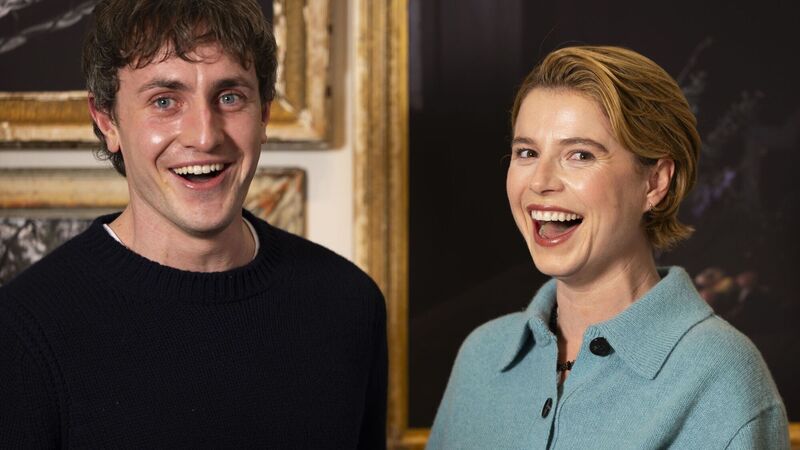
Paul Mescal and Jessie Buckley. Buckley speaks of Mescal with the hushed awe of someone describing a religious apparition.

There is a relatively new genre of performance that has emerged in recent years, and it is neither film nor theatre, neither tragedy nor farce, though it borrows heavily from all. It is known as the Actors’ Round Table. Ostensibly, this is a place where great thespians gather to discuss “the craft”. In reality, it is a kind of ayahuasca-induced compliment vortex in which grown adults sit in aggressively tasteful chairs and tell each other things that no human being should ever soberly say.

Actor A leans forward, eyes moist, voice reverent. “What you did in that scene,” they say to Actor B, who is not one bit embarrassed, “changed me as a person”. Actor B nods, suddenly stricken with humility, before replying: “Coming from you, that means...everything.” Somewhere off-camera, an awards publicist smiles the smile of someone watching their pension mature.

These round tables have become a staple of awards season: filmed in warm lighting, edited to remove any trace of silence, doubt, or reality. The premise is simple. Actors interview actors. The result is always the same. They discover, together, that they are not merely good at their jobs but are, in fact, luminous beings whose very existence has elevated cinema, humanity, and...

It is not enough anymore to say that someone was “very good” in a role. That language belongs to plumbers and accountants. No, Actor B must have redefined what acting means. Their performance must be described as fearless, raw, brave — adjectives once reserved for firefighters and first responders are now applied to people who cried convincingly while wearing bespoke knitwear.

Take Jessie Buckley and Paul Mescal, two actors of genuine talent, both capable of remarkable subtlety on screen. Watch them at a round table, however, and you might conclude that each is responsible for the other’s continued will to live. Buckley speaks of Mescal with the hushed awe of someone describing a religious apparition. Mescal, in turn, looks as though Buckley’s work has rearranged his molecular structure.

Is this a bit mean? Perhaps. But it is also impossible to ignore how quickly admiration curdles into operatic excess. Because no person alive could possibly be as good as Actor A describes Actor B. If they were, they would glow faintly in the dark and require a Unesco endowment.

Where, one wonders, have all the real actors gone? Would Richard Burton — a man who drank oceans, devoured Shakespeare, and understood ego intimately — have sat at a table murmuring about the “gentleness” and “spiritual courage” of Rip Torn? Would he have gazed into Oliver Reed’s eyes and said, “You made me feel safe”?

Or would he have grunted, lit a cigarette, and said, “He was good. He turned up. That’ll do.”

Compare this to the modern ritual: Timothy Chalamet describing Jesse Plemons as if he personally reintroduced oxygen to the atmosphere. 

Timmy speaks with such solemnity you half expect him to produce a censer. Plemons, meanwhile, nods gravely, like a man accepting a sainthood he insists he does not deserve but will absolutely be keeping

Do none of them feel deeply uncomfortable? Do they not hear themselves? Surely at some point, the words — transcendent, soul-altering, generational! — must begin to fold like a deck of cards under the slightest scrutiny. Or perhaps discomfort is simply edited out, left on the cutting-room floor alongside boredom and irony.

What makes these round tables so peculiar is not that actors admire each other — they always have — but that the admiration has become performative, strategic, and eerily reciprocal. Praise is no longer an expression; it is a currency. You flatter me today, I canonise you tomorrow. Together, we ascend. Imagine if other professions adopted this model. An annual mandatory round table for trades. Plasterer Kevin, tell us what inspires you about Plumber Pat.

Kevin clears his throat. “When I watched Pat fit that u-bend,” he says, voice breaking. “Time stood still… I swear… I swear I saw God.” 

Pat wipes a tear. “I’ve always said Kevin builds walls the way some people build meaning.”

Of course, this would never happen, because most professions cannot survive that level of dishonesty. Actors, however, are uniquely equipped. They are trained to emote, to affirm, to sell a version of reality that flatters the room. And the room, crucially, is full of mirrors.

The truth is, most of us — in Ireland anyway — already have an annual round table where we get down and dirty with the truth about each other. It’s called Christmas. It involves drink, grudges, and someone finally saying the thing they’ve rehearsed all year. No one is described as “fearless". At best, they are described as “not the worst bollix I ever met". Perhaps that is what is missing from the Actors’ Round Table: the possibility of contradiction.

The courage to say, “You were good, but you’ve done better.” Or even, “That didn’t quite work for me.” 

Until then, we will continue to watch these velvet-lined séances, where the incense is praise and everyone leaves floating six inches above the ground, convinced they have just witnessed — and participated in — greatness.

And somewhere, Richard Burton pours another drink and laughs himself hoarse.

More in this section

Revoiced

Newsletter

Sign up to the best reads of the week from irishexaminer.com selected just for you.

Cookie Policy Privacy Policy Brand Safety FAQ Help Contact Us Terms and Conditions

© Examiner Echo Group Limited