Maeve Higgins: Grateful to have sanctuary in US but her heart still beats for Ukraine
Maeve Higgins: Grateful to have sanctuary in US but her heart still beats for Ukraine

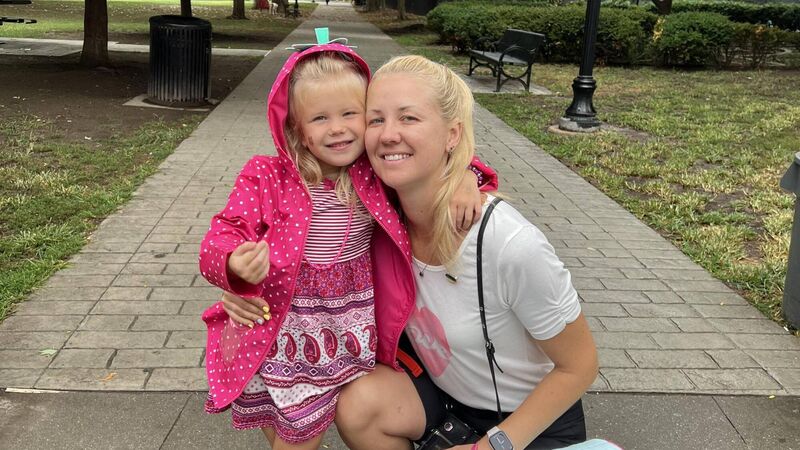
Liudmyla Holovko and her daughter, Nicole. Picture: courtesy of Liudmyla Holovko

‘IT WAS one day, just a few seconds, on February 24, when President Zelenskyy said a war would change all our lives.” Liudmyla Holovko recalls the fateful day one year ago when Russia invaded Ukraine. In March 2022, Liudmyla took her then four-year-old daughter, Nicole, leaving her husband, brother, and parents in the family’s hometown of Lviv, and fled across the border to Poland.

In April, a Russian missile attack on Lviv killed at least seven civilians, prompting the city’s mayor to tell the BBC, “Everyone is unsafe”.

The mother and daughter moved on to Germany and then to the US, where they received Temporary Protected Status, granted by the US government for migrants unable to return to their dangerous home countries.

The Holovkos are two of around 100,000 Ukrainians who have moved to the US since the war began.

As President Zelenskyy foretold, their lives have indeed changed. Today, Liudmyla and Nicole are living in New Jersey. Lyudmila is now a solo parent; Ukrainian men cannot leave the country without extenuating circumstances. She is studying at Hudson Community College, taking English classes four days a week. Having spent months volunteering to help settle other compatriots as they arrived, she is now determined to reach a high level of proficiency in her new language, seeing it as the key to a good job.

Like many Ukrainians, she remains stunned by how quickly the war disrupted her life.

“A year ago, I didn’t know I’d begin studying again. I didn’t know I’d be back in college or even in the US.”

Back in Lviv, she held a master’s degree and ran a successful nationwide auto parts business with her husband. But her reason for coming rings clear as a bell.

“Here, we are safe.”

In New Jersey, she is not afraid for her own or her daughter’s life.

We don’t have to go to the basement anymore. We don’t hear sirens; my daughter can go to preschool now. When the war started, I couldn’t even bring her to preschool. It was crazy. Just very scary.

I ask Liudmyla how long she thinks she will live here.

“I don’t know, but it will be a long time. I don’t know when the war will end, but I don’t think it will be safe in Ukraine even after the war. There will be bombs everywhere, in the parks, near the lakes, in the forests, and now everybody has guns.”

After withdrawing from Afghanistan in 2021, US President Joe Biden had to act fast to provide refuge to approximately 80,000 Afghan arrivals. His predecessor, Donald Trump, had spent four years dismantling resettlement agencies and reducing refugee numbers to a record low. Then came the Russian invasion, sending millions of Ukrainians fleeing for their lives. In April last year, the Biden administration announced the Uniting for Ukraine initiative. It allows a faster entry process into the US, not relying just on national and local resettlement agencies as part of the process. The initiative also revived the idea of regular Americans sponsoring new arrivals and supporting after arrival in the US.

Community 

I spoke to Sarah Krause, executive director and co-founder of the Community Sponsorship Hub, tasked with growing the role of communities in protecting, welcoming, and integrating refugees and other forcibly displaced people. What qualities does a community need to make a new arrival welcome and feeling at home? She emphasises “community”.

While individuals can sponsor Ukrainian arrivals, Ms Krause advises forming a group.

“Sponsorship is most successful when responsibility is shared. So be thoughtful [when forming] that group to ensure you are bringing in people with different perspectives, skills, and resources. Even availability — you might be challenged if everyone is working nine to five in your group and has limited time off.”

As well as the practical side of helping people settle in a new country, such as housing, healthcare, and education, cultural differences often need to be factored in. The US is well-placed to offer this. Take New Jersey, where Liudmyla and Nicole settled: one in four people are immigrants themselves, and one in six have immigrant parents.

Ms Krause also mentions Viets for Afghans, a volunteer-run organisation that began after the fall of Kabul in August 2021, created by Vietnamese Americans in Washington state that has helped multiple Afghan families to resettle in the US. Many of those volunteering felt compelled to act because their own families were once refugees who fled after the Vietnam War.

“Diversity certainly helps ... in your group, diversity in your community,” says Ms Krause, “but that isn’t necessary as long as you are thoughtful about how you can facilitate cultural connections for the newcomer.”

Obstacles

Some of the most confounding parts of Liudmyla’s new life included renting an apartment without a credit history. She laughs as she recalls the unique conundrum many newcomers face.

“To get a credit score, you need to be here for one year, but I just got here. And even if I had money, they wanted a credit score. I said I can’t have a credit score because I didn’t live here until now!”

The adjustment was not easy for her little girl either, but Nicole settled into preschool in New Jersey. She turned five here, and last October, suddenly started speaking English. According to her mother, she has not stopped since.

She’s a happy kid now. She sounds like the people from here. She says, ‘Mom, I like it here,’ and now she teaches me English.

But there is always the ache of being forced to move thousands of miles from loved ones. To stave off the loneliness of her new life, Liudmyla FaceTimes with her husband and parents daily.

“I do cry, of course, because my heart is with my husband. But I just hope that I will see him again soon.”

She tries to focus on the positive.

“America gives me these possibilities: to be safe, for my daughter to go to school, for me to learn this new language.”

Liudmyla’s priority is clear, one surely shared by parents around the world. “I want my daughter to have a good life. I don’t want her to be frightened for her [own] life.”

More in this section

Revoiced

Newsletter

Sign up to the best reads of the week from irishexaminer.com selected just for you.

Cookie Policy Privacy Policy Brand Safety FAQ Help Contact Us Terms and Conditions

© Examiner Echo Group Limited