Mick Clifford: Religion should not be a bargaining tool

In 2012, Education Minister RuairĂ Quinn kicked off his forum for patronage and pluralism with the aim of the divestment by the Church of patronage of around 40% of schools to better reflect society.
We had a bit of a dilemma when our firstborn arrived: Do we get him baptised? I have no religion and my wife has less. Ideally, we wanted the children to be schooled in a multi-denominational setting that would be the natural place for a child of non-religious — lapsed Catholics in our case — parents to go in a progressive, liberal society that caters for all. Except that’s not how we educate children in this country.
There were two Educate Together schools in our general locale in north Dublin, but the waiting lists were lengthy. On advice, soon after the birth, we applied to put his name down in about seven different schools, most of which were — like over 90% of primary schools — under the patronage of the Catholic Church.
The general opinion among parents was that this was necessary due to a belief that there could be a shortage of places.
In such a milieu, baptism was not a religious nor even a cultural issue. The choice was either to get the child baptised to ensure that he would five years hence have a place in a local school or else take a stance on principle, refuse to go through with what was effectively a charade, and hope that he might get into one of the multi-denominational schools.
We went through with the charade.
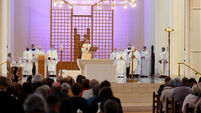
The ceremony was really nice, largely because the Catholic Church excels at rituals, which is an attractive feature of the institution. But beyond the actual event, the whole process felt like a form-filling exercise. This was not, as Catholic teaching would have it, about sorting the child out for avoiding the eternal damnation that lurks beyond the kingdom of Heaven.Â
It was instead about ensuring that he would have an even chance of receiving the education to which he is entitled as a constitutional right.
 So we got the baptismal cert and off I trotted to the various schools to present it as proof that, in the event of a numbers issue, our child should be bumped up the queue ahead of any non-believers. In terms of a citizen’s relationship to the State in an alleged Republic, the whole affair was bananas.
Parents no longer have to go through the charade. Since legislation was introduced in 2018, the baptism barrier to schools admissions has come down. However, Catholic schools want it raised again. The Catholic Education Partnership has stated that the removal of the right of Catholic schools to discriminate on the basis of religion in their admission policies is a “discriminatory law, solely directed at Catholics and no other faiths”.
Right. So the religion which controls over 90% of schools in an allegedly pluralist society is the subject of discrimination. This level of victimhood surely beats Banagher.
The involvement of the Catholic Church in primary school education in this country over the last decade is a sorrowful mystery that could have been scripted by St Augustine. Divest us of this power o Lord, but just not yet.
Apparently, the hierarchy within the Church acknowledges that the level of control it currently enjoys — which has differed little in decades — is unsustainable. Yet despite that, what appear to be genuine attempts by successive governments to fashion a system that reflects society have been stymied.
In 2012, the Minister for Education Ruairà Quinn kicked off his Forum on Patronage and Pluralism with the express aim of the divestment by the Church of patronage of around 40% of schools to better reflect society. Over the following two years, just one Catholic school was divested out of 3,129. The scheme struggled on but never really got going. The hierarchy held up their hands, stating it wasn’t their doing, this was all about parental choice. The parents were stopping the Church from loosening their grip on the education system.
'Reconfiguring'
These days the buzzword is “reconfiguring”, which makes provision for the schools to change patronage but the properties stay in the ownership of the Church. The Programme for Government has a target of having 400 schools reconfigured by 2030. This would merely reduce the grip of the Church from over 90% down to around 85%. But, ludicrously, even that appears to be too ambitious. Last year a single school was reconfigured. Once again, the hierarchy and associated education organisations are saying they’d love to see their power shrinking, but parents just won’t let them go.
Fear of change, any change, can have a powerful effect on parents, but it is also the case that scare stories abound. A church that was intent on having its patronage reflect society — and its own congregation — could reassure, invite in and to talk to parents about alternative patrons, have confidence that in a new dispensation its offering would remain the predominant choice of families. Yet that is not what is happening. Instead, the hierarchy collectively throws their hands to Heaven and points to parents who allegedly — despite their own increasingly secular character — want nothing more than a Catholic education for all their children.
Now, the baptism barrier is being thrown back into the mix as a bargaining tool.Â
The Catholic Schools Partnership has said that Catholic parents have expressed a concern that if their community consents to the transfer of a school to another patron, they cannot be sure that they can secure enrollment for their child in the remaining Catholic schools.
The positioning could be read as a thinly veiled threat: Give us back our power to discriminate over who has first call in 90% of the State’s schools, or you can forget about any co-operation in refashioning the system into one properly reflecting society. One side effect of reraising the baptism barrier would be to once more reduce, in many eyes, the induction sacrament of the institution to a form-filling exercise for many citizens who just want the best shot at education for their children. Is that really the way to attract new, and retain existing, adherents to the religion?
I have no doubt that there are serious people in both the hierarchy and Catholic education community who want to have a school system that caters exclusively for those who genuinely subscribe to the religion in a meaningful way. In such a milieu, they could fully impart their ethos as part of a child’s development, in whatever way they believe differs from the offering other patrons provide. But such people are not being heard within the institution. All the evidence is that the approach is “what we have we hold”.
And when it comes to exercising or manipulating power, the Church has millennia of experience to draw on. Up against that, any government of the day — transient, distracted by bigger fish to fry, unwilling to spend political capital on the issue — is just putty
in their hands.
CONNECT WITH US TODAY
Be the first to know the latest news and updates