Joyce Fegan: A disconnect between the power and the people
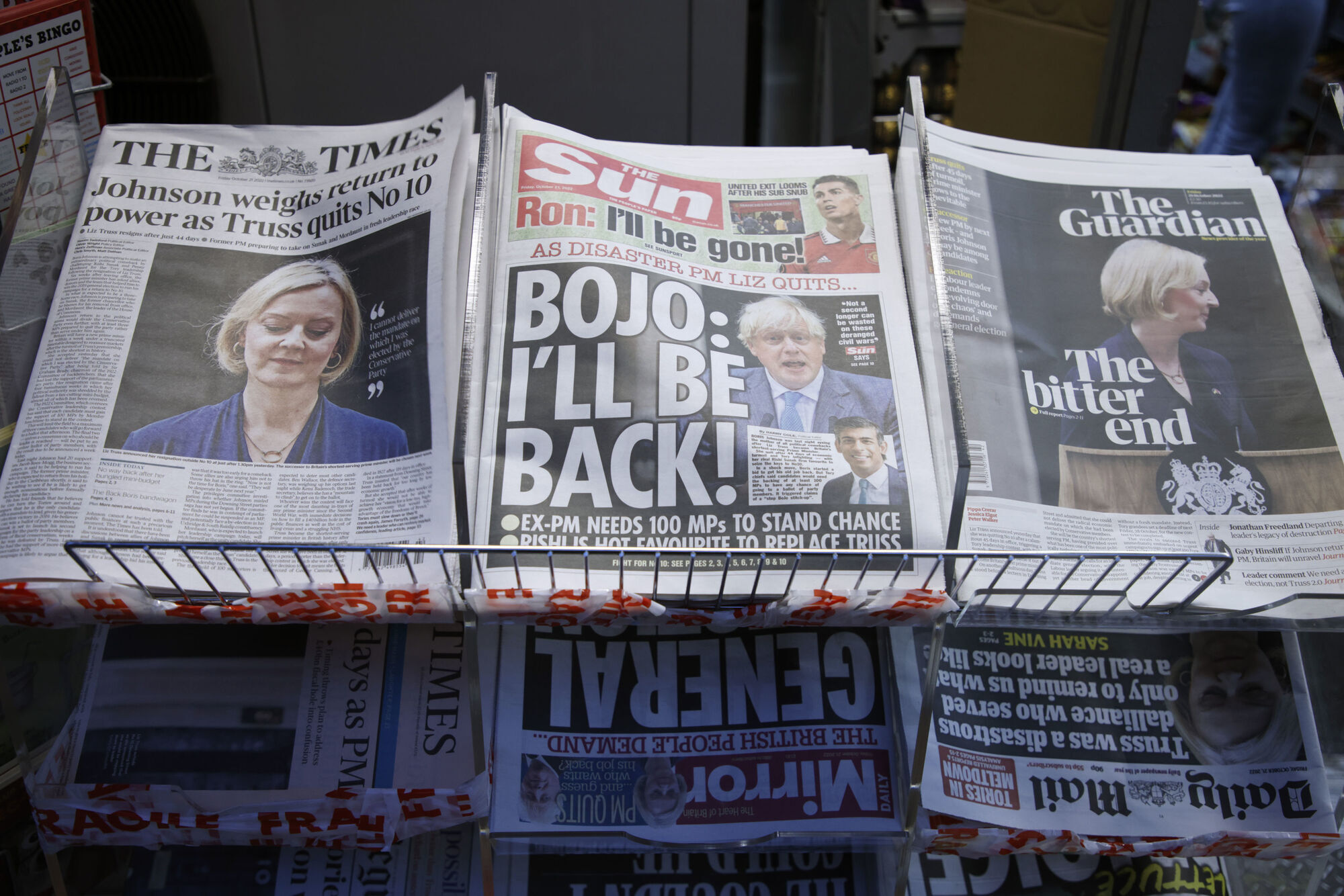
A selection of British national newspapers showing the reaction the resignation of Liz Truss. Picture:: AP Photo/David Cliff
Bar the passing of a queen with a near-century long reign, or the odd wedding, there’s rarely much action outside Buckingham Palace.
But not on Thursday. As a handful of tourists took underwhelming snaps in a drizzly, overcast city and as a flat-capped Londoner led a guide of American tourists, the gates were opening and closing, a cavalcade of police cars formed and men in tailored suits, not accustomed to navigating rain, commuted by foot from the palace, across Green Park and into nearby buildings, some government offices.
By 2pm the country’s new prime minister would be gone.
Whether the scenes were connected we will never know, but what is not connected is the chaos we feel is emanating from across the water as we watch the news from Britain back home and what’s actually happening on the streets.
The Sky News bulletin in the airport reads “chaos in Westminster”. The TV at the hotel breakfast reads: “rip-off Britain crisis”. The BBC has even appointed cost of living correspondents as well as a campaign across all programming and all regions called “tackling it together”.
Back home it looks like the empire next door is falling to pieces but walk its streets and it’s business as usual.
Only those making the most noise and garnering the most attention-grabbing headlines aren’t the ones keeping things ticking over.
The melting pot of immigrants are the ones on the night shifts, the early shifts, getting breakfast on the table for lone-travelling businessmen. Those running food stalls offering everything from Filipino to Haitian fare meticulously set up shop from 9am and hope to make a living until sunset.
A used syringe, with its needle still attached, lies discarded among the bed of autumnal leaves that cover Green Park — a stone’s throw from the Palace. Homeless people, again mostly lone men, take shelter and find solidarity under archways by Waterloo Station and in shallow tunnels by the millionaire rows of Mayfair.
There is no chaos in the city. People are too busy keeping the show on the road, their own individual one, and the collective by default.
The tube drivers are all showing up for work and the mind-blowing matrix that is the London underground continues to serve millions a day without much of a glitch. The workers all the way down there smile and chat cordially among themselves and even in the throngs of a crowd manage to signal those with a buggy or wheelchair to use the wider exit gate.
Where there should be chaos, there’s none. The workers that run London are getting on with it.
Even a guy whose job it is to shift copies of the Big Issue on Millennium Bridge for the day downs tools to help lift a buggy up a flight of steps.
There’s co-operation, gumption, and support to be found on the streets.
Cost of living
The price of things is one of their big media stories too. Only when it’s nearing a pound for a euro, their avocados are working out at 75c each versus maybe €1.50 here. There’s housing and electricity and transport though too. The commuters have gone heavy on the push bikes, it’s front page news for the Times on Wednesday — “its popularity is surpassing levels seen in the pandemic when usage was highest in 60 years”. The reason 50% more people are cycling regularly compared with before the pandemic is “soaring fuel prices”.
An Irish friend who recently made London her home tells me her electricity provider has offered free electric blankets for the winter. That seems like the house is going to win every which way. But doesn’t it always? That same friend, who is on the commute from 7am, isn’t too caught up in the chaos we see emanating on our screens from Westminster. She says her mum back home has been asking about it too but honestly, she’s just… the words don’t come.
But if you were to finish someone’s sentence for them it would be that she’s working from dawn to dusk and commuting in between and either side. She does say it’s expensive to do her grocery shop, about £10 for three chicken breasts. She reckons she should shop around more, inadvertently blaming herself. Sure, don’t we all?
There’s a disconnect between the chaos we feel is across the water and what’s actually going on on the streets.
There was all this talk of tax cuts and who would pay for what. And who’d get less and who’d get more. Pensions were to be affected, so too was social care — and greatly.
You sit these conversations alongside the Pakistani mum of two on the 6am breakfast shift, the group of homeless men selling books for £1 by Waterloo Station, the street vendors powering up their generators to feed the busy office workers and you wonder who’s going to be damaged most by any changes.
And you turn on the news and all you hear is rhetoric from Conservative Party members saying how bad all the kerfuffle has been for the Tories.
Apparently “extraordinary damage has been done to the party”.
If there’s a disconnect it’s between some tantruming politicians in Westminster worrying about perceived reputational damage to their little tribe and the large and hardworking public that surrounds the chamber on all sides, for hundreds of miles.
We had a Taoiseach who walked the streets of Dublin to see homelessness first hand. And this wasn’t a leader from one of our more left of centre parties.
We are far from perfect, but our disconnect feels a little less severe than the one between the people and the power next door.
Who keeps a country going?
Is it its early morning, late night immigrant workers, its white collared professionals, or its carers who facilitate the economic work of many?
Or is it those who tussle and manhandle for power in order to write far-reaching policy?
Or, is it the toil of those who must live and work under policies written for them, by people who will never know long commutes to a city to earn a few bob covering a hotel breakfast shift?
We watch on as royals get married, divorced, discredited, and buried and we did the same as the empire next door exited our union. Now we’re looking on as they navigate cuts and costs and economic welfare and it feels like carnage, and it can all feel so different to us. But we’re much the same in some ways. Walk the streets and it’s busy workers with their heads down commuting to jobs to pay bills to keep food on the table, in the hope that whatever noise is going on around them, will not land on their or their loved ones’ doorsteps.
CONNECT WITH US TODAY
Be the first to know the latest news and updates