Michael Moynihan: Disastrous environmental effects of city council’s planning policies
Michael Moynihan: Disastrous environmental effects of city council’s planning policies

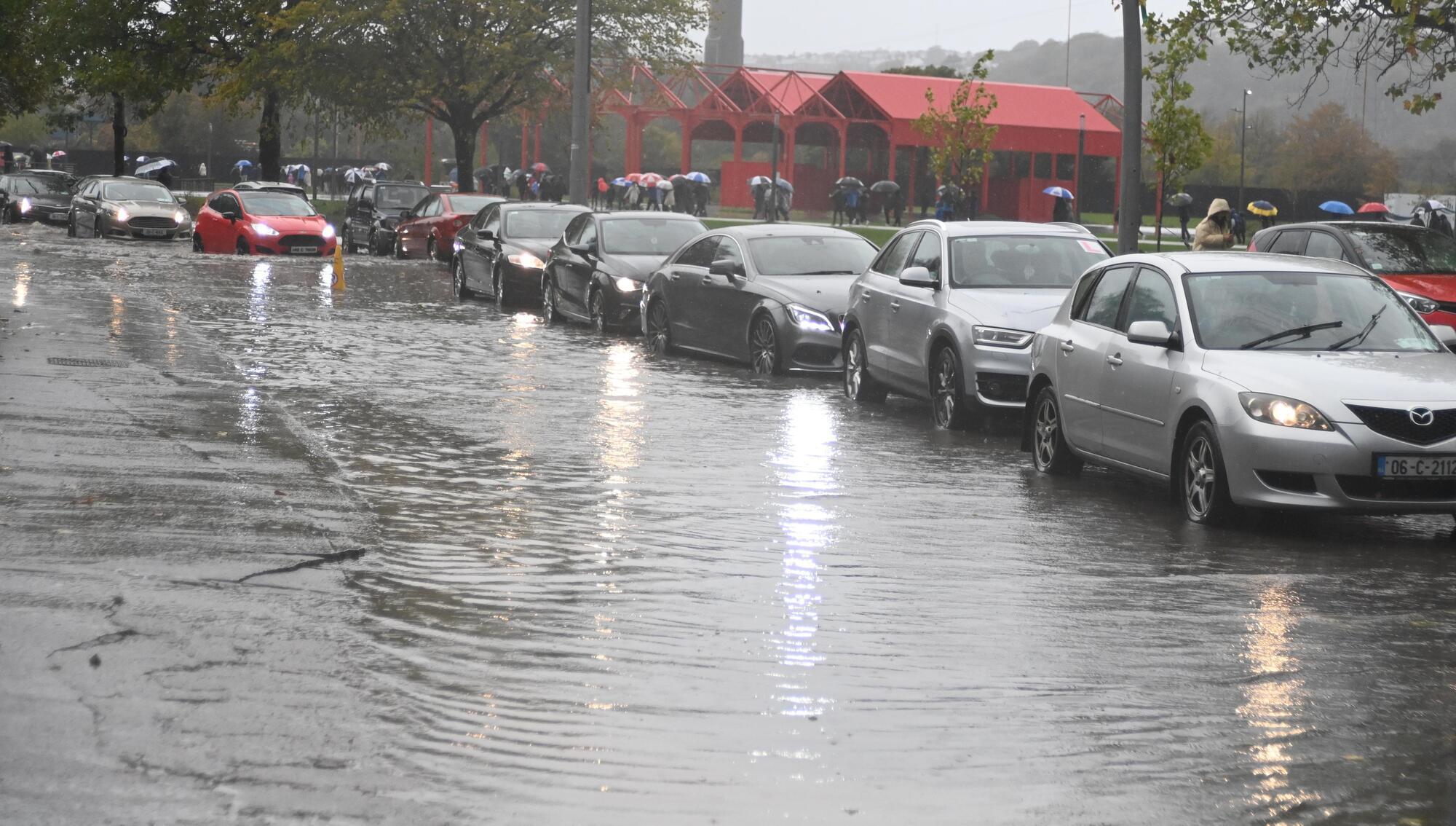
Vehicles pass through flood water on Monahan Road as crowds depart Páirc Uí Chaoimh after the county hurling finals in Cork city. Picture: Larry Cummins

If ever the title of Venice of the North was up for grabs, it was at or about 6pm last Sunday in Cork. I don’t like to spark PTSD among readers — intentionally, at least — but even the mention of last weekend’s downpour may be triggering. It should at least have you wringing out your socks as a Pavlovian response.

Yours truly was out in it briefly. Not at the county hurling final, but doing the weekend shop; I got home before the rain began to come down like stair-rods, to quote a Cork icon for whom the county hurling final was a familiar outing. He used the term the day the Second World War broke out and there was something similarly apocalyptic about last weekend’s rain, an eerie, ominous atmosphere in the city which was linked to St Finbarr’s win in the above-mentioned game.

On a serious note, though, what did we really learn from last Sunday?

One very obvious takeaway is the local authority’s level of readiness for an event like this. The argument could be made that 55mm of rain was a huge amount of water to contend with. The argument could also be made that having the rain fall on a Sunday afternoon, as opposed to a weekday when council staff are out and about anyway, compounded the problem.

However, Met Éireann did provide a warning of heavy rain well in advance of Sunday. Because everyone in Cork is a meteorologist this week there’s been a good deal of criticism on Leeside of the yellow warning issued on Saturday. (For not being a red warning, in essence.)

A quick visit to the Met Éireann website reveals this definition of a yellow warning — “STATUS YELLOW: Weather that does not pose a threat to the general population but is potentially dangerous on a localised scale.”

This seems a reasonable representation of what happened in Cork on Sunday. Still, I see that Lord Mayor Deirdre Forde has said the yellow warning was only issued the day before the rain — only to have Met Éireann point out that heavy rain was forecast as early as last Thursday.

That’s the weather side of what happened, but we have to differentiate between the rainfall on one hand and the resulting conditions on the other

Flooding in Blackpool; flooding on the South Link; flooding on the quays; flooding in Rochestown, and flooding near Páirc Uí Chaoimh.

Those with a rudimentary grasp of geography will recognise immediately that some of these areas are near rivers, but not all. The Lee did not contribute to the flooding on the Commons Road or the Boreenmanna Road on Sunday, for instance.

Go further: there was flooding in the vicinity of Blackpool Church on Sunday, but a video from the area taken by the Save Our Bride Otter group suggests the River Bride wasn’t responsible for the water on the road, and it certainly couldn’t have been to blame for the water coming downhill from Spring Lane further north in Blackpool.

Anecdotal evidence suggests that problems arose because gullies and drains were blocked, causing water to back up and pool on roads, and that’s certainly plausible

It would explain why those pools seemed to centre on where such drains and gullies are located around the city, but that theory was contradicted by Cork City Council on Monday.

A spokesperson said: “Ahead of the event and as part of their scheduled work programme, Cork City Council crews had ensured that the city’s network of trash screens and gullies were all clear.”

Yet Michael Murphy, general manager of Turner’s Cross Tavern, was telling a slightly different story when speaking to this newspaper on Monday.

“It was well after 6pm before the fire brigade got here,” Mr Murphy said. “In fairness, once they unblocked the drains, the water subsided pretty quickly.

“But we didn’t see a council worker until after midnight. Lessons must be learned out of this, especially around the maintenance of drains and gullies.”

In fairness, he wasn’t saying the drain was already blocked when the rain began. Nor was he blaming the council for whatever blockage was there in the first place.

His point about the maintenance of drains and gullies stands, however, and is reinforced by pictorial evidence produced by the Save Our Bride Otters group mentioned above, which shows blocked drains on the northside of the city.

Is there a bigger problem than drains and gullies? The City Hall spokesperson mentioned earlier acknowledged that some areas may require an upgrade of drains, while the council may also need to adapt “sustainable urban drainage” methods or “natural surface water management” that could see large green areas in urban locations designated as flood storage areas.

However, Mayor Forde was far more blunt: “When we think of the system that was installed all those years ago, and all the houses built, the drains possibly aren’t fit for purpose in these days.”

Cork City Council can point to the rainfall experienced last Sunday as an exceptional event, though how exceptional it will prove to be in time is debatable

We’ll have more such events because of changing weather patterns, something accepted by most people who aren’t posturing because of ulterior motives, but last weekend showed the disparity between a concept that seems notional (“yes, of course climate change is real”) and its manifestation in real life (“why am I stuck on the South Link for an hour?”).

The local authority can also say its maintenance of alleviation measures such as drains and gullies is efficient — residents may be sceptical based on last weekend, but that’s just a sideshow.

A local authority acknowledging a need for large green areas for flood storage, or its mayor admitting that the city’s drainage system is not fit for purpose with “all the houses built” in recent years?

That’s the main point, a local authority acknowledging plainly that its planning policies have had a disastrous effect on the local environment.

Converting swathes of the city into housing, and the consequent removal of natural drainage and run-off, is making events like last Sunday’s worse than they need to be

Whether drains and gullies are blocked or not is beside the point. A cynic might express thanks that those drains and gullies were in such good condition last Sunday and ask what would have happened if they hadn’t been cleared per the city council statement?

Other developments on the horizon have the potential to influence this situation and not necessarily for the better. The Bus Connects plan will involve large-scale ground works in a variety of locations around Cork and will need to be evaluated with particular regard for drainage. The cynic mentioned above would no doubt chime in here to point out that with so many locals involved in planning Bus Connects the vagaries of Cork’s underfoot conditions have doubtless been taken into account.

Consider this a red warning for the future.

x

Check out the Irish Examiner's WEATHER CENTRE for regularly updated short and long range forecasts wherever you are.

More in this section

Revoiced

Newsletter

Had a busy week? Sign up for some of the best reads from the week gone by. Selected just for you.

Cookie Policy Privacy Policy Brand Safety FAQ Help Contact Us Terms and Conditions

© Examiner Echo Group Limited