Mick Clifford: Apartment defects the latest step in a sorry saga
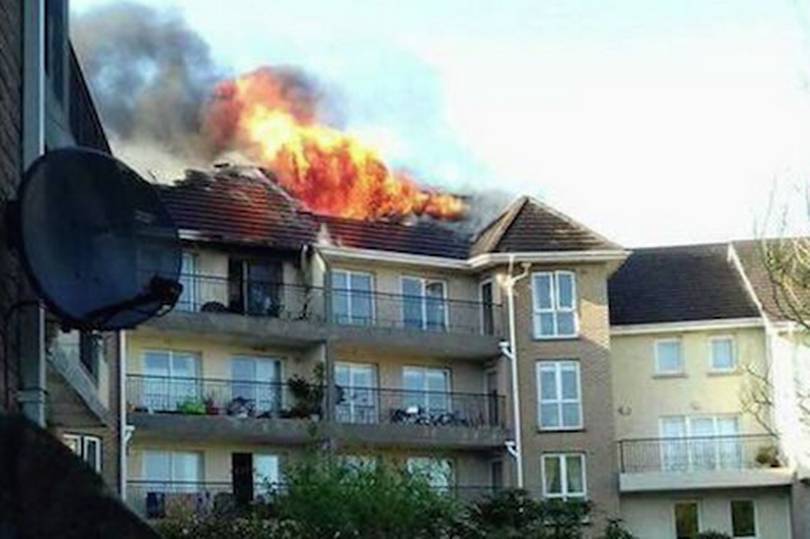
The fire at the Verdemont apartment block in 2002. Photo: Dublin Fire Brigade
Stuff doesn’t just happen. Stuff occurs at the end of a long period during which policies are shaped, positions taken and warning signs studiously ignored.
Last week, the latest stuff arrived in the form of news that fixing defective apartments is going to cost around €3bn. This is in addition to the same amount which it is calculated will be required to repair homes due to defective blocks. If you were to put some money on what the final combined bill will be, I’d suggest €8-10bn would represent a value bet.
A working group set up by the housing minister is set to report that fire safety, structural defects and water ingress are present in up to 80% of apartments built between 1991 and 2013. This represents somewhere between 62,500 and 100,000 homes.Â
In the vast majority of these cases, the problems are mainly to do with fire safety defects. The exact figure is difficult to tie down simply because many homeowners and landlords prefer to ignore the problems until after they have sold the property on. They are gambling that a fire won’t break out in the meantime.
Over the last eight years, the has highlighted dozens of cases of fire safety defects. The most egregious involved Verdemont, a complex built in Blanchardstown, west Dublin in 2001. The year after it was completed a young couple, Louise Wall and Mick O’Farrell, lost their lives when a fire broke out in the apartment they were renting.
Serious fire safety defects were discovered in the subsequent investigation. A diligent garda superintendent recommended prosecutions, but the DPP concluded the evidence may not stand up. The coroner wanted further investigation of the building.Â

Nothing was done. It was as if the authorities couldn’t or wouldn’t accept at the time that a whole complex could have been built in a shoddy and dangerous manner. That would have opened up an appalling vista, and it was only in 2011 when a High Court judge ordered the evacuation of Priory Hall, that the reality of what had gone on could no longer be ignored.
In 2017, another fire broke out at another apartment in Verdemont and spread rapidly. Over 100 homes had to be evacuated. Luckily, the blaze occurred in the afternoon and not the dead of night so there was no further loss of life. By then, cases were coming to light all over the state about major fire safety defects.
An investigation was finally undertaken, the remedial cost estimated at €14m and fire marshals detailed to patrol the complex 24/7 until the buildings could be made someway safe. The presence of fire marshals installed in dozens of apartment blocks in recent years, detailed to act as human fire alarms, is one of the physical legacies of the Celtic Tiger building boom.
The whole defective apartment story is the most searing indictment on a political culture in which vested interests yield a level of power that works directly against the public interest. One typical example of this culture is the manner in which publicans managed for decades to stymy the country’s drink-driving laws.Â
Politicians ignored carnage on the roads attributable to drink-driving because tackling it would have involved taking on the publicans. In 1998, an expert group recommended mandatory breath testing.
The government hid behind alleged problems with the Constitution. Eight years later, by which time media focus and public anger had highlighted needless deaths, the constitutional problems disappeared and the testing was introduced. The public interest finally took precedence, but only at the end of a long, tortuous battle that involved plenty of deaths and untold grief.

Just as large sections of the body politic colluded with publicans against the public interest, so also they did with developers against the imposition of proper regulation. Nobody really wants to be regulated but most sectors simply don’t have a choice.
Throughout the 1970s, the building industry resisted mild attempts at regulation to replace hopelessly out-of-date by-laws. Their position on the matter was that they were responsible people who didn’t require regulation. Then in 1981, the Stardust disaster happened. The deaths of 48 people injected urgency into a push for proper building regulations.
Eoin Ă“ Broin’s excellent book details the Dáil debates that followed. Repeatedly, the interests of the construction sector were put to the fore. The industry had, the minister of state at the time Fergus O’Brien, told the Dáil, previously proposed “an alternative system of control, based on certification by the industry itself”.Â
Therein lay the birth of self-regulation.
There was little scrutiny on behalf of the public interest from the main opposition party, Fianna Fáil. Bobby Molloy was concerned that any bill to regulate “would have the effect of increasing costs considerably” and amounted to a “major burden being added to an industry already on its knees”.Â
It would be the guts of 30 years before such a softly-softly approach to protecting the public would be laid bare. People who were not yet born, or living as children when the law was being made, would eventually bear the resultant financial hardship, health-destroying stress, and loss of life that resulted directly from the body politic’s failure to prioritise the public interest.
Things change, but not necessarily by much. Since 2014, new building regulations have been brought in but many observers have noted that there are still major shortcomings and continued reliance on the industry to police itself.Â
Even at this point, the Government is determined that regulation will not be undertaken by the State, as it is in most other jurisdictions. Since details of the working group’s report were leaked last week, there have been suggestions that a levy will be imposed on the construction sector to contribute to the cost of remediating the defects.
Eight days ago the chief operating officer of the Irish homebuilders association, Hubert Fitzpatrick, was interviewed on RTÉ radio’s programme.
“It’s unreasonable to expect the general industry, which is fully compliant, to be blamed for the faults of a few,” he told Sarah McInerney. A few? Some 80% of apartments built over a 22-year period?
Mr Fitzpatrick thinks times have changed.Â
“We are in a highly regulated industry today,” he said. “Any levy would question the future viability of many developments needed today.”Â
It is the same tune that was being played nearly 40 years ago when laws were being made. Same poor mouth, same attempt to conflate a vested interest with the public interest.Â
The big question remaining is whether the government today, knowing all the public now knows, is willing to go along with it any longer.









