Terry Prone: Secrecy a thing of the past as Pope opens up trove of Second World War letters 
Pope Francis has made 40,000 files accessible to anyone who wants to read them — but they do not make for comfortable reading
Terry Prone: Secrecy a thing of the past as Pope opens up trove of Second World War letters 

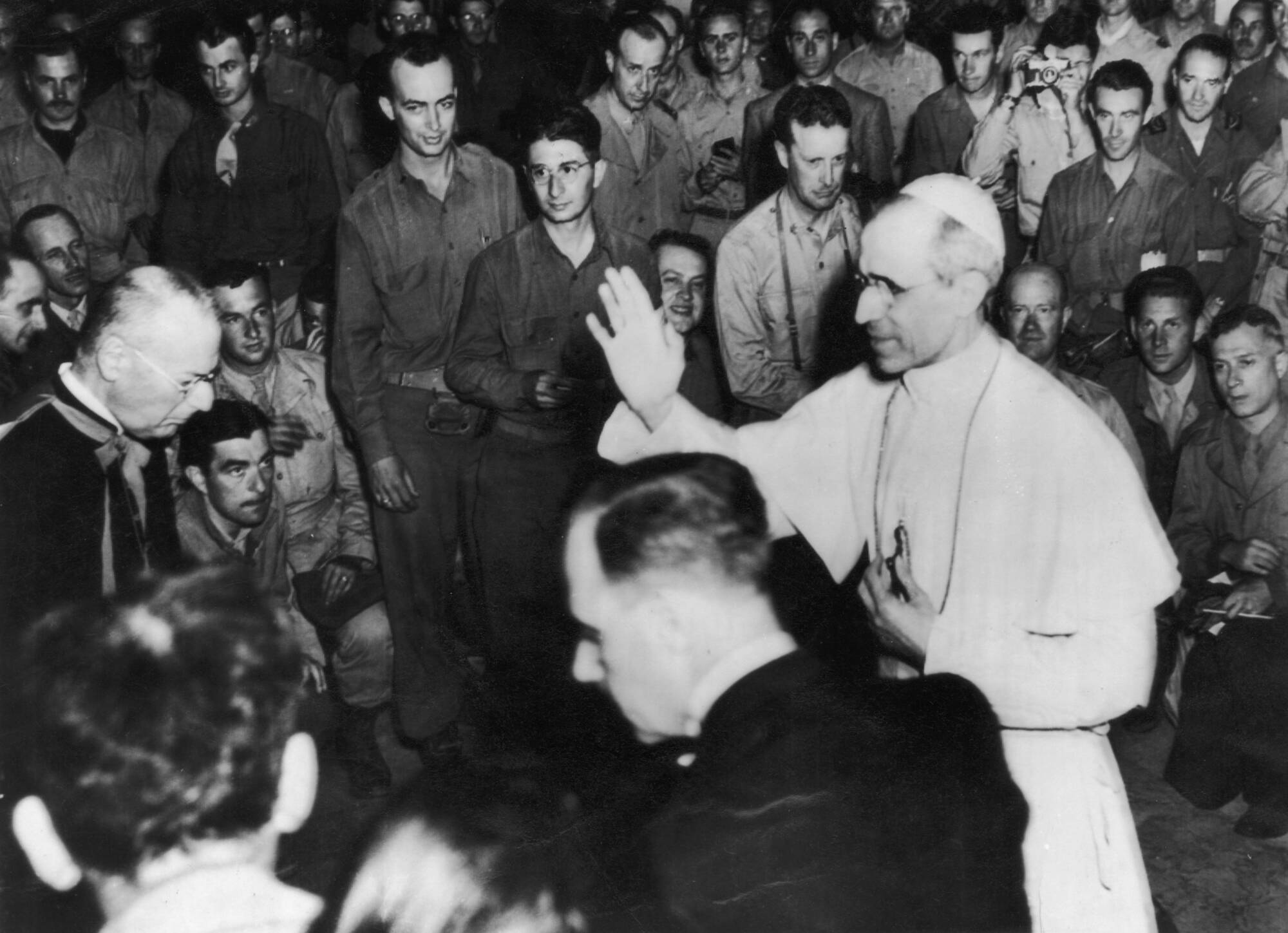
Pope Pius XII blesses a group of war correspondents in the Vatican, shortly after the liberation of Rome during the Second World War, on June 7, 1944. Picture: Getty

The mills of God grind slowly but they grind a little faster when a man such as Francis occupies the Vatican. Since 2020, letters seeking the direct help of Pope Pius XII from Jewish people in Europe during the Second World War have been open to scholars. Now the Pope has gone further, making the 40,000 files accessible to anyone who wants to read them. 

They do not make for comfortable reading, coming as they did from people frantic to avoid concentration camps or desperately seeking help to find family members who had been taken to such camps.

The letters — kept in the Vatican for three quarters of a century in drawers simply labelled “Jews” — do not show a beginning, middle, and end narrative. In some cases, the initial request for help stands alone, untethered from any assistance the Pope may have provided. 

We know that one of the letters came from a 23-year-old student in a Spanish concentration camp, who pointed out to His Holiness: “There is little hope for those who have no outside help.” We also know that the student survived the concentration camp and rejoined his mother after the war. What we don’t know is if the Pope contacted Franco, the floridly Catholic ruler of Spain at the time, to request that he help free the young Werner Barasch.

Accusations

The odds are firmly against it, though. Twenty-three years ago, English historian John Cornwell became convinced that he could write a biography of Pius XII that would vindicate him and put to rest accusations that he had done nothing to oppose the Nazis’ "Final solution".

The powers that be in the Vatican agreed, allowing him to examine files from the war years, not including the letters now opened up. What he found changed his mind so radically that the resultant book was called Hitler’s Pope. Cornwell not only portrayed Eugenio Pacelli as having been carefully inactive during the war years of his papacy but as having signed the Reich Concordat with Germany in 1933, thereby ensuring the Nazi movement would achieve and consolidate power unopposed by the powerful Catholic Church lobby.

Church power

It is difficult for younger people to understand just how powerful the church was at that time. Had the Pope intervened with Franco, Franco would have responded with mannered obedience. The Pope

Francisco Franco, the floridly Catholic ruler of Spain during the Second World War. Picture: Baron/Getty

had the powerful weapon of excommunication at his disposal, and it was deployed — once — against a Belgian for wearing his SS uniform to Mass. 

However, when a priest named Josef Tiso became president of Slovakia, a country at the time a satellite of Nazi Germany, only vague general criticisms issued from St Peter’s, even when Slovakian Jews were deported to extermination camps from 1942. 

It does not require examination of the letters released by Pope Francis to prove beyond doubt that Pius XII knew what Tiso was doing, yet he never excommunicated him. 

Even when Tiso was found guilty of treachery after the war and executed, he still wore the full Catholic priest regalia

It could, in the last century, have been argued that His Holiness might not have known, let alone imagined, the scale and horror of the Holocaust. Information emerging in the last 20 years establishes that he didn’t need to imagine: He knew. He knew.

Escape from Auschwitz

Two men did the impossible, escaping from Auschwitz with the objective of informing Roosevelt, Churchill, and the Pope of the facts and figures of the concentration camp. They had observed and memorised the selection process at the ramp where inmates arrived, calculated the numbers gassed immediately thereafter, and committed to memory names, dates, and details. 

Their hope was that first of all the Jewish organisations in occupied Europe would understand that the fiction presented by the Nazis of “resettlement” was a lie and that this knowledge would stop the almost catatonic progress of Jews into the trains taking them to their deaths. 

They knew better than to believe deportees could fight armed SS men, but believed even a doomed battle at the beginning of the process could significantly, even fatally, disrupt it

To their horror, they found Jewish leaders resolute in their refusal to believe in or share the truth. Other target audiences — including FDR’s administration — reacted equally negatively, dismissing the data presented. 

Churchill believed it and was moved by it, but direct connection between that emotional reaction and what the two escapees sought — aerial destruction of the railway lines leading to Auschwitz — is difficult to find.

The same thing happened to Jan Karski, a member of the Polish resistance, in the Warsaw ghetto, who was begged by Jewish leaders to ask the Pope to publicly excommunicate Germans who murdered Jews. He promised them he would do it and he got the data through to the Vatican, but nothing important happened as a result. “It didn’t do any good.”

Failure to act

As if the information coming from within the Warsaw ghetto and Auschwitz were not enough to persuade the Pope to act — and it clearly was not — he had access, day after day, week after week, to the letters that Pope Francis has now released to the world. These letters came from desperate Jews all over Europe who appreciated the enormous moral heft wielded by the Papacy and believed the Pope could save countless lives.

Pope Francis, who has made the letters from Jews during the Second World War available to everyone to read. Picture: Andrew Medichini/AP

The Pope said nothing, used none of the weaponry available to him, concentrating instead on conserving the spiritual and territorial power of the Vatican. He may have seen as ineluctable the advance of Naziism — a view which renders suspect his faith in an all-powerful God. Cardinals and bishops following his example could point out what happened after Archbishop Johannes de Jong of Utrecht condemned Jewish deportations in a pastoral letter of July 1942: The Nazis simply moved on to destroy Jews in the Netherlands who had converted to Christianity.

Papal apologists

Apologists for Pacelli point out that he did not seek to prevent Cardinal Roncalli (later Pope John XXIII) saving Jews by document forgery and faux-conversion and he tacitly allowed Cork priest Hugh O’Flaherty, working in Vatican City, to save thousands and even promoted him after the war. 

However, turning a blind eye to clerics saving lives is not the same as using the fulcrum of the Vatican to halt mass murder

John Cornwell, ending the research phase of his book in 1977, had found evidence that “from an early stage in his career, Pacelli betrayed an undeniable antipathy toward the Jews, and that his diplomacy in Germany in the 1930s had resulted in the betrayal of Catholic political associations that might have challenged Hitler’s regime and thwarted the Final Solution”.

Pope Francis’ opening of the files to anyone who wants to do further research may help Jews all over the world find details about loved ones seeking help during the Holocaust. Others may find evidence to reduce Pius’s culpability. Either way, the gesture hammers human responsibility home to today’s hierarchy. Secrecy was possible in the past. Not any more.

x

More in this section

Revoiced

Newsletter

Sign up to the best reads of the week from irishexaminer.com selected just for you.

Cookie Policy Privacy Policy Brand Safety FAQ Help Contact Us Terms and Conditions

© Examiner Echo Group Limited