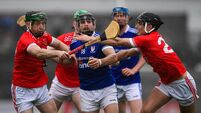
Michael Moynihan: Can we just find some love for the league?
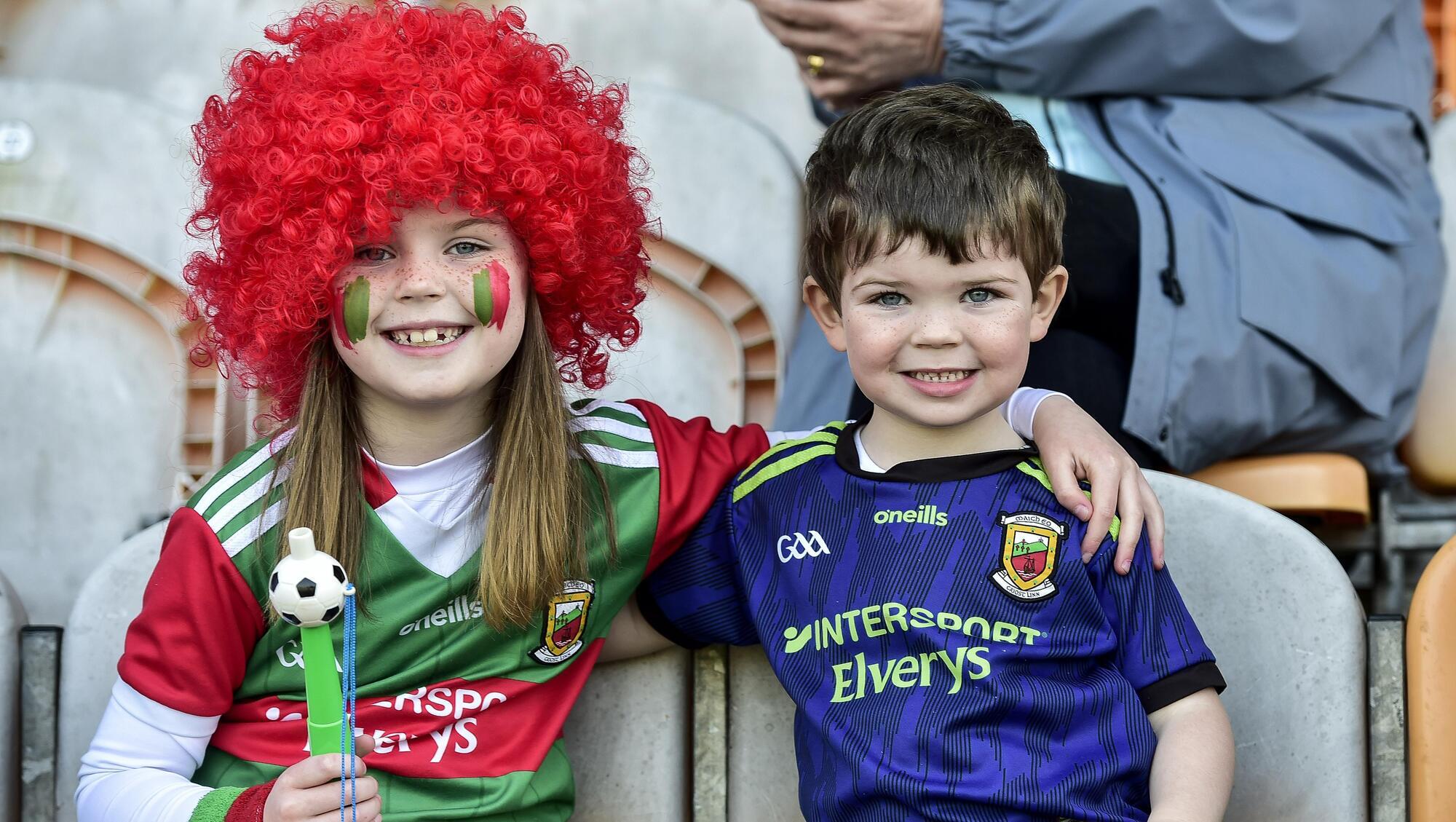
Young Mayo fans ahead of the game against Kildare on Sunday afternoon.
Farewell to the league, then. It was nice knowing you.
Sorry for striking the apocalyptic note, but it’s catching. In the last few weeks the growing dissatisfaction with the hurling league has been getting louder and louder.
Every day there’s a different complaint. Why isn’t it more competitive? Why didn’t we have a super Sunday a couple of weekends ago? Why aren’t Limerick taking it seriously? Why isn’t it more like the . . . football league, when all is said and done?
One question at a time, then.
For this observer the main issue with this year’s league is that it’s this year’s league. As in the first such campaign with no great gap between the end of the NHL and the beginning of the provincial championships. Consequently teams are finding their way when it comes to preparation: it’s also worth remembering that the round-robin provincial format is still a new challenge in and of itself, having barely been introduced before we were all struck with covid two years ago.
What does all of that mean? Teams trying to hit some kind of peak for late April are clearly sacrificing some league weeks for preparation: that’s impossible to argue with.
Add in the decades of ‘league is league but championship is championship’, a belief difficult to rinse out of the bloodstream, and one acknowledged by managers in post-game interviews as they constantly offer updates on how close their championship games are.
Perhaps in the next season or two, when managers and S and C coaches become more familiar with the demands of the calendar, you’ll see more competitive games in the hurling league.
If you want to see competitive games in the first place, that is.
One of the sticks used to beat the hurling league with is the football league - as in, there’s a spread of equally matched teams in four divisions, which results in a series of meaningful games which have augured into the makings of an NFL Red Zone with promotion and relegation in the balance to the final whistle in the last round of games this past weekend.
This is true, though the comparison omits one pesky fact. It isn’t a comparison.
Gaelic football is not hurling. One sport is played at a competitive level in every county in Ireland bar one, perhaps, and the other isn’t (and by the way, this is a well-known fact, so don’t feel so proud of broadcasting it as though it’s the Third Secret of Fatima).
It surely follows that the more popular sport will be more competitive across a wider range of divisions, because it enjoys a greater spread of teams who will be able to match up with their counterparts and equivalents.
Be careful with those comparisons, though. The football league is more competitive than the hurling league, but is it as competitive as other leagues in other sports?
(In the last ten years there have been four different winners of the NFL; in the same time the NHL has been won by five counties.) If you dismiss that as a barometer of competitiveness, there are others. Take a national league in which the eventual All-Ireland champions were beaten by six goals in last year’s league before reversing that decision in the All-Ireland semi-final.
Well, we all know that in hurling a team can get away from its opponents pretty fast if it gets a couple of goals - sorry, wait. Am being told that that happened in the football league last year.
That can’t be true, because if it had occurred I’d surely have heard the weeping and lamentation as the National Football League was declared unfit for purpose. Must have missed it.
A reader writes: given what’s coming up in a few weeks, where is the hurley emoji? Why don’t we have one?
(Clearly they hadn’t seen the first part of this week’s column.) My research tells me that all you need to get an emoji created is a ten-page paper that you submit to the Unicode Consortium, a non-profit organisation that sets the standard for how text is represented and displayed across various programmes and software. Apparently it deals with about 50 emoji proposals a year but most don’t get very far because the icon must still look like the object it represents even at a very small size, which is where most proposals fail. However, I confidently predict a hurley and sliotar emoji combination will be produced as soon as anyone in the GAA gets around to it. Because if there’s one thing a GAA official relishes, it’s a ten-page proposal that needs to be vetted by some kind of committee.
When it comes to following the lead of someone in sport, you’d think most people and organisations would shy away from John Terry.
Recently seen eulogising Roman Abramovich, the former Chelsea player has also been involved with NFTs, launching his own line of same - which promptly lost 90 per cent of their projected value.
I was going to try a basic Terry descriptor based on his back catalogue, which ranges from, ah, involvement with a teammate’s wife to various allegations of racism, assault and so on. I was soon overwhelmed with options, given parking in a disabled spot is a second-tier entry on the list.
What, then, possessed Liverpool FC to get involved in the world of NFTs? The charge sheet against non-fungible tokens is as long as . . . well, the charge sheet against Mr Terry.
Consider this throwaway paragraph from The Athletic: “. . . NFT trading has also been strongly associated with fraud and the blockchain technology underpinning those deals can be environmentally destructive. Carrying out the transactions requires vast amounts of computing power, and therefore electricity, though the extent of this varies according to the blockchain.” You’d think that would give pause to any organisation. Until you also read The Athletic adding that in Liverpool’s case, “if all the NFTs are purchased the club will stand to bring in nearly £10 million, with 10 per cent of that being donated to the LFC Foundation.” Suddenly all becomes clear.
A professional sports club standing to make that kind of money from a couple of hours’ work by a couple of its in-house graphic designers? The next question is obvious: how long before every sporting organisation in Ireland is doing this?
The next time someone talks to you about the good old days in Ireland, you can recommend Fintan O’Toole’s We Don’t Know Ourselves: A Personal History of Ireland Since 1958 to them.
It’s a cliche to say you don’t appreciate the strangeness of the times when you’re living through them, but O’Toole’s book brings to vivid life the bizarre Ireland of the sixties and seventies in particular.
In fairness, bizarre isn’t the right word, because it doesn’t do justice to the grinding poverty, the widespread corruption, the hypocrisy of the powerful and the smothering grip of the church. The book depicts something that was less of a nation than a nation-sized casino, with the fix in on every table. The good old days is right.