Clodagh Finn: Best way to tackle racism is not only to call it out but to challenge it
Amid racist incidents, we must interrogate prejudice itself
Clodagh Finn: Best way to tackle racism is not only to call it out but to challenge it

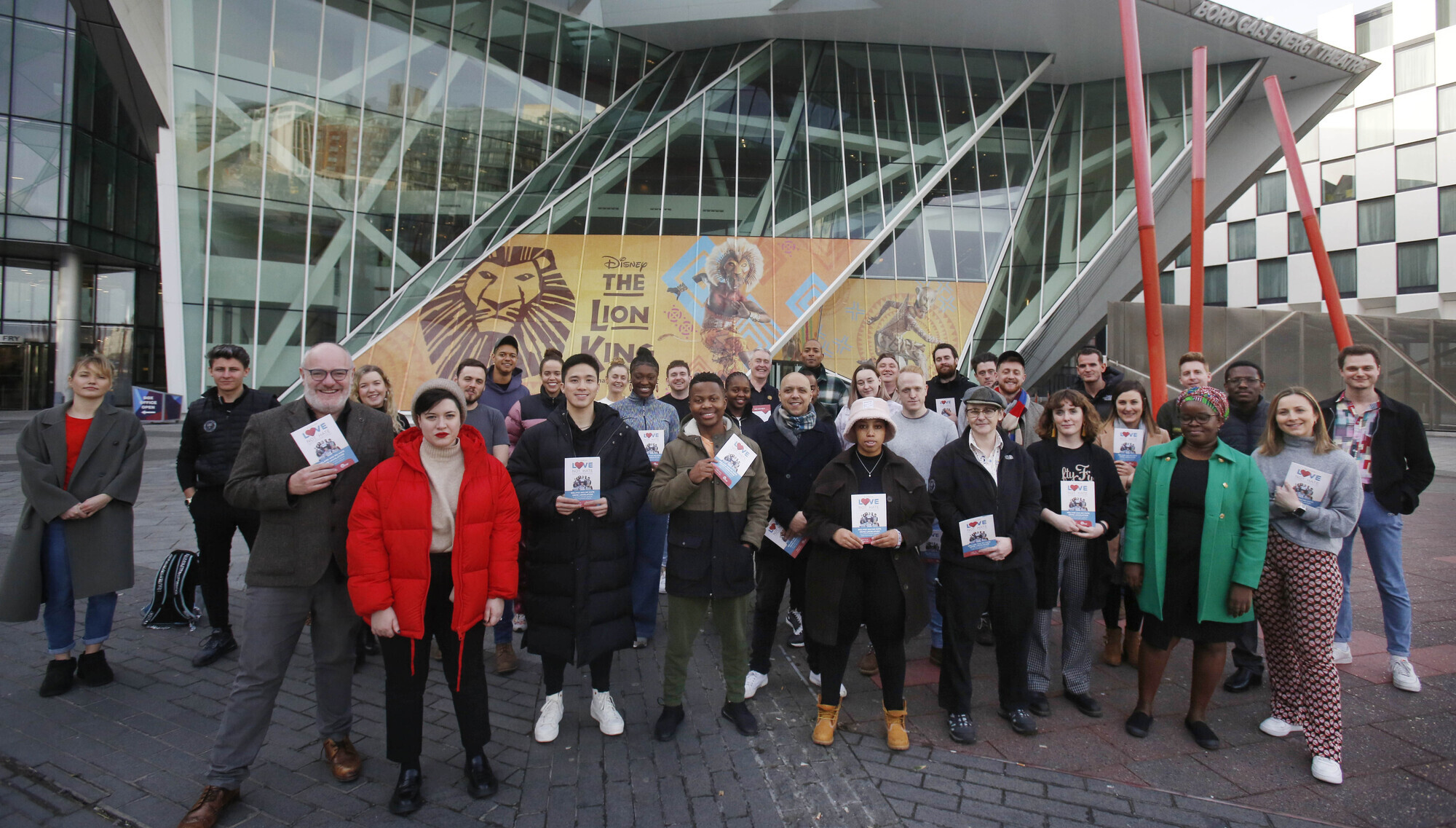
Staff from Irish Network Against Racism come together with cast and crew from Disney's 'The Lion King' and Stephen Faloon, manager at Bord GĂĄis Energy Theatre, to show their support for INAR's Love Not Hate campaign. Picture: Leon Farrell/Photocall Ireland

Does the name Rachael Baptist ring any bells? Perhaps not, but more than 250 years ago, the black Irish singer was a celebrity and something of a phenomenon. She toured Ireland, turning the places she visited — Cork, Bandon, Limerick, Kilkenny — into “towns of pleasure” as audiences applauded with delight.

There is a particularly vivid account of her 1750 debut at Crow Street Theatre in Dublin where she appeared, resplendent in the yellow silk gown that became her trademark, in front of a whole house illuminated with wax lights.

And here’s the bit that needs retelling. Whenever she opened her mouth to sing, all racial prejudice dissipated. The lull of her sweet melodies dispelled “the prejudice her colour aroused”, according to contemporary accounts.

One concert-goer was so mesmerised by her performance at a fundraiser for Kilkenny Infirmary in 1767 that he wrote a poem saying she deserved a laurel crown, whatever the “the white Fair-ones” swollen with “proud disdain” thought of it. It was published in Finn’s Leinster Journal, though that is not to suggest that 18th-century Ireland was a land of inclusion and tolerance.

All the same, I thought of that concert — and Rachael Baptist, who reminds us that Ireland was much more diverse than we might think — when I read of the racial attack on the cast of The Lion King in Dublin, which is now being investigated by gardaí.

I wonder if that group of men who vomited out racial abuse, homophobic slurs, and threats of violence would have done so if they had been to see the show?

You can’t watch the global phenomenon that is The Lion King and not be moved. 

As actor Stephenson Ardern-Sodje, who plays Simba, said after the attack: “This job, this show, and our company is an overwhelmingly glorious celebration of black excellence and diversity in all its forms.

“Even if a vocal minority refuse to recognise our light, we can’t help but shine anyway.”

If the men who attacked members of the cast had seen them move, like beautifully crafted sculptures, bringing a savannah landscape to life, would they, like those who heard Rachael Baptist, have allowed it to punch a crack in the wall of their prejudice?

It is that moment when prejudice is challenged that is of particular importance now.

Though, it is also really important to interrogate prejudice itself. What prompted that group of men to swing their wrecking ball of ignorance in the direction of the performers after they left the Bord GĂĄis Energy Theatre?

What poisonous and limited idea led them to look on this group of talented people and decide that they should be attacked?

Was it a question of skin tone? If so, did they consider a person of colour to be unIrish? They may not want to know, but it is worth remembering that Rachael Baptist was not the only person of colour living in Ireland in the 18th century. There was a black community here of between 1,000 and 3,000 people, scholars now estimate.

Researchers are also discovering a more diverse racial presence in Ireland that dates back to the early modern period, according to a fascinating online exhibition on mixed-race Irish curated by the Association of Mixed Race Irish and Mixed Museum.

Or was the attack fuelled by some notion of racial inferiority?

Did those men look at these gifted visitors and consider them not only as ‘other’ but ‘less than’?

Jimmy Carr: Under fire for his comments.

If those men are ever brought to justice, that question will probably not be asked, but it should. The best way to tackle racism — which is ignorance in another form — is not only to call it out but to challenge it.

This week, there have been calls to cancel Jimmy Carr for his abhorrent suggestion that the industrial-scale murder of “gypsies” by Nazis during the Second World War was one of the Holocaust’s “positives”.

There is outrage and rightly so. Though, I would argue that he has done us some service because he has unveiled a seam of racism that is not only alive and well, but thriving. If you listen to the clip from his Netflix special, His Dark Material, the thing that is most disturbing is not the provocative comedian’s vile ‘joke’, but the audience’s roars of laughter in response.

We should not cancel him, or his audience, but challenge them.

While we can’t ever know why so many people thought Carr funny, it is probably safe to say that it was underpinned by the deeply damaging and erroneous belief that all people of a certain race, ethnicity, or creed are the same.

It’s preposterous to lump millions of people together under a single category and dismiss all of them, but that is the noxious principle that keeps racism alive.

Sometimes, even people you expect to understand racism don’t. Recall Oscar winner Whoopi Goldberg’s recent remark that the Holocaust was not about race. “The Nazis were white people, and most of the people they were attacking were white people,” she said.

I don’t think anyone believes she intended to be anti-Semitic or dismiss the mass murder of Roma or the millions more killed because of their religion, ethnicity, or beliefs.

But her remarks, like Carr’s, have an upside; they offer an opportunity to look again at how we ‘other’ people.

Even well-intentioned acts of so-called solidarity can reinforce old, damaging stereotypes. The Black Lives Matter movement led to a global outpouring of support, but that support does little, if anything, to tackle our “passion for categorisation”, as American writer James Baldwin put it.

Award-winning Irish writer Emma Dabiri quotes him in What White People Can Do Next, a brilliant, thought-provoking book that exposes many uncomfortable truths. The anti-racists of today are like the abolitionists of the 19th century, she writes: “A commitment to allyship with black people doesn’t automatically mean you don’t think black people are somehow inferior: It means you don’t think that they should be treated discriminatorily as a result.”

Allyship — the support marches, the symbolic gestures of support, the phrases on social media — all underline separateness and exacerbate division, she says. What’s needed instead is coalition-building, which is about identifying shared interests and creating the kind of democracy that benefits all people, regardless of race. The book sets out a manifesto of how we might achieve that.

Incidentally, Dabiri has just been selected by Villanova University in Pennsylvania as the 2022 Charles A Heimbold Jr chair of Irish studies in the College of Liberal Arts and Sciences for the spring semester. 

It says: “The visiting writer-in-residence program offers Irish studies students the enriching experience of a close classroom experience with one of Ireland’s finest authors.”

There is no reason why students closer to home can’t have a taste of that enriching experience too: What White People Can Do Next should be on the school syllabus. And Rachael Baptist should be included in the history books.

More in this section

Revoiced

Newsletter

Sign up to the best reads of the week from irishexaminer.com selected just for you.

Cookie Policy Privacy Policy Brand Safety FAQ Help Contact Us Terms and Conditions

© Examiner Echo Group Limited