Fergus Finlay: Pandemic took away the voices of people with intellectual disability
Fergus Finlay: Pandemic took away the voices of people with intellectual disability

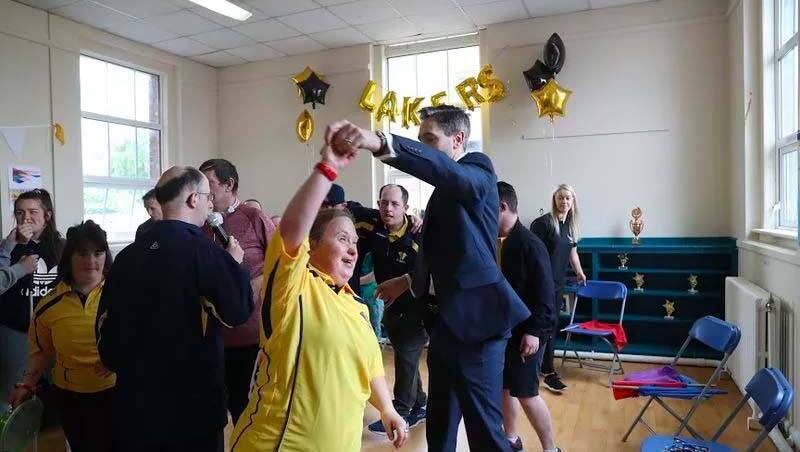
Minister for Further and Higher Education Simon Harris at Lakers social and recreation club in Co Wicklow in 2019. It's a club for people with intellectual disability.

IT’S a funny feeling. We reckon there are a lot of amends to be made: Amends for lost time; amends for loneliness; amends for friendships that were really hard to sustain; amends for all the effort that went into keeping people safe, sometimes at the cost of their happiness and sense of fun.

However, at the same time there’s a great buzz in the air. We can’t wait to get the doors open again, to see people we haven’t seen for months. There’s a new programme going out next week, with 50 classes for members to join as they wish. I’m betting most of them will be booked up within days.

Our people, the people we’re there for, are our members. We don’t allow terms such as client or service user. Classes are designed for members, and only after we ask members what they want to do. And we need to be careful about that. Three of our members — Dan, Rebecca, and Marian — sit on the board, and the rest of us would get a hard time if we start doing stuff that’s of no interest to the members.

Lakers, that’s what I’m talking about. I’ve written about it before, so you might be familiar with it. For those to whom it’s new, let me tell you a little about it. Better still, go to the website, lakers.ie, and have a look for yourself.

It’s a club for people with intellectual disability. It’s based in Bray, Co Wicklow with a reach across the south of Co Dublin. The word club is important, and one I struggled with initially. I’ve spent years working as a professional service provider, and now I’m one of a couple of hundred volunteers in a club.

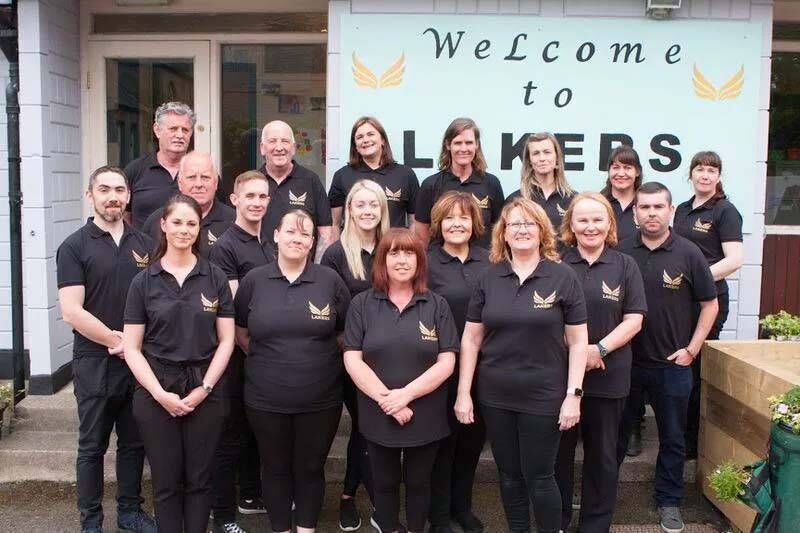
Staff at Lakers social and recreation club.

The difference is essentially this: Service providers set out to meet need, hopefully (though not always) on a basis of respect, out of the range of services they have available. They have people who use those services, and those people have a range of labels — patient, resident, client, service user. A club only has members and must seek to respond to the needs expressed by those members by developing the services they want and need.

From the moment the pandemic started we put everything online in our club. Within a couple of days we had zoom classes in cookery, art, drama, music, and a load of other stuff. It worked as well as it possibly could. We wondered if our members would be able to cope with the internet and everything that goes with it, but they adapted brilliantly. For many of our members, logging on became so much a part of their routine that some may have difficulty re-adapting.

However, they lost an awful lot along the way. And as the pandemic wore on, people with an intellectual disability became one of the hidden casualties.

I’ve heard an awful lot of debate over the past two years about the people who suffered as a result of lockdowns and social distancing and the virus in general: Young people struggling in school; elderly people, cocooned (remember that word?) and kept apart from the rest of us; the crises in nursing homes; the stresses of having to cope with PPE and terrible working conditions in healthcare; the difficulties young mothers and pregnant women had to face, accessing necessary services alone; the plight of businesses in catering and entertainment, struggling from day to day.

There’s a long list of things — much longer than I’ve mentioned here — that we’ve debated endlessly and agonised over throughout the pandemic. However, I don’t remember a single discussion on radio or television about what happened to people with an intellectual disability from one end of the pandemic to the other. They disappeared from our view almost entirely. We have all been so preoccupied with how much we’ve been affected that we haven’t even noticed what happened to some of our fellow citizens.

Maybe it’s because they don’t complain. Some of them, after all, don’t have the voices to shout out loud. It has always been the case when services or financial resources were cut in the past that people with intellectual disabilities and their families tended not to take to the streets. That kind of protest wouldn’t have been possible anyway in the pandemic, even if families were able for it. However, it’s surprising, isn’t it, that there was no room on the airwaves?

If people with intellectual disabilities suffered in silence, that didn’t mean there was no suffering. Many of the services on which they depend were severely curtailed from start to finish of the pandemic (assuming we’re close to a finish, that is). Their schools were closed, their training courses were shut down, a lot of essential therapies — speech and language, for instance, simply stopped.

A very large number of people with intellectual disabilities live in residential services. Those whose families could take them home were asked to go home. In many cases that meant leaving their now homes to go back and live with parents who were themselves elderly and vulnerable to the virus, and therefore in isolation. Day services were more or less cancelled for most of the pandemic period.

Everything was done in the interests of safety, of course. And frequently, there was no choice about some of the decisions taken.

However, the consequence for a lot of people with disabilities was that their lifelines were simply taken away. Two years later, I know a lot of people with disabilities who simply don’t understand why “that stupid virus” (as my daughter calls it) was allowed to do so much damage to their lives.

Children with a disability live in their families, as do most children, but frequently need additional professional supports; adults and older people with an intellectual disability live in our world.

BECAUSE our world can be unwelcoming, they often depend totally on their peers for friendship, for meaningful relationships, for outings and for a bit of fun. ('Their peers' means other people with an intellectual disability.) Whatever clubs or organisations they belong to are vital for their growth and development as adults, and for continued independence. In isolation, people with an intellectual disability can lose their language skills. They can forget many of the things it took them years to learn — personal care, independent travel, how to manage money. They can forget what it was like to have a friend. Or even how to be a friend.

Anyone involved in this world has seen all that happen in the last two years. Silently, without complaint, many have lost the best bits of their lives. Many who have struggled to overcome the barriers we’ve always thrown in their way have found the pandemic too big a hurdle.

That’s why we have amends to make. That’s why, as quickly as possible, we have to rebuild — or to coin a phrase, we have to build back better. Not just us in Lakers, but every service and every facility. And the state needs to be prepared to make additional investments too. We didn’t properly support people with a disability during the pandemic. We all believe we did our best, but we never heard their quiet voices.

More in this section

Revoiced

Newsletter

Sign up to the best reads of the week from irishexaminer.com selected just for you.

Cookie Policy Privacy Policy Brand Safety FAQ Help Contact Us Terms and Conditions

© Examiner Echo Group Limited