Michael Moynihan: Time to look beneath the surface — potholes are a serious business
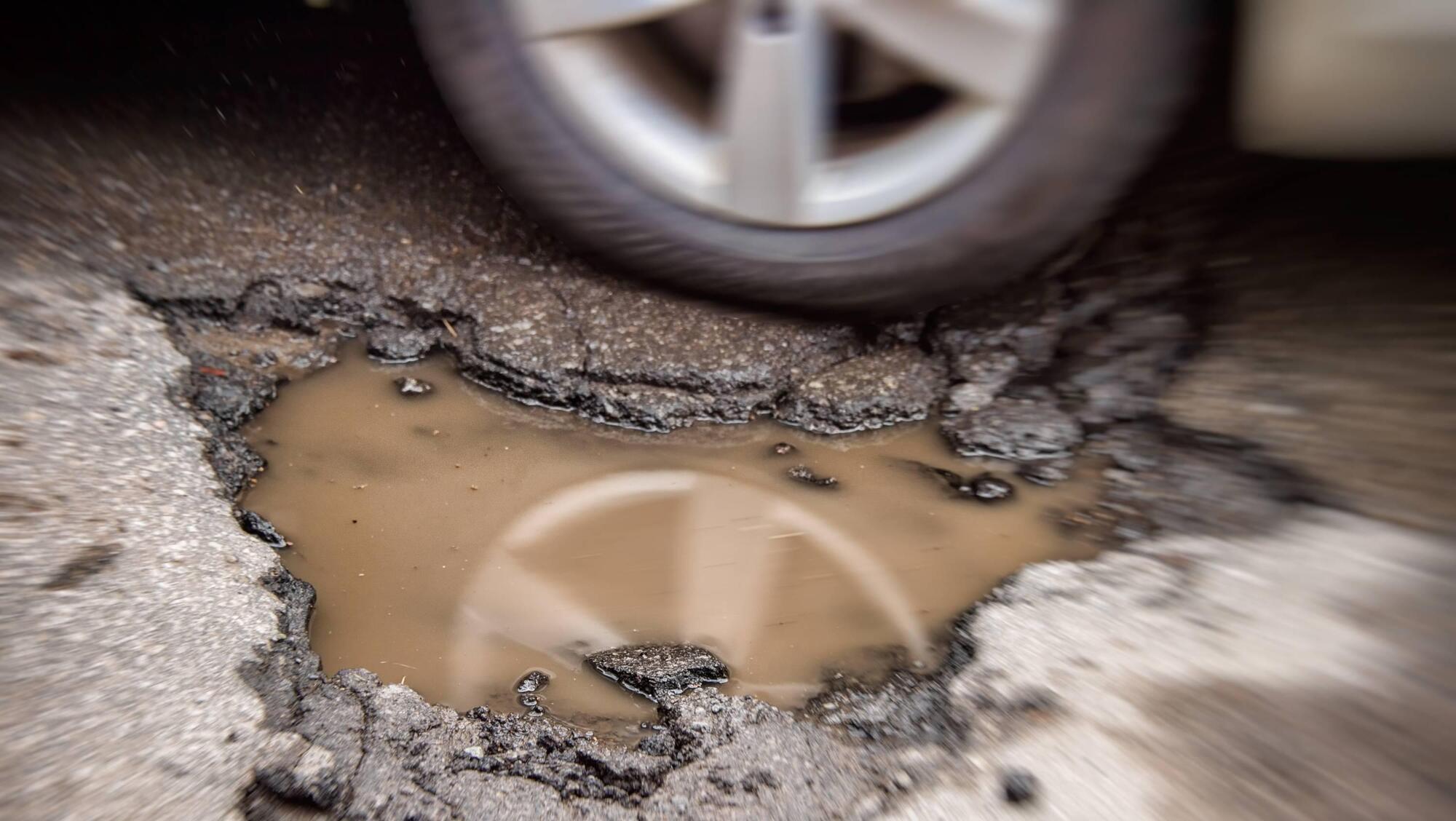
Cork City Council spent more than €10,000 on pothole claims over an 18-month period, according to reports.
A couple of weeks ago, yours truly pointed the car along Anderson’s Quay — ready to whiz past Jury’s — when immediate evasive action was required because of the looming abyss which presented itself in the middle of the road.
I’m not speaking in metaphors. The yawning hole was a physical reality rather than an existential crisis — in specific terms a vast, jagged bunker in the road, an obstacle positioned perfectly to suck the vehicle down into the netherworld beneath our feet, never to be seen again.
A pothole, in other words.
Once I manage to get past it — close-run thing, in all honesty — it set me on a reverie for our lost pothole heritage. Our potheritage, if you will.
Où sont les potholes d’antan, as Villon never quite said.
There was a time when potholes weren’t so much an occasional irritant as obstacles reliable in their ubiquity, so prevalent that plotting a course on Irish roads had to take them into account.
When your columnist was going to the hedge school decades ago, Mike Murphy was the radio voice we heard in the mornings — “voice” singular — and he often cited a fearsome cave with a thoroughfare going through it, rather than the other way round, somewhere north of Limerick City: those of a similar vintage will no doubt remember the references to the pothole on the Ennis Road. I certainly do.
Of course, even on the way home from that close shave recently on the quay, I began to encounter potholes everywhere, or so it seemed.
For instance, cornering into the Ballinlough Rd from Bernadette Way there was a sly kidney-shaped tyre-killer, complete with loose pebbles leading into and out of it like a trail of breadcrumbs. Short in diameter, but deep. And lethal.
I carried on and came down Wallace’s Avenue to see potholes in embryo, sagging stretches of roadway which look to be a couple of heavy showers away from becoming potholes in reality. Seriously.
Onwards to the Marina, and a tricky manoeuvre past a growing entity halfway down the Centre Park Rd which incorporated a drain somewhere in the middle. Further on, a pothole down from Cortado Coffee big enough to accommodate any two pedestrians walking the riverfront.
Any advance?
“Wait,” said a pal of mine when I shared my sightings.
I have a regular that I keep an eye on, just as Fitz’s Boreen turns up from the Commons Rd, by the McDonald’s.”
That you keep an eye on?
“Absolutely. It’s where buses and lorries turn, so it’s obviously a weak point in the road. Every few months, the hole appears. Then it’s repaired.
“And then a few months after that, the hole appears again.
It’s wearing nicely at the moment, you should check it out the next time you pass.”
Well, just ahead of the next time I pass might be a better choice.
(All reminiscent of a great, if minor, passage in The Godfather, where Mario Puzo mentions gang boss Anthony Stracci, who had “a fleet of freight hauling trucks that made him a fortune primarily because his trucks could travel with a heavy overload and not be stopped and fined by highway weight inspectors. These trucks helped ruin the highways and then his roadbuilding firm, with lucrative state contracts, repaired the damage wrought. It was the kind of operation that would warm any man’s heart, business of itself creating more business.”)
Much of the city centre is pretty serviceable — though it’s notable that the sheer amount of building being done has taken a toll on the road surfaces approaching those sites, along the lines mentioned above.
Elsewhere ... a bit further out of town, when you first hit the N8 after that roundabout at the bottom of the Lower Glanmire Rd, consider the missing layers at the start of the slope, the ragged gaps that stretch almost long enough to constitute different parts of the road rather than actual potholes.
Incidentally, the etymology of “pothole” is worth a minute or two of your time. One plausible theory revolves around a Middle English term for a deep hole — pot (though that would make the word hole-hole, which sounds a little like the “chicken pollo” dish which was served in a Cork restaurant many years ago).
A more enjoyable though less plausible theory centres on old Roman roads in England being covered with clay — which was used by potters short of material, who left “potter-holes” or potholes after them.
However, that doesn’t butter our parsnips. Or even fix our potholes, which is a pressing concern for people.
A few years ago, The Irish Voter, a study of voting patterns and behaviour, was published, and co-author Michael Marsh said at the time: “Politicians are professionals.
They know what gets them elected, and it’s not performing in the Dáil. It’s fixing potholes. It’s knocking on doors.”
Well, knocking on doors to tell the people in the house the potholes are gone, presumably, but point taken.
No offence to Mr Marsh, but is there a sense abroad that politicians should be fixated on more elevated concerns, or given to rhetorical flights, instead of getting potholes fixed?
Because if there is, time to reconsider. Potholes are a serious business. Last June, it was reported that there were over 500 active claims against Cork County Council at the end of last year — 120 active claims in relation to potholes.
Sean O’Riordan of this parish fleshed this out with the story of a man who had damaged his car in a pothole near Béal na Bláth, with one councillor saying it was likely to be the same pothole that reappears every couple of months and has caused damage to a number of vehicles.
Meanwhile, Cork City Council spent more than €10,000 on pothole claims over an 18-month period according to other reports — between January 2019 and June 2020, City Hall spent €10,461.25 on 150 public liability claims made against the local authority, claims The Echo, stating “related to potholes in the region ... more than one complaint per day was made about potholes in Cork City over the same 18-month period.
Information obtained from City Hall shows that between January 2019 and June 2020, 885 complaints were made about potholes across Cork City.”
Is there a solution to the pothole problem?
Other jurisdictions seem more acquiescent, accepting that the pothole will always be with us. A quick trawl on Google reveals that in Chicago, one mosaicist fills potholes in his locality with bright tile portraits, while in Schenectady, New York, a designer plants flowers in her local potholes.
A summer or two ago, however, an enterprising individual in New Orleans pulled a surprise move by listing a pothole on AirBnB.
Now this is lateral thinking.
It had never occurred to me that the relative lack of potholes in the country could be ascribed to an imaginative response to the crisis in accommodation.
Housing people in holes in the road may seem to you a proposal that belongs to broad satire, but the same could be said about some solutions which have been offered with a straight face.
The alternative is to give Anthony Stracci a ring.

Subscribe to access all of the Irish Examiner.
Try unlimited access from only €1.50 a week
Already a subscriber? Sign in
CONNECT WITH US TODAY
Be the first to know the latest news and updates

More in this section