Clodagh Finn: Dublin’s street is ahead, but Cork’s Grafton St has a trump card
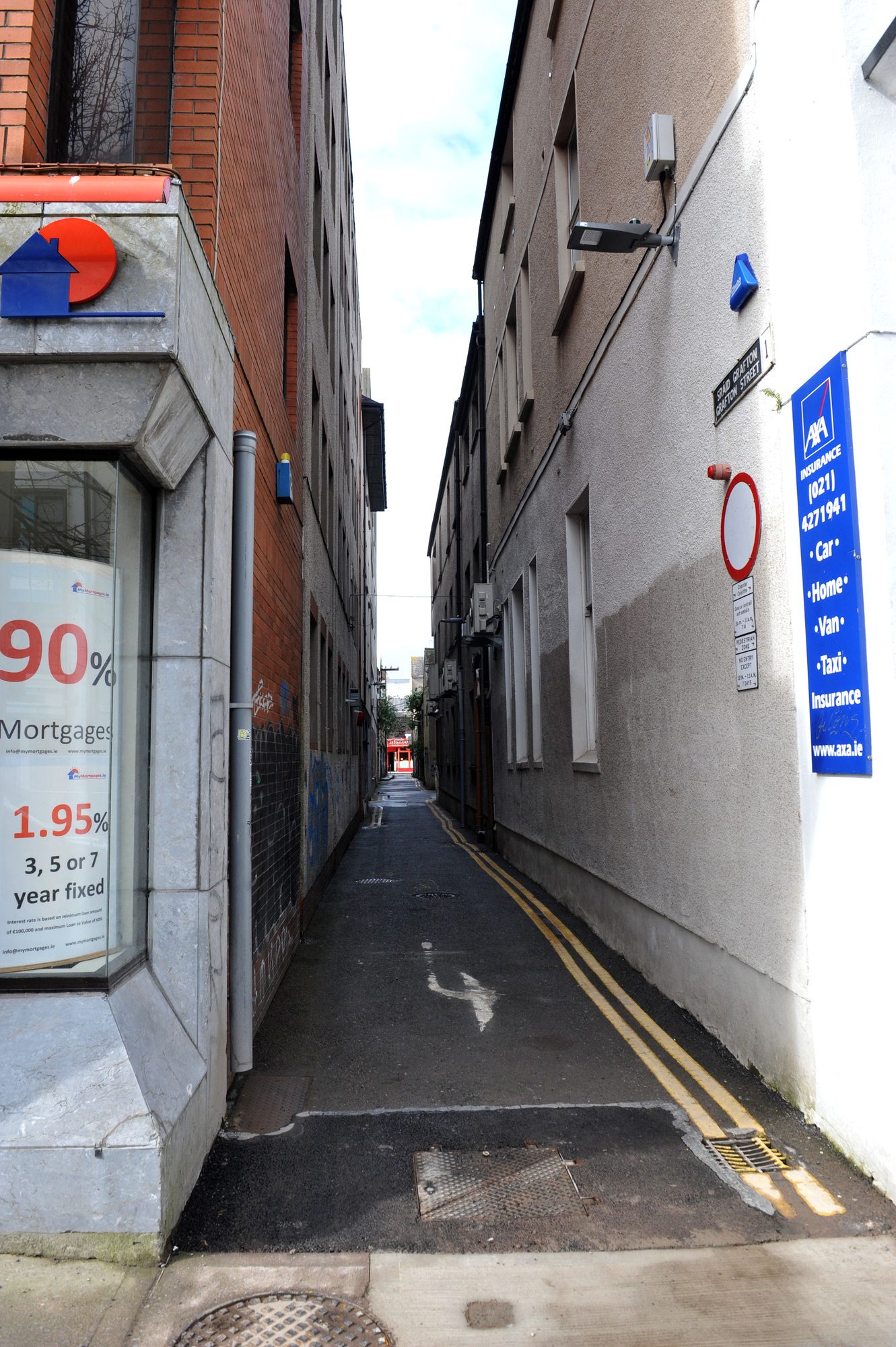
Grafton St, Cork, which has links to the 1690 siege of the city.
It is, perhaps, the only time when Dublin unquestionably wins out over Cork. I’m talking about Grafton St, or rather the little-known tale of two Grafton streets; the one in Dublin, a wonderland with magic in the air, as the song has it, and the one in Cork which is narrow, truncated, and, well, rather dank.
Put them side by side and even a proud Corkonian (is there another kind?) might concede that the Dubs have it.
Or would they? asks your foolhardy Kerry correspondent who secretly admires the way Cork people openly celebrate their own (obvious) greatness. Grafton St, Dublin, might be the flashy showcase — even allowing for the dents punched in it by pandemic closures — but Grafton St, Cork, arguably has a greater claim to the name. It is not much of a trump card, but it is one.
Let’s start with the siege and Cork’s stronger claim to the Grafton name. The first Duke of Grafton, Henry FitzRoy, did battle on the very street that bears his name and died shortly after being struck by a musket ball.
He was the son of King Charles ll of England, but was “born on the wrong side of the blanket”, a far more well-mannered way of saying his mother, Barbara Palmer, was one of the king’s many mistresses. Mind you, the most controversial, beautiful, and influential one at that, to quote ardent admirer, the famous diarist Samuel Pepys.
So Henry had opportunities in spite of his status, which explains how he came to be appointed vice-admiral of England and later second-in-command during the 1690 siege of the city when the Earl of Marlborough was sent with a large contingent of troops to regain control of the city.
In late September, the city was bombarded and the eastern wall — where the city library is now and a stone’s throw from Grafton St — was breached. It was probably during this foray that the Duke of Grafton was struck down. Some accounts say the musket ball broke his ribs, while others claim it hit him in the eye. In any case, he was seriously injured and died shortly afterwards.
What happened then is described in graphic detail in Garnet Joseph Wolseley’s 1894 account: “His body was embalmed, sent to England in a cask of spirits, and buried at Euston [while] his brain and entrails were buried in the little old graveyard of Ballintemple, near Cork.”
His name stayed in Cork, too; living on in a narrow street that links Oliver Plunkett St to the South Mall.
Incidentally, depending on the account you read, Grafton St in Dublin is either named after the same duke or his son, Charles, who owned land in the area.
Terry de Valera, youngest son of Éamon de Valera and his wife Sinéad, opts for the former. In 1986, he wrote: “Grafton St. was named after a foreign nobleman, the first Duke of Grafton, the illegitimate son of Charles ll. Is it not a shame that one principal thoroughfare of our capital city still bears the name of a foreigner, and one of little worth at that, when so many eminent Irishmen so well deserve to be remembered?”
His mother favoured Wolfe Tone and it would be interesting to see what names might emerge if it were put to a vote now.
Sadly, however, you’ll be hard-pressed to find many complimentary references to Cork’s Grafton St, although it certainly has colour. Aoife M Foley, reader at the School of Mechanical and Aerospace Engineering at Queen’s University Belfast, recalls surveying a brothel on the street on a Good Friday in 1997.
She was working as a site engineer at a time when women engineers were still so much the exception that they could not find a pair of hobnailed boots to fit her so she had to wear slaughter-house, steel-capped white wellies. Her work on the multi-storey car park site adjoining Grafton St meant she was tasked with surveying all buildings that backed on to it.
One of them turned out to be a brothel, and the only way she could gain entry was on a holy day, when it was closed. (That single fact deserves a column of its own). While doing the survey, she was instructed to stay on the left-hand side of the building as doors leading to the business side of the house were on the right. On the roof, she saw two washing machines and sheets hanging out on a line to dry.
You’ll find newspaper reports of prosecutions relating to that brothel and much earlier newspaper reports (the , 1870) saying that prostitution was common on Grafton St in Dublin too.

Scratch the surface of any street and you’ll find stories that may or may not be preserved in the name, although street names can tell us an awful lot. In Cork, for instance, not only does Grafton St remind us that the duke lost his life there more than 300 years ago, it also recalls the moment when the city started to reclaim marshy land, transforming the physical and social landscape for centuries to come.
“Cork,” says Prof Foley, “was like little Venice, and this is reflected in the culverts, doorways, and industrial architecture in Cork City.”
She now teaches on power systems, renewable technologies, and energy markets but is passionate about geography and history; so much of which is visible in our streets if only we took the time to look. She readily admits that Grafton St in Dublin wins hands down, but says the Cork street is her more illustrious sister.
The Cork street does, at least, have the distinction of having a much more intimate relationship with the first Duke of Grafton than its Dublin counterpart, if that is the right word given the undeniable gulf between them.
A present-day campaign to remove references to Queen Victoria from Cork street names echoes an earlier one when Cork Corporation’s Street Names Sub-Committee debated, in the 1940s, renaming the Grand Parade as Connolly St, South Mall as Pearse St, and Pembroke St as Kent St, among others.
It was never going to be implemented, as independent scholar Aoife Bhreatnach explains. Cork Corporation had to get two-thirds of ratepayers living on the street to agree to the name change and that was unlikely to happen.
Either way, Grafton St didn’t make the never-implemented list. Sometimes, it pays not to be the street ahead.