Michael Moynihan: Yes, the values of your city may go down. Just ask the people of Cork
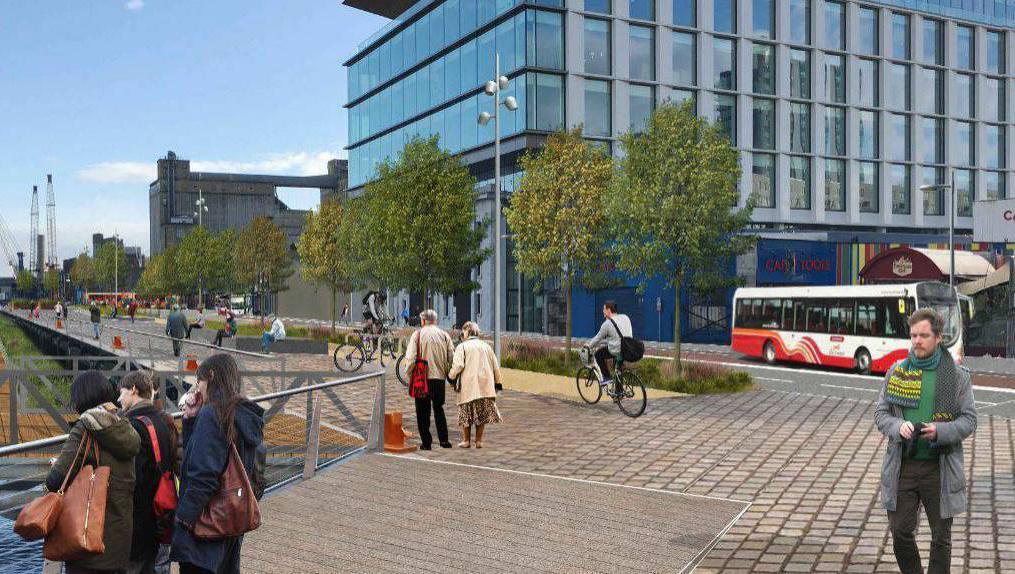
The Cork Docklands to City Centre Road Network Improvements Scheme imagined people living as well as working and playing in the Albert Quay area. But a developer that won approval to build apartments there will instead develop more offices.Â
A TENSE exchange the other morning as I was getting my All Cash (Gold) scratch card in the newsagents up the road.
To be precise, a tense exchange just after I bought the card.
âExcuse me,â I said. âIâve scratched off half the card and, to be honest, I donât like the way this is looking. Iâll have a Lotto ticket instead, please.â
The response was one you could only interpret metaphorically, but I persisted.
âIâve had a consultant in to carry out a detailed appraisal process and review of my chances of making a profit on this purchase,â I said.
âThe cost of delivering a profit is â at least â 15% higher than the anticipated value on completion, making the project completely unworkable. For me, at any rate.â
Again, the response verged on the physically impossible, so I made a dignified exit.
If youâre not clear where Iâm coming from with this exchange, allow me to refresh your memory.
Last weekend, the Property Editor of this newspaper, Tommy Barker, wrote about the development planned for the site of the old Sextant bar on the quays of Cork.
He wrote: âPlans for a 25-storey apartment development in the heart of Cork City have been scrapped as being non-viable financially, with the quayside site set to become a 16-storey office block instead.
âNoting much stronger than expected take-up of offices in Cork City, despite the setbacks of Covid-19, developers, JCD Group, has applied to Cork City Council for a totally revised proposal for a 170,000 sq ft office tower on the former Sextant bar and Carey Tools site on Albert Quay...

âPlanning had been granted to JCD a year ago for a 25-storey âbuild to rentâ apartment development. But, following a detailed appraisal process and review by Deloitte, it was found that even at existing high market rents âthe cost of delivering the project is 15% higher than the anticipated value on completion, making the project completely unworkable,â said the company.
âRents required to make the 201-apartment project financially viable would have had to rise an average of 21% from current levels, to as much as âŹ2,800 per month for a two-bed unit, which JCD say âis not sustainable in the Cork marketâ.âÂ
You can probably see where Iâm coming from, trying to claw back some of the funds I myself ventured on that scratch card.
Itâs hardly a surprise that this development has caused so much unhappiness in the last few days, given the way it pulls together so many sensitive issues. Homes, and the provision of homes. Conservation. Big business. Puzzling decisions.
One at a time, then.Â
Some of the reaction is tied to the disappearance of the Sextant.
Thereâs something apposite to this: If you walked across the road from the Sextantâs old location last Sunday evening, when we had the first real experience of summer weather this year, you would have blended into the crowds of young people sitting on the quayside.

The issue of social distancing and appropriate behaviour is something that Iâll park for a bit, because my main point here is that it made for a potent image, hundreds of young people milling about in the open air. Feet dangling over the side of the quay. The sun lighting up their faces.
Not because they would all have been inside a bar like the Sextant in another time, but because it offered a living tableau of the squeeze on homes and accommodation in the city.
In fact, it was easy to regard a sizeable percentage of those laughing in the sun, with the river gleaming up at them, as the exact number of people shut out from the possibility of home-ownership in the city. A possibility made even smaller because of the change in purpose, from apartments to offices, for the corner space just over their shoulders.
The other part of the jigsaw which furrowed brows was the decision by the developers to just change to office space because they discovered that apartments wouldnât be as profitable.
This is a delicate one to phrase, but perhaps the most straightforward description is the best: Isnât taking a punt what the free market is about? Can we actually say âcapitalism at workâ with a straight face here?
You may, like the man on the bus in the TV ad years ago, not know what a tracker mortgage is, but you certainly know from a million other ads over the years that the value of investments can fall as well as rise.
The rewards come from having the guts to put it all on the line, to back your hunch when all the chips are on the table, and be rewarded for your bravery â you know the narrative style that paints such people as buccaneering, rugged individuals who went for glory.
And when the glory doesnât come? I donât bear any ill will towards the developers in this case, but changing direction like this smacks of... Whatâs the exact term in classical economics?
Having your cake and eating it?Â
Iâm sure that friends of mine who enjoy the odd wager would like to have this facility with their turf accountants â to back one particular horse until, as noted above, the cost of delivering a win is higher than the anticipated value on completion of the race, making the project completely unworkable.
Applying the model discussed above, the punter would then be given the facility to move his bet to another horse entirely. In fact, why stop with just the one switch â could we create a system where the punter just canât lose because of the unlimited opportunities to switch wagers?
Yes, thatâs facetious. And yes, there are other realities at work here.
Itâs all fun and games for most of us as neutral observers, but thereâs also the question of a gaping space in the middle of the city. A couple of weeks ago yours truly imagined a visitor to the city landing by train, getting a taxi into the city by way of Ăamon de Valera Bridge â not the most straightforward route, admittedly â and seeing that gap along the quay, looking like the aftermath of an extracted incisor.
That situation canât be allowed to continue indefinitely, and something has to be gained from this situation which will at least make a positive contribution to the life of the city.

But this affair still leaves a distinctly bad taste. Switching from apartments to offices means this is another development which runs the risk of being lively and well-populated from nine to five, and then an impersonal glass hulk for the rest of the day, an echoing canyon abandoned out of office hours.
If youâre interested in living near some kind of urban safari park, then this is the kind of cityscape that will appeal to you, but Iâd guess most people would prefer a city with residents and workers and visitors and tourists intermingling in a natural, organic way in an actual neighbourhood.
Facilitating that approach is a challenge at the best of times. Last weekâs news shows just how difficult it is.