Joyce Fegan: 2021 - Into the new year, into the void
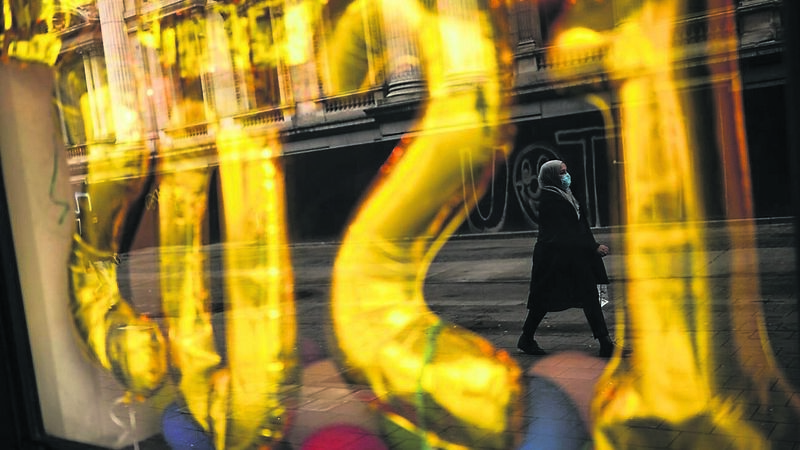

When thinking about this column space over those doldrum days between December 26 and now, few things came to mind. Who wants to read any more reflections on 2020? Who needs another Covid column? And what could anyone possibly say about 2021?
This is not an ordinary new year or New Year's Day, and 2020 was no ordinary year.
But my Instagram feed still filled up with images of all sorts. There were photos of worn-out runners alongside the thousands, yes thousands, of kilometres walked in them.
There were photos of Covid babies and house keys, and lots and lots of pictures of people either getting into the sea, in the sea or getting out of the sea.
There were posts about better times to come — the hope that everyone in Ireland will have been offered the vaccine for Covid-19 by this August. Yes this August, because we are now in 2021.
There were posts about the types of questions one might ask themselves as one year ends and another begins. Some questions include: what are you leaving behind in 2020 and what are you taking with you?
I've yet to answer either of those questions for myself.
Away from Instagram and in the private world of text messages, a dear friend admitted that a part of her did not want to let go of 2020.
It was the year in which her beloved mother was still alive, but 2021 would be the year her mother never got to see.
In the midst of public grief, there is personal grief.
In WhatsApp there were memes and messages gladly wishing 2020 farewell, but not so many about welcoming 2021.
In newspaper columns in other countries there were lessons learnt about collapsed sourdough starters and pithy philosophies on a year spent watching television that ranged from the bizarre to the culture-shifting .
And then in the chasm between the comedic farewell to one year and the tragic welcoming of another, there is an air of something no one can quite name, perhaps doesn't want to name.
Apprehension.
Apprehension as we enter the unknown, an abyss between how we used to live and how we will live post-pandemic. Apprehension as we exit a year where everything we believed was certain and solid and unchangeable became uncertain.
Would my dad make it through chemo without catching Covid-19?
How much longer will I have to be a parent and a teacher for?
Will the schools reopen?
Can I catch Covid from a takeaway?
How long does Covid live on surfaces?
Will my workplace close down under the new restrictions?
Will my new baby's first glimpse of me be me wearing a mask?
Can we sneak 11 into the church for the funeral of a woman who gave birth to 10?
Us humans like facts and stats and certainty. We love control. Not this.
We are in a void.
In April 2020, the novelist Arundhati Roy wrote a confronting piece for the . It was neither doom-filled nor utterly optimistic.
It was called 'The Pandemic is a Portal'.
It was kind of along the same lines as what President Michael D Higgins was saying about using the pandemic to reset our society.
Roy said the coronavirus had "made the mighty kneel" and "brought the world to a halt like nothing else could".
She said we longed for a return to "normality"; that we were attempting to "stitch our future to our past" without really acknowledging the "rupture".
The rupture is our seam come undone. The rupture is a tectonic, irreversible shift in how we do things around here. The rupture can be repaired, but the repair cannot return our world back to us as it was.
In the repairing of this rupture, we have "a chance to rethink the doomsday machine we have built for ourselves", said Roy.
We should not desire to return to rat races or whole days of a week spent on commuter belts. We should not long to continue to miss bath time and bedtime five nights a week.
We should not desire to return to a world in which the housing market is a private entity where families are evicted indiscriminately. We shouldn't long for a return to a society where double jobbing and nixers and side hustles are needed to make ends meet.
"Historically, pandemics have forced humans to break with the past and imagine their world anew. This one is no different. It is a portal, a gateway between one world and the next," wrote Roy.
Last Tuesday, in its last media briefing of 2020, World Health Organization (WHO) experts warned that, even though the pandemic has been very severe, it is “not necessarily the big one”.
“The planet is fragile. We live in an increasingly complex global society. These threats will continue. If there is one thing we need to take from this pandemic, with all of the tragedy and loss, [it] is [that] we need to get our act together. We need to honor those we’ve lost by getting better at what we do every day," said WHO's Dr Mike Ryan.
This shouldn't scare us into paralysed powerlessness. This should inspire us into empowered action. The world has made changes before.
Back in March 2020, President Higgins called all of this.
“What is going to emerge globally, is that there is an unanswerable case now, both globally and regionally in the European Union, for having universal basic services.
“That is a flow of basic services that will be there to protect us in the future, from which we can depart to be able to live, for people to have a sufficiency for what they need. This is what happened after the war; this is what happened after the Great Recession in 1929," he said.
Despite the start of a new year and the end of an old one we are in a void — neither back in our old world nor in our new one.
And from that void we can be paralysed by uncertainty or we can emerge with new ideas.
CONNECT WITH US TODAY



Be the first to know the latest news and updates