Alison O'Connor: Leo's difficult transition to second in command
Leo Varadkar's need to be the centre of attention has been a thorn in his successor's side — but could it come back to haunt him?
Alison O'Connor: Leo's difficult transition to second in command

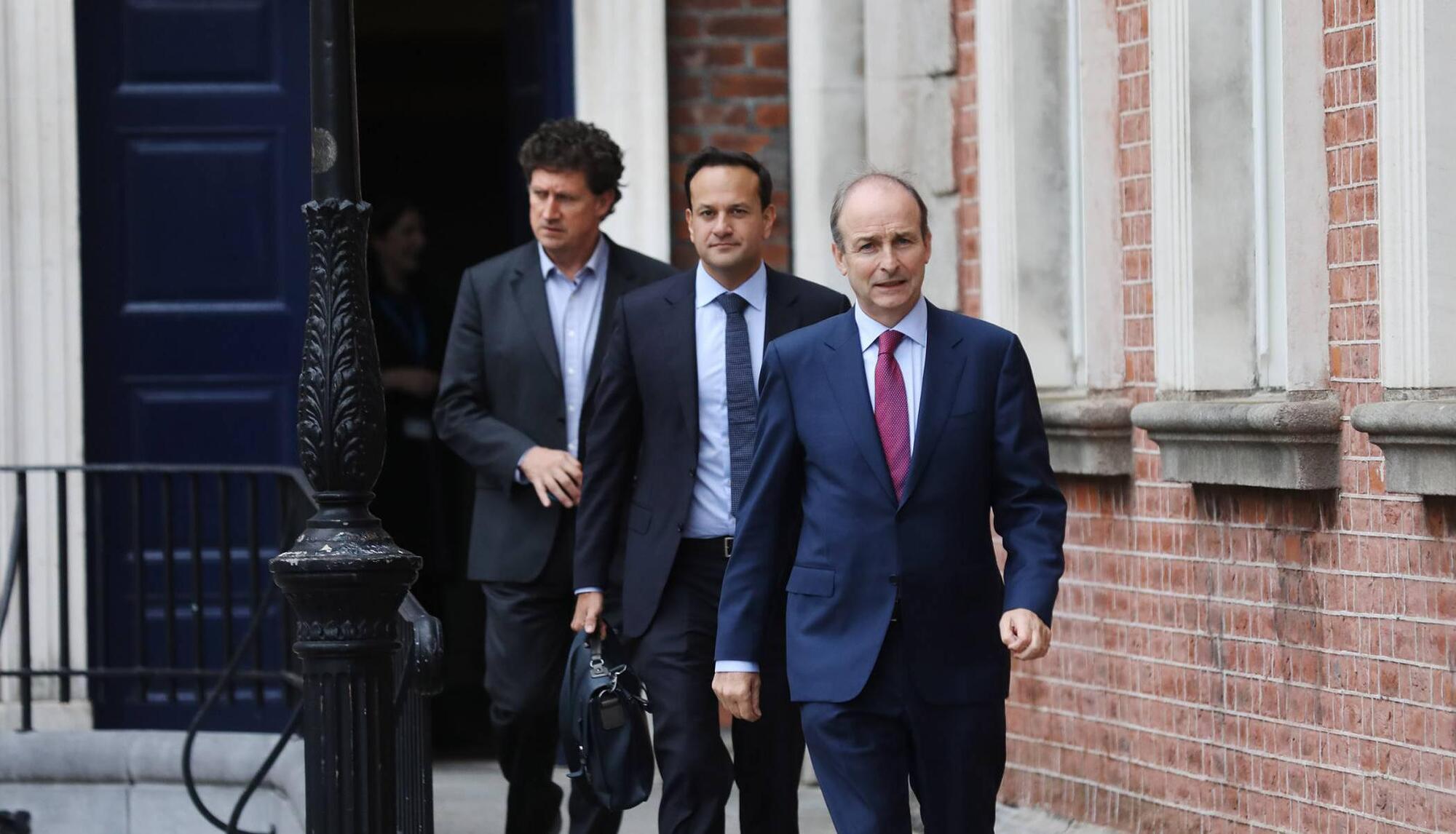
Party leaders Eamon Ryan, Leo Varadkar, and Micheál Martin at Dublin Castle. Picture: Julien Behal Photography

It was a year that brought us many things, not least our first Fianna Fáil Taoiseach in almost a decade. What better way to end it than to evaluate his performance? Logic might dictate this course of action, however the political imperative points towards throwing an eye instead over his Jack-in-the-Box Tánaiste. So let’s just accede to that Varadkar desire to be perpetually at the centre of attention. Let's make this all about Leo.

It will shortly be six months since Leo moved from the position of leading the country to the role of second in command. But even those without any formal training in psychology would feel safe in speculating he is still acclimatising to this inferior position in the pecking order. How else to explain the constant 'me, me, me' need for attention? It doesn’t have to be the good kind either, just the sort that keeps your name constantly in the headlines, or #trending on social media.

2020 was, roughly speaking, a year of thirds for Leo. The first bit was the general election. The less said about that the better in terms of what had originally been promised when he took over as Fine Gael leader, and the actual result where the party lost 12 seats and came in third after Fianna Fáil and Sinn Féin.

Who would have imagined that a global pandemic would come along and rescue him from that electoral failure? To be scrupulously fair here, it was his superb handling of Covid during those first crucial few months of lockdown (the middle third of the Varadkar year) that played a pivotal role in us keeping it together as a country.

His was a steady, assured presence, with an ability to say just the right thing at the right time. 

Come June, it cannot have been easy, on a human level, to be a Taoiseach with such high political capital having to hand over the reins of office to a man whose political standing, at that time, was far inferior.

Immediately following that swap, and ever since, Leo Varadkar has gone out of his way to be the sharp stone in Micheál Martin’s shoe. He continually stirs the political pot in order to cause trouble.

So successful is he in keeping himself at the centre of attention he keeps getting called by his old title of Taoiseach — not least by his successor! There is no end to the episodes where he has stepped in to make announcements and pronouncements, whether in person or on social media, usually just ahead of the Taoiseach or Government being about to discuss the subject at hand or make an announcement on it. 

Whether it’s international travel, lockdown extensions, further lockdowns, the value of lockdowns, lockdown levels, what should happen to pubs, Leo is right there with the spoiler.

The zenith of this attention-seeking behaviour came in October. The Tánaiste gobsmacked the nation with his attempted disembowelling, on live television, of the chief medical officer Dr Tony Holohan and the rest of Nphet for recommending a level 5 lockdown. It was a needlessly brutal attack. 

Then, just later that same week, he was back in the news talking about the need for a circuit-breaker lockdown. Then we had him mentioning potential January lockdowns, before we’d even officially been placed back on Level 3 at the end of November. It’s confusing, I know, but do try and keep up.

At the start of December, he unhelpfully told his parliamentary party — a setting where leaks to the media are virtually guaranteed — that “there are a number of unknowns about the vaccine”. I mean, why?

Just last week, according to a report in the Sunday Independent, he told an online event that he believed it would be better for “me and my party” if he had delayed calling the general election until April. There may have been a different electoral outcome “and, in my mind, one that would have been better for the country”.

Cast back your mind to April when we were all in the midst of lockdown, not the lockdown-lite we’ve more latterly come to know, but the real stuck-indoors-empty-streets one. 

The Tánaiste believes in hindsight that a general election, when most of us were afraid to go beyond our hall door, would have been a good idea in order for him and his party to capitalise on the goodwill engendered through his handling of a pandemic. All worth it, clearly, because “that would have been better for the country”. Mirror, mirror on the wall and all that.

If the three parties in this Government are ever to attend an equivalent of marriage-guidance counselling, Fianna Fáil and the Greens could produce a very long list of grievances.

All of this before we even mention the fiasco of the Tánaiste’s decision to share a confidential draft contract with a friend, Dr Maitiu Ó Tuathail of the National Association of General Practitioners, for which he faced a vote of no confidence in the Dáil.

Or the circumstances surrounding the choice of former Attorney General Seamus Woulfe to be a Supreme Court judge. Justice minister Helen McEntee told the Dáil that she took on board a comment from her boss, Leo Varadkar, that Seamus Woulfe would "make a good judge", but said she uses her own judgement when making decisions.

It is not just those outside of Fine Gael who look on in bemusement at the Varadkar antics. Even within the party, there is confusion as to the Tánaiste’s current modus operandi. 

Is all publicity really good publicity? Is it really all about keeping your name in the headlines, regardless of the subject matter? 

Colleagues realise all too keenly the damage done by the NAGP and Woulfe controversies, and the manner in which other Cabinet members had to spend their own political capital in defending the bosses’ mistakes.

For a number of months, Fine Gael had been happily coasting along on very good opinion poll ratings. However, at the end of last month, the Red C/ Business Post poll saw Fine Gael dropping four points. However, it did remain the most popular party in the country on 33%.

The same poll showed Sinn Féin at 30%, up three points, that party’s highest ever rating since Red C began polling in 2003. Fianna Fáil, at only 12%, was up one point.

It’s only one poll — certainly not a trend — but given everything that had been going on with their leader, it’s enough to cause worry. 

There has been no party breakdown in discipline. Some of them are privately unsure about the political equivalent of bare-knuckle boxing with Sinn Féin, whether it is in the Dáil chamber or online. Sure, it fairly effectively squeezes out Fianna Fáil, but what does it tell people about Fine Gael and what that party stands for?

As he approaches his Christmas break, Leo Varadkar would do well to set aside some time for thinking about what exactly it is he is doing, both as leader of Fine Gael, and as the country’s Tánaiste in a coalition Government. Otherwise, there is a real danger that in 2021 he will end up meeting himself on the way back.

More in this section

Revoiced

Newsletter

Sign up to the best reads of the week from irishexaminer.com selected just for you.

Cookie Policy Privacy Policy Brand Safety FAQ Help Contact Us Terms and Conditions

© Examiner Echo Group Limited