Resist the calls from those who shout the loudest
Should the needs of 300,000 people trump those of 2 million?
Well the message from Government this week is that they do.
What am I talking about?
Well, Finance Minister Paschal Donohoe confirmed his intentions to prepare his budget on the basis of a no-deal Brexit.
Given the high level of uncertainty, Donohoe had no other option.
In making his announcement, Donohoe firmly ruled out any cuts in personal tax in the budget, one of the key promises of the Varadkar regime.
We all remember his slogan of helping those people who get up early in the morning.
Seeking to re-establish his credentials of prudence, Donohoe said there will be âminimalâ changes to the tax code, and ruled out cuts to income and personal taxes.
âI am not going to do that,â he said.
He also said that increases to social welfare payments would be âtargetedâ at the most vulnerable.
As a result of his decision, we know that Government spending will increase by âŹ2.8bn with just âŹ700 million yet to be allocated.
Of the âŹ2.1bn already committed, a huge chunk of that relates to the promise to further increase public sector pay.
While those pay rates were agreed under the current three-year public pay deal, and while the commitment to continue to pay them is understandable from Donohoe's and the Government's perspective, the inequality between public and private workers is once again exposed.
Ten years ago, when this country was plunged into the worst economic crisis in living memory, the Brian Cowen led Government sought to get to grips with the impact of the decimated public finances.
Cowen and his then finance minister Brian Lenihan clashed vigorously as to the merits of such a public sector deal at a time of great crisis.
Cowen, against the express wishes of Lenihan, sought to continue Fianna Fail's commitment to the model of Social Partnership, even though the country was borrowing âŹ20 billion a year just to keep the lights on.
The Croke Park Agreement, signed in June 2010, was Cowenâs attempt to continue the social partnership model.
âWe are the authors of it, and we should stick with it, especially now we are in tough times ... It doesnât mean you come out with a deal you canât afford, but you must respect the process, because [if you donât] then who is going to listen to you? You canât act in bad faith,â Cowen later defended his decision in the 2016 book Hell at The Gates.
âThere was a popular movement in some elements in the media; it was never my way to take a macho approach, in terms of running the country.â Lenihan, for his part, strongly resisted the move as it committed scarce resources at a time of great crisis.
He felt the country could ill afford to enter into any agreements and wasnât shy about letting people know this.
âLenihan didnât want anything at all to do with it,â revealed then chief whip Pat Carey.
He felt it absolutely made no sense to be doing a deal with anybody. He would get quite exercised about that ... On the other hand, Brian Cowen felt whatever chance we had of muddling through, we must try and have some level of industrial peace.
Lenihan for his faults and limitations as finance minister, recognised correctly that by guaranteeing the pay of a cosseted sector in society, whose jobs were not at risk, would be deeply divisive.
It was and the decision of Donohoe to forego the tax cuts risks reigniting such divisions.
The Fine Gael commitment to raise the entry point at which people begin to pay the higher rate of tax is not only prudent but badly necessary.
How is it fair that if you are on less than âŹ40,000, and earning less than the average industrial wage that you are hit with a marginal rate of tax of above 50%?
It is not.
Donohoe's options, given Fine Gael's minority Government position, are extremely limited and sad to say given the power of the public sector unions, looking after the public sector is easier than trying to help those in the private sector who are the real backbone of this country's economy.
But Donohoe can't win.
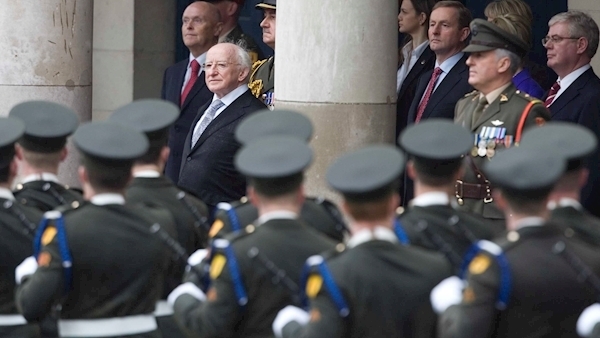
Just this week, he and the Government came under pressure to loosen the purse strings to improve the pay and conditions for members of the Defence Forces from no less than President Michael D Higgins.
President Higgins, who is supreme commander of the Defence Forces, said on Wednesday it was âno secretâ that changes in conditions for serving men and women âhas brought its own challengesâ.
âThose providing such a vital service as those in our Defence Forces must be real partners in interpreting and responding to such changes,â he said.
âShould this not happen, there is a real danger of a gap opening-up between our expressed appreciation of their work and the circumstances we deliver for its practice.
âMany are understandably concerned about the ability to attract and retain people of the highest calibre in the Defence Forces.
âIt is not too much, I would suggest, to expect that serving men and women should have conditions including an income and prospects that are sufficient to provide for themselves and their families.â
As we reported yesterday, the President's comments went down in Government circles like a lead balloon with ministers describing them as âdeeply unhelpfulâ.
âOf course they were deeply unhelpful. We are trying to hold a public pay deal together with sticky tape and blu-tac. This will only heighten the pressure on us to loosen the purse strings even further,â one senior minister said.
Speaking publicly, Agriculture Minister Michael Creed hit a most undiplomatic tone, saying he found the President's decision to comment "quite unusual".
"This issue has significant currency and has been recognised by Government also. I think it's [the [President's comments] quite unusual.
No, I'm not surprised or annoyed to be honest with you, it is an issue out there. Look, he has [commented], and his voice is the same as the Government and the Oireachtas.
TĂĄnaiste Simon Coveney said he does not have "any huge concerns" about Mr Higgins interjection.
"I think President Higgins was reflecting a concern and a frustration in Government, that is why we have had a public sector pay commission looking at Defence Force pay,â he said.
The problem for the Government is that concessions to one group have inevitably led to a rush of demands for others who all have been demanding restoration of boom time pay rates.
It is utterly ludicrous that these demands are being accepted. Our country had lost the run of itself and as a matter of policy we are returning to those same ludicrous pay levels for a very sheltered, cosseted section of our workforce.
So I appeal to you Minister Donohoe, resist such calls and give a break to the group of people who really need it and not those who simply shout loudest and most often.