Red admiral linking Ireland to Cuba, siempre
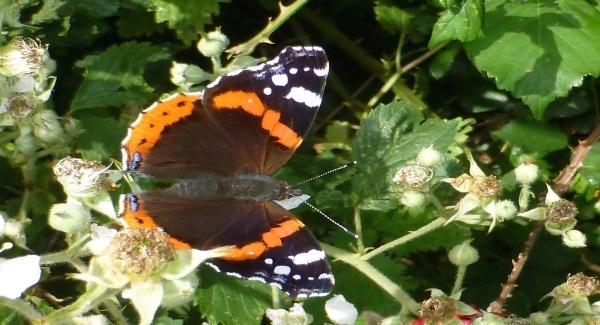
I was sorry to have done so. Semi-torpid, it half fell, half fluttered to the decking and stood there, immobile, wings closed.
It was already five in the evening, and a cold, cloudless night with possible frost was forecast.
Obviously, I couldnāt pick it up by the wings and reaffix it upside down to its sheltered roost, but if I left it exposed on the deck, it would likely be killed by the cold.
I felt sorry for putting its life at risk.
In Ireland, only a very small number of red admirals outlive winter; most die, while some attempt a reverse-migration to the Mediterranean region whence their progenitors arrive in early spring and summer.
So, as this late-stayer might possibly become a āresidentā, I didnāt want to be responsible for the death of potentially new Irish insect-citizen.
Deciding it should spend the night indoors, I captured it without trauma in an inverted glass bowl, took it to an unheated room, placed an eyedropper of water nearby, for fear it would dehydrate, and left it.
In the morning, I put it in an open cardboard box in an open shed, took off the bowl so that it could fly free, and left an overripe grape beside it.
The sun hit the shed about 10am, and at 11am I found it had flown. Who knows but that it took a sip of the grape juice for breakfast.
The idea is fanciful, but red admirals are great fruit eaters in gardens in autumn, when flower nectar is scarce.
Anyway, I hope it has survived.
With black, velvety wings, each intersected by a brilliant orange bar, and gleaming white spots at the wingtips, every admiral adds more colour to our summer. Historically called āred admirableā, perhaps it was their size, as much as 8cm across, that earned them the admiral title.
Their Linnaean name is Vanessa atalanta.
I thought this might have to do with their Atlantic range but knew that Iād seen and photographed them in Cuba. Researching, I found that their range extends right around the northern hemisphere.
Thereās a Cuban stamp in a series āMariposas Cubanos 1997ā, with an excellent sketch of the species.
The Cuban admiral is exactly like our own. Our own? Well, itās been proved to be resident, even if in small numbers.
The āatalantaā is, in fact, taken from the name of a mythical Greek virgin huntress who, when ordered by her royal father to marry, agreed only if the aspirant bridegroom could outrun her.
None could; but one clever suitor, knowing she had a āthingā about apples (red admiral butterflies also find them irresistible. Was this why Linnaeus gave them the āatalantaā suffix?) threw apples in her path as they raced and, because she stopped to pick them up, reached the winning post before her, and gained the nuptial bed. (They were very imaginative, the Greeks! However, itās interesting that, as in the original sin myth, pre-Christian Greek women also had apple fixations).
Cuba butterflies now transport me to the news that el Commandante, Fidel, is no longer smoking his cigars. Like our presidente, I signed the book of condolences at the Mansion House.
When my wife and I spent a month travelling the length of Cuba on country buses and living among the ārealā people, we found them genuinely enthusiastic about the regime, grateful for the changes they had under Fidel after the abuses and exploitations they had suffered under the dictator he overthrew, Batista, and the American sugar companies and gangsters who together made the Cuban men into slaves, and turned their wives into prostitutes because they had no other recourse.
Speaking Spanish was useful in getting a taste of the inside track.
Few approved of everything in the society ā we did hear complaints ābut all were grateful for the new world Fidel had wrought.
I got an email from a working-class woman in Cuba this morning saying all Cuba was weeping for Fidel, but we āwill continue with the values he taught us, and live with dignity.ā
In Cuba, we saw many billboards extolling the changes of the revolution but none bettered the legendary picture of a park bench empty but for a bunch of flowers, with the caption reading: ā200 million street children in the world, and not one of them is Cubanā.