Support children rather than hand a wodge of dosh to every corpse


THE ’AUL bereavement grant. Don’t you just love it? I must say I did when I successfully applied for it after my mother’s death some years back.
When I say I “successfully” applied for it I may be misleading you because the only qualification for a bereavement grant is a corpse. I had one. I got the grant. I had never heard of it before but on my mother’s death the forms came my way and I was invited to apply for it, like 22,000 others a year, I went ahead.
I used the €850 to fund a little reception at home after the funeral. It was handy because it meant I didn’t have to broach the subject of splitting the costs with my siblings, which would have made me feel mean.
It would not have left me broke, however. My mother’s death after just two years after she sold a south Dublin house for a boom-time price meant myself and my siblings were about to split up a serious amount of dosh. We had never needed a pay-out less than at that moment.
If I had examined my conscience for even five seconds I would never have applied for that grant. But I didn’t. I took what was coming my way and spent it on a Middle Eastern buffet with wine, coffee, and dessert.
It makes me want to puke that Right and Left, in the form of Shane Ross and Sinn Féin, are clamouring to bring back that ghastly hand-out in the next Budget. And it’s not just because of the grant itself, the restoration of which at Sinn Féin’s level of €600 would cost about €17 million or €20m at its former level as proposed by the Independent Alliance.
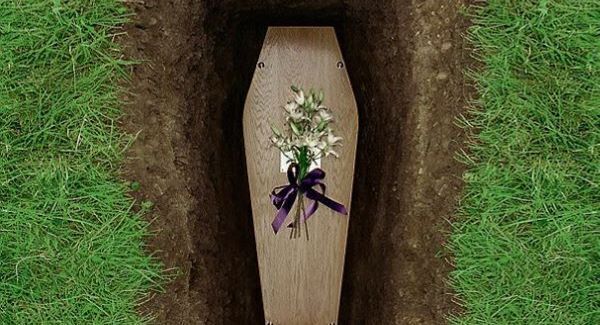
It’s because it’s symbolic of all that’s wrong with our political representation that they would prioritise a wodge of dosh for every corpse in the land over more investment in well-directed supports for children and young people. It is the fiscal articulation of the greasy political handshake at the funeral of every dog and divil whose family doesn’t actually bar the door of the church.
The crocodile tears are horribly unconvincing. Sinn Féin’s Denise Mitchell sobs of “helping families when it is most needed at this most difficult time” but they just took their cue from Fianna Fáil who positively bawled when the grant was axed in 2013. Niall Collins wailed that everyone deserved “a dignified departure from the world” while Michael McGrath blubbed: “Even the dead are not safe from this government.” Interestingly, Fianna Fáil hasn’t yet committed to restoring the grant.
Surely we are all agreed that everyone in this State deserves a dignified send-off. As things stand anyone in need of assistance towards a funeral can apply to the Exceptional/Urgent Needs Fund. This is right and proper and if more funds or well-trained staff need to be hired then additional resources should be provided for them.
But most people and their families can find the money for a funeral. Even at its boom-time rate, the bereavement grant only went so far against the expense of most funerals, anyway, which often top €5,000. It’s not surprising under-takers protested loudly against the axing of the grant in 2013. They know the less well-off often spend most money. Years ago a well-established Dublin undertaker showed me around his coffin range. The ornate coffin was, he said, “for your Moore Street flower seller” while the stripped pine “would be what you’d recommend to people you’d meet in the golf club.”
The State should not be adding fuel to this fire. The State should step in where there is hardship with a particular focus on those left behind. The Widows’ , Widowers’ or Suriviving Civil Partners’ Contributory Pension is taxed and is paid to surviving partners of people who have paid 260 PRSI contributions or more.
There is a “qualified child” allowance for those with a child under-18 or under-22 in the case of those in full-time education. The one-off Widowed or Surviving Civil Partner Grant of €6,000 is paid to surviving partners in receipt of this grant or a One Family Payment if they have any such “qualified child”.
I have no problem with this. I would point, however, to the glaring disparity between the treatment of widows with children and the treatment of lone parents. Surely the most heinous cut which was inflicted by the last government was the stripping of the One Parent Family payment from lone parents whose youngest child was just seven years old.
There is no understanding that that child will need the support of at least one adult through his or her education and Child Benefit is cut off for all children at age 18 whether they continue in education or not.
There is unmistakeable moral censure lurking behind this disparity: the idea that a widow did not choose her misfortune while a lone parent was the author of her own.
There is clear evidence that these cuts have worsened the situation of lone parents and by extension, their children. Figures for last year will be ready soon, but figures for 2014 show a rise in the number of single parent families described as “at risk of poverty” with 58% suffering “deprivation” and a “consistent poverty” rate of 22.1%. The group in society with the lowest level of “consistent poverty” at 2%, was the over-65s.
Like most Irish people I think it is shameful that any elderly person in this State suffers deprivation. But I am not convinced that paying each and every pensioner in or around an extra fiver a week, which seems to be the agreed price in the auction for the elderly run by Fianna Fáil and Fine Gael is the answer — with Sinn Féin coming in at €3.50 for those living with others and €5.70 for those living alone. It will take about €150m out of a €650m spending pot. And in the context of the treatment of chronically deprived lone parents and their children, I think it is cynical.
At least it is being paid to the living. Far more cynical is the proposed payment of between €600 and €850 to the families of everyone who dies, young or old, rich or poor. And as 40% of the elderly live alone, in many cases it will not even pass to an elderly person but rather to a middle-aged family member.
She is unlikely to object. I didn’t. But as she raises her glass to her departed loved one she is toasting the death of “new politics”.
CONNECT WITH US TODAY



Be the first to know the latest news and updates