Three emergency doctors serving one million people is heart-stopping
If two former health ministers like Varadkar and Martin can’t knock their heads together across the negotiating table and sort our health system in 2016 we have no right to call ourselves developed, democratic or free, writes Victoria White

Three emergency doctors serving one million people is heart-stopping

I HAD this column planned. I had a stack of books lined up in front of me on Monday night and I had every intention of ploughing through them so that you could plough through my oh-so-perceptive thoughts on the state of the planet.

Then the chest pains started. I tried to ignore them but they kept coming back. I’d had just the same pains last week. I also had two weeks of seeing stars, feeling breathless and my head swimming. I began to get scared.

I had rung my doctor on Friday but she’s changed her surgery to appointments only and my appointment wasn’t ’til the following morning. I was scared to go to bed with the chest pains in case I didn’t wake up. A former colleague, Brian Boyd, had written a searing account of his heart attack just last year and he’s around my age. My father and his father died suddenly before they were 60. I can’t pretend these issues aren’t mine.

But what to do? “I can’t go to A&E!” I wailed. I had spent eight hours in the Eye and Ear just a few weeks before and I swore I wouldn’t ever again go through such torture. We have no health insurance but hang on, you can go to VHI’s Swiftcare clinics if you’re prepared to pay up. What price one night of my life? Here’s my credit card.

Which is all very fine and well except Swiftcare doesn’t do the tough stuff. My heart looked OK to them but they couldn’t chance it. You’re going to hospital, honey, they said. It was then about 8pm. “I’ll be there all night!” I wailed. No, no, they said — you have the letter saying you have chest pains so they’ll see you quickly.

And they did. Blood samples were taken and I am reasonably sure that there was some heart monitoring done early in the night. They must have decided I wasn’t likely to croke right away. The next communication I had from them was in the early hours of the morning, possibly about 4am, when I had a chest X-ray. The whole bench cheered when I was called in but I came back again to wait until 6am when I finally saw a doctor. The doctor diagnosed a virus of the inner ear.

“I’ve been here 10 hours”, I said. “I know”, he said, He described the situation as “dysfunctional” What happens, he explains, is that the chronic emergencies — the car crashes etc— get prioritised and the less urgent emergencies get left sitting there. He told me there were three emergency doctors serving one million people on Monday night/Tuesday morning.

Health Minister Leo Varadkar

Not surprisingly, the guy seemed tired and hassled. If I were him I’d be looking for a transfer somewhere else— Yemen, anyone? I wasn’t one bit surprised to hear Fergal Hickey of the Irish Association of Emergency Medicine on the radio this week saying it’s hard to get doctors to work in the area. Clearly, there is a resource issue here. The number of patients on trolleys has ballooned since 2008 to make last month the worst on record, with a total of 9,381.

But the correct management of resources is as big an issue. We are throwing money at health but it needs to be managed professionally by people who know how to predict demand and allocate resources. This is the skill of all managers from the village shop to the top restaurant to the airport terminal. Clearly managing health is a particular challenge requiring particular expertise which I don’t have. I’m just a patient.

And it is the patient who is forgotten in all of this. In the Accident and Emergency waiting room in Vincent’s Hospital, Dublin, last Tuesday morning I saw a young girl lying on a bank of hard chairs with a drip in her arm. I saw an elderly man who had had a suspected minor stroke sitting through the night. A new friend from my row of seats was in silent agony with a suspected infected gall bladder and spent 10 hours sitting there without even a pain killer.

No resource issue, no management issue, excuses the absolute lack of humanity which was displayed to us A and E-ers in Vincent’s this week. We were met with a blank refusal to give us any information as to when we might be seen. My gall bladder friend was told to look out the window and observe the ambulances coming in and was told she would be seen when these emergencies were over.

No one came around and asked us if we were OK, or offered us a blanket, or even had a look to see if any of us was croking on the hard seats. Many just walked out, miraculously cured. The homeless man got the most attention. He was told to check in or get out.

Fianna Fáil leader and former health minister Micheál Martin

The contrast between the hospital staff and the ambulance staff was stark. A woman beside me whose elderly relative had been brought in by ambulance was reassured that while there was as yet no bed, the staff would stay at all times with her loved-one. Maybe an hour later, when a trolley was found, she was told to bring in her loved-one’s glasses and then head home for a little rest.

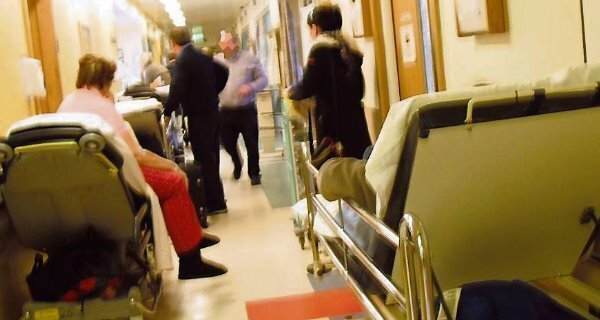
That eye contact and kindness must have gone some way towards alleviating the distress of seeing her loved one on a trolley. But the trolleys shocked the living daylights out of me when I saw them on the corridors. One journalist described the scene as a war zone but for me it looked like the slag heap of a monumental sculptor’s studio: the chalk-white limbs of elderly people were lying willy-nilly in that ghastly light.

The reality of what it means to have no privacy when you are sick and old was rammed home in a way that all the shock-horror stories had never achieved. These numbers are people stripped of their dignity: on Tuesday there were 45 trolleys in Vincent’s, 38 trolleys in Beaumont, Dublin, 25 in the Mater and 20 in Cork’s Mercy Hospital. In hospitals such as South Tipperary, Bantry General and the Midlands Regional the number on trolleys last month compared with March last year has more than doubled.

Fergal Hickey spoke of ambulances lined up outside Sligo General Hospital and said the failure to form a government was delaying progress on the trolley crisis. Mssrs Kenny and Martin need to understand that they are currently presiding over a health service in which sick people seem surplus to requirements.

In Vincent’s A and E this week I witnessed wonderful abilities more common the developing world: people just sat there and accepted their fate and they formed supportive communities. The management skills more common in the developed world were completely missing. If two former health ministers like Varadkar and Martin can’t knock their heads together across the negotiating table and sort our health system in this year of 2016 we have no right to call ourselves developed, democratic or free.

x

More in this section

Revoiced

Newsletter

Had a busy week? Sign up for some of the best reads from the week gone by. Selected just for you.

Cookie Policy Privacy Policy Brand Safety FAQ Help Contact Us Terms and Conditions

© Examiner Echo Group Limited