Spring bursting into life along clifftops of home
It is a lovely morning, the sun shining, the sea blue. The weather has put a spring in my step, to match the season. A national version of a poem I learned at school keeps running through my head: “Oh, to be in Ireland/ Now that April’s here...” The poet, Robert Browning, was in fact longing to be back in England, listing, one by one, the events in nature that he looked forward to enjoying as his ship grew daily closer to Albion, his beloved isle.
I mentally listed what I saw as I went, a sort of checklist of the events in nature that I see every spring in my own particular patch — celandine, like children’s drawings of the sun, on the roadside verges, daffodils in hosts (as Wordsworth said), gorse in yellow flower fringing the cliff edges, a wren that has survived the winter (up to 80% of wrens fail to survive hard winters), a pair of stonechats, the plumage of the cock already vivid, a raven in the field, and then on a field post, keeping watch above its traditional cliff-face nest, in which some pink chicks could be seen stirring among the fluffy horsehair or sheep wool that lines it.
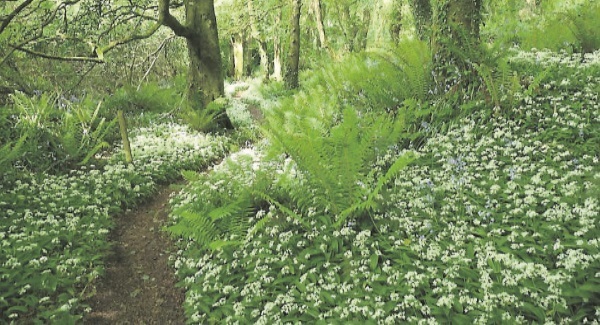
After the sea, the woods, and there, now, among the millions of ramson leaves I wrote about last week, white flowers are opening, and bluebells are, here and there, in bud. Violets were flowering in hummocks, and a clump of wood sorrel, with white flowers among large, shamrock-like leaves, had managed to find space to thrive among the ramsons. Prettiest of all, were the delicate, flowers of wood anemones, with soft, white petals surrounding delicate, pastel yellow centres and dark green leaves.
Along the byroad home, alexanders were flowering vigorously, though not gaudily, the lemon-green flower heads, many branched, like a hand held palm up with flowerets on the fingertips. Some grew 1.2m tall, the thick celery-like stems grooved and hairless, the leaves dark green and diamond shaped, emerging from sheaths close to the stem.
Alexander roots taste of parsnip. The plant was called for Alexander the Great, being a native of Macedonia. It may well have marched with his armies, the seeds in his soldiers’ knapsacks as cures for flatulence, snakebite, and many other ills.
The young stems may be cooked and eaten as a poor man’s asparagus. The Romans threw alexander roots, stems, and leaves into a cauldron to flavour a stew. For hungry soldiers or shepherds, the discovery of a break of alexanders after a long trek may have been a godsend. Here was a three-course supper: Vegetable soup to start, asparagus and parsnip for main course, and fritters made from the flowers for dessert.
An ancient Irish recipe for “Lenten pottage” lists alexanders, watercress and nettles as ingredients. All wild plants, no cost, no GM ingredients, plenty of vitamin C.
So, in the small world of West Cork nature that I now, after 25 years walking it, know relatively intimately, all is well. First celandines, dandelions, daisies and gorse, then wood anemones and wood sorrel, then ramsons, then bluebells. Herons nesting and hatching (our freeloading heron was there to greet us the first morning, voracious because he has family to feed, of course), and the ravens with young in the nest.
It was all very heartening to see. In La Gomera, wild flowers by the millions covered abandoned terraces, and road verges, all colours and forms. Butterflies were flying, admirals, painted ladies and plains tigers, a species we do not have here. pallid and plain swifts toured the skies, newly arrived from Africa.
After the walk, I turned to the stack of mail on my desk and found a newly published book entitled The Wild Plants of the Burren and the Aran Islands, a new edition of a field guide by Charles Nelson, senior research botanist at the Botanical Gardens, Dublin, published by The Collins Press.
Leafing through the pages, each with a colour photo of a plant to be found amongst the grikes and crannies of the limestone pavements, I was, once again, intrigued by the sheer wealth of orchid species and rare and wonderful sandworths —some recently discovered — that survive and thrive on this seemingly inhospitable landscape of stone.
I vowed that before the month is out I would arise from this desk and go there, now that April’s here.









