Zika and aedes are a deadly duo
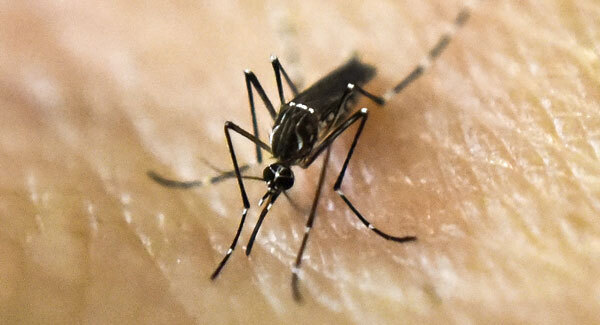

Like the notorious dengue and yellow fever viruses, this one uses mosquitoes as a taxi service. Female mosquitoes need a blood meal to form their eggs. Flitting from person to person, they pick up and spread the parasites with their bites.
The malaria bug, which isn’t a virus, uses anopheles mosquitoes to get around. These are active mainly at dawn and dusk.
But the aedes genus of mosquitoes, carriers of Zika, dengue, and yellow fever, fly both by day and night, so staying indoors and sleeping under mosquito nets is no defence against the infections they carry. South American mothers-to-be can do little to protect their babies. We have nightmares about sharks and snakes, but mosquitoes are the creatures we should avoid.
The news concerning diseases carried by insects isn’t all bad, however. Dr William Weir, of Glasgow University, has been studying the lifestyle of one the nastiest ones. There are about 30,000 new cases of sleeping sickness in Sub-Saharan Africa each year. The disease is caused by a protozoan, a single-celled organism which enters the bloodstream in the saliva of a blood-feeding tsetse-fly. Not related to mosquitoes, these highly aggressive insects are the size of houseflies. Twenty-three species are known.
Irish firm Aalto Bio Reagents launches first antibodies for Zika tests https://t.co/Sb9LUxriec (RMC) pic.twitter.com/qjN7vueUVb
— Irish Examiner (@irishexaminer) February 6, 2016
Once inside the body, the protozoan travels to the brain and attacks the nervous system, causing lethargy and confusion. It can drive its victims mad before killing them. Tsetse eradication measures help control the spread of sleeping sickness. Trees, where the insects rest up, have been cut back and pesticides, including the notorious DDT, sprayed over large areas. Wild animals such as zebras, also targeted by tsetses, have been slaughtered. When feral pigs were exterminated on the West African island of Principe in the 1930s, the tsetses disappeared. However, they returned 20 years later.
So far, attempts to develop a vaccine against sleeping sickness have failed, but Weir’s research raises a glimmer of hope; he has found what may be the bug’s Achilles heel. His team took blood samples from 75 victims of the disease over a wide area. When the protozoans in the samples were examined, their DNA proved to be genetically identical irrespective of the areas from which they came. This highly significant finding shows that the world’s tsetse flies are descended from a single individual. The researchers believe that the ancestor of the sleeping sickness parasite found an ideal host, the human body, within the last 10,000 years. Protozoans can reproduce both sexually and asexually.
Able to generate offspring more quickly and easily by cloning, the bug lost the run of itself and gave up sex entirely. Chastity may be one of the seven cardinal virtues, but celibacy has its downside.
Here's all you need to know about the Zika virus https://t.co/muGo8xIH1A pic.twitter.com/vQR5d2ykjW
— Irish Examiner (@irishexaminer) February 4, 2016
The bug is vulnerable to the “photocopier effect”.
A copied page will have blemishes not present on the original. If copies of copies are made repeatedly, they eventually become unreadable. Mutations, random defects in the copying of DNA, are the genetic equivalent of photocopier imperfections. When creatures reproduce sexually, genes from both parents are shuffled like cards in a pack, leading to genetically diverse offspring. Natural selection, the survival of the fittest, weeds out defective individuals; only the well-adapted ones survive. With cloned offspring, however, no such mechanism is available, and defects build up from generation to generation.
This vulnerability may help scientists working on a cure; the bug won’t be able to develop immunity to a vaccine when one is produced. Weir’s findings, alas, don’t apply to Zika. Viruses are the Houdinis of microbiology. As the HIV and flu ones have demonstrated, they can mutate to counter almost anything we throw at them. Defeating Zika will be a whole new ball game.
- William Weir et al. Population genomics reveals the origin and asexual evolution of human infective trypanosomes. January 2016. elifesciences.org.

CONNECT WITH US TODAY



Be the first to know the latest news and updates










