Ostriches barter eggs for survival
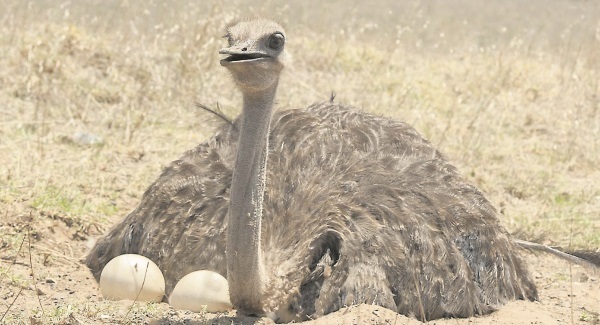

THE current edition of Zoo Matters has an interesting item on ostriches. Dublin Zoo’s cock and six hens share a communal nest each year, as is the custom with these flightless birds. Ostriches are used to a warm climate. 

Ostriches barter eggs for survival

Our Irish weather this summer didn’t suit them; the hens laid but the eggs failed to hatch. Then, team leader Helen Clarke-Bennett and her colleagues noticed something strange; eggs were disappearing from the nest.

When night-vision cameras were installed, the culprits were caught in the act; local badgers had turned to burglary. A badger would approach the unattended nest and select an egg. Walking backwards, it would roll the egg up an incline and release it repeatedly. Eventually, running down the slope, the egg would break against a hard surface, yielding its content to the thief. Tell-tale egg remains were found close to a badger set near the zoo.

Ostriches are used to threats from burglars. Hyenas and jackals, prowling the African savannah, can break open the thickest of eggs with their powerful jaws. Birds can’t do so.

The Egyptian vulture, with rather weak jaws, feeds on the scraps discarded by its more powerful cousins at a carcass. It’s not a bird you’d expect to target ostrich eggs but this scavenger has a trick up its sleeve. In a rare example of tool use by a bird of prey, it lifts a stone, weighing up to 1kg, and drops it on an egg to break it open.

The vulnerability of its eggs to predators might explain why the ostrich has developed an extraordinary breeding strategy. During the dry season, the male stakes out a territory and digs several ā€œgolf bunkerā€ depressions in the ground.

He displays to the local females until one of them, the major hen, becomes his mate. She inspects the showhouse depressions, selects one, and lays four to eight eggs in it. Then other females, minor hens, visit the territory, cavort with the owner, and deposit their eggs in the nest. There are usually up to six such females.

Nests eventually contain 20 to 25 eggs but as many as 60 have been recorded.

The minor hens don’t stay around to assist with incubation. Instead they visit other males’ territories where they lay again. The major hen incubates the eggs during the day. The male takes the night shift.

The sitting hen, faced with a surfeit of eggs, pushes some to the perimeter of the nest. The rejected eggs are always those of minor hens. If the nest is raided, the peripheral eggs will be the most vulnerable. The hen seems to sacrifice them to buy off the local predators in an avian protection racket. The attrition rate is still very high; up to 90% of nests fail.

Only the major hen and the male, who engages in elaborate distraction displays, care for the young.

The world’s largest living bird, abandoning its avian heritage, wants to be a horse or a giraffe. Like them, it relies on its eyesight, powerful legs, and stamina to keep out of harm’s way. The huge eyes occupy most of the space within the skull; an ostrich has excellent vision.

The head, raised high on a long neck above the vegetation of the open savannah, has a 360-degree range and acts like a radar warning system. If a big cat or hyena is spotted, the ostrich flees. Even a recently hatched chick can run at speed with the stamina to avoid most enemies.

The popular notion that ostriches stick their heads in the ground, when danger threatens, is false. If they did that, the species would have become extinct long ago.

Like the horse, it has another defensive string to its bow. An angry ostrich can deliver a kick which, it’s claimed, can kill a lion. Would-be predators think twice before closing with an ostrich.

  • Helen Clarke-Bennett. Birds of a feather. Zoo Matters. Autumn 2015.
x

More in this section

Revoiced

Newsletter

Sign up to the best reads of the week from irishexaminer.com selected just for you.

Cookie Policy Privacy Policy Brand Safety FAQ Help Contact Us Terms and Conditions

Ā© Examiner Echo Group Limited









