Hats off to the big dipper
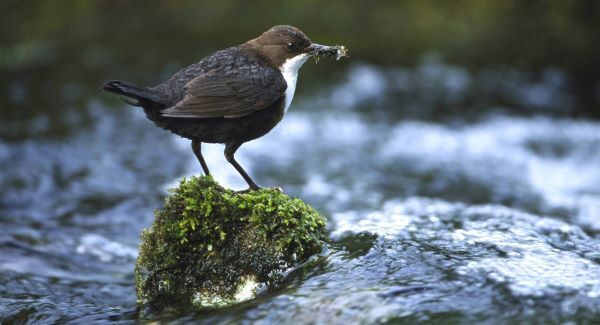
It was a blustery day with short squalls of rain blowing in on the wind. A typical April day that happened to be occurring in May. Looking for a change of scenery, I crossed the county border and drove into the Wicklow mountains. I parked and walked up along the tumbling headwaters of the River Liffey.

Hats off to the big dipper

A bird appeared suddenly, flying low along the river and jinking round each bend. A roundish sort of bird with wings beating incredibly fast, it looked like an enormous bumble bee or a giant wren. It was, of course, a dipper.

Dippers are uncommon rather than rare and are confined to shallow, fast-flowing rivers and streams with gravelly beds. They are also one of the most extraordinary birds in Ireland. By some quirk of evolution a typical perching bird, midway in size between a robin and a blackbird, has adapted to life under water. Dippers get most of their food by jumping into the streams where they live and moving around by a combination of running along the stream bed and ‘flying’ under water until they run out of breath. Their main quarry is the aquatic larvae of flying insects, though they will also eat things like snails, freshwater shrimps and very small fish.

In Victorian times the gamekeepers and waterkeepers on the great Scottish sporting estates decided that dippers also ate the eggs of salmon and trout and declared war on them. Over a three-year period 548 of them were killed. Post mortems were carried out on them and not a single fish egg was found in the stomach contents. The scientific name for the dipper is Cinclus cinclus. This is quite a good representation of the ‘zinc zinc’ call that they make when they’re disturbed. It’s often the first clue you get that they’re present when you’re on a river bank.

However, the one I met in Wicklow was actually Cinclus cinclus hibernicus, the Irish dipper. Dippers are among half a dozen bird species in which scientists recognise a distinct and unique Irish race or sub-species — or, at least, many scientists do. The subject is a little controversial.

The facts seem to be that the Irish dipper, which is also found on the Isle of Man and some Hebridean islands, differs from those in mainland Britain in some plumage characteristics. It also appears Irish dippers have thinner legs because the people who ring birds say they require a different size of ring. However, the geneticists say they haven’t discovered any significant differences in DNA.

I rather hope that the plumage experts and the bird ringers are right and the geneticists are wrong. There’s something rather gratifying about the thought that evolution has bequeathed us our own unique dippers, along with Irish jays, red grouse and coal tits.

DISCOVER MORE CONTENT LIKE THIS

x

More in this section

Revoiced

Newsletter

Had a busy week? Sign up for some of the best reads from the week gone by. Selected just for you.

Cookie Policy Privacy Policy Brand Safety FAQ Help Contact Us Terms and Conditions

© Examiner Echo Group Limited