The lesson for us all is that Ireland’s teachers need to be re-educated
You were meant to be reading an article that began: “My teenage boys are sleeping upstairs. Any minute now, they’ll be down to raid the fridge and go on the internet. This is what our teachers are doing to our children, blah, blah, blah.”

The lesson for us all is that Ireland’s teachers need to be re-educated

But the truth is that the strike is fine. The winter is hard in Ireland. I hate getting up when it’s still dark, and I hate getting four children off to school.

Two children is quite enough for me and the ones who are still in primary school get up later. Just packing two lunches, instead of four, seems like a holiday to me.

In fact, you might be reading this before I’m even out of the bed myself. There was a fantastic traditional music gig in town last night that I really fancied. I don’t know when I’ve been out recently on a mid-week night, but the eldest could babysit if he wasn’t going to school today.

So, really, the teachers’ strike worked out well for everyone in our house, except the primary schoolchildren, who are sick with jealousy.

We’re getting used to these strikes. We get used to just about anything in Ireland. Just look at the way we’ve got used to our dire secondary-education school system? We’ve got so used to it that our teachers’ unions are striking to stop it being reformed.

This is a situation that Pasi Sahlberg, a Finnish education expert who lectures in Harvard, described last week as “unique globally”. “Internationally, it is more common that teachers are the ones that insist on more freedom and autonomy in assessing and grading their students, rather than the other way round”, he said.

Isn’t it just wonderful to be unique? Uniquely resistant to change. Uniquely resistant to innovation. Uniquely resistant to taking responsibility.

And there isn’t much of a fuss. The teachers’ unions are even claiming that parents “in the community” support their strike action today. Maybe we all realise, at some basic level, that it doesn’t much matter if the children go to school or not. The course is the course. All that matters is cramming as much as you can into yourself and then spewing it out at the exam.

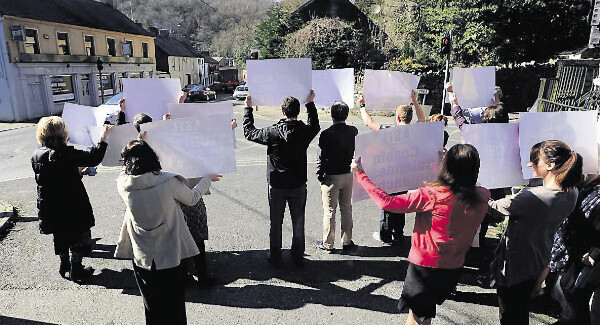
The teachers strike in Bandon, Co Cork.

This is the system the strike aims to retain, remember. The teachers’ unions say they are dying for reform; their only issue is with the school-based assessment, rather than external assessment. How can you tell, the teachers ask again and again, if a ‘B’ from Bohola is the same as a ‘B’ from Ballyfermot, if you have school-based assessment? And some commentators have backed them up, saying we’re such a small, corrupt little country that only external assessment will guarantee fairness.

Which shows they haven’t even grasped the basic concept of ‘formative assessment’ as a tool that could transform our education system. It’s not about the ‘B’ or the ‘C’, lads. It’s about teachers acting like the highly-trained professionals they are and “identifying and responding to the students’ learning needs”, as the OECD explained in their research across eight countries, in 2005, which formed a backdrop to the proposed changes in this country.

To say that they found formative assessment had a positive impact would be an understatement. The OECD describes the “achievement gains” associated with formative assessment as “among the largest ever reported for educational interventions.”

So everyone does better, then, but the biggest gains are made by students who were previously underachieving. That’s because one size doesn’t fit all in education, and teachers who are assessing while they teach, rather than teaching to an exam, can find innovative ways to reach switched-off students.

I was one of those students. I remember being rigid with boredom for most of my secondary schooling. The only things that kept me going to school were looking at birds out the window, passing notes to the other girls, and making eyes at the boys. I associated learning strictly with home, where I memorised the reams of stuff I needed to get good exam results.

I had a good memory and could do that easily. Others were not so lucky. What the OECD research found was that the 20% of students performing the worst in the exam system gained most from formative assessment. That included children with special educational needs.

Surely, that explodes the idea that there is anything ‘fair’ about our current, exam-based system, which teaches to the children who learn in one, particular way and not to the others who don’t? And which tests every child the same way, regardless of their needs, their skills or their challenges?

And which allows the children who fail in that one way, on that one day, to make failure part of their identity, when many of them could be successful at building the very skills we need for the modern world?

The OECD research shows how really good schools, internationally, have used standardised assessment models, but have still been able to assess their students in ways that took note of their individuality. In this way, the ‘gaps’ between the achievers and the non-achievers have been partly closed.

Teachers have divided their classes to focus on a group that has difficulty with a concept. They have developed teams of students to learn co-operatively. This means the students learn to judge their own work and their peers’ work, skills the OECD considers “invaluable for lifelong learning.”

Some bits of the curriculum go missing. But the bits that are done are understood. That rings a bell with me, the woman who slept through her entire schooling in mathematics and can’t even help her primary-school children with their homework.

What’s central to the formative assessment model of education is responsibility: teachers’ and students’. What’s central to our exam-based system is the absence of responsibility. And what the teachers are trying to do, by striking and attempting to block even the 40% assessment in the Junior Cycle, which is all that is left of Ruairi Quinn’s bold plans, is to duck their responsibility to our children.

They don’t want the massive change in our education system that ongoing assessment would produce. They want to teach the way they learned and they are prepared to keep our children out of school to resist relearning how to teach.

And many of us parents, products of the old system, don’t give much of a stuff if the children are off or not. That’s the point we’ve reached. If the exams are all that matter, why have teachers at all? Why have schools? Why have education?

Are we going to wake up and tell the Government, whom we pay, that the teachers they pay must make these changes? Or are we content to whisper at our children’s doors this morning: “Sleep on, my sweets. When you wake, the world will be the same as it ever was. The same as it always will be.”

x

More in this section

Revoiced

Newsletter

Had a busy week? Sign up for some of the best reads from the week gone by. Selected just for you.

Cookie Policy Privacy Policy Brand Safety FAQ Help Contact Us Terms and Conditions

© Examiner Echo Group Limited