Ageing Quinn teaching them how it’s done

The prevailing emotion was anger, a general, unfocused, yet deeply felt anger that little has changed as the tide recedes on a savage recession.
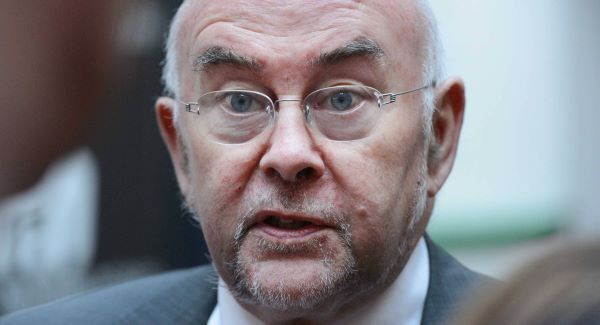
Quinn is straight out of central casting for the modern politician. He is, to a large extent, only loosely attached to any ideological harbour. He was first elected to the Dáil in 1977, and since 1982 has retained his seat. Unlike others who have survived as long as he has, Quinn displays substance, and has ideas on how to improve the country. For a few years, in the 1990s, he served as Minister for Finance, but then toiled through his best years in opposition, his ideas neutered while Bertie fiddled and burned.
Quinn did what was required to get back into power, spreading false promises like manure before the electorate. And then, once on the inside, he, like all the others, reverted to type, but with one small caveat.
Quinn knows he’s on the last lap of his career. He knows that he only snaffled a Cabinet seat at the last moment, apparently whipping it from the arms of Roisin Shortall. He has the cut of a man in a hurry to do something while he can, now that he is freed from the shackles of re-election imperatives.
So he is moving at a speed alien to a culture that only changes with urgency when a crisis looms darkly over government buildings.
Quinn is bucking the trend. His eagerness to address everything, from shortcomings in curriculum to the Church’s monopoly on primary school education, has left some stakeholders dizzy. At the opening of the INTO conference on Tuesday, the union’s president, Brendan O’Sullivan, called for a “moratorium on initiatives”.
Quite obviously, too much change upsets the comfort levels of some within teaching.
To be fair to teachers, they find themselves at the mercy of a Speedy Gonzales minister, at a time when morale is on the floor.
The pay cuts, and the cutbacks in service, have hit education hard. The job has become more difficult, and the impact is accentuated in this field because a large cohort of teachers still retains a vocation.
Enduring all that, under a government that had promised a better way, is not easy. Thus, Quinn’s rush towards change couldn’t have come at a worse time if he is to bring everybody along with him.
The reception Quinn got at the ASTI conference told plenty also.
He was heckled and jeered, and treated like he was something the cat had dragged in, rather than the elected representative of the people.
Many saw the display as petulant, and at another time such an assessment would have been perfectly accurate. Context suggests otherwise, though. Those who were most vocal largely represent a younger cohort within ASTI, and many of them are aligned to an internal gathering in the body that calls itself ASTI Fightback.
As with wider society, it is this younger cohort that has borne the greatest brunt of recession. Casualisation has crept into teaching, with between 27% and 35% of ASTI’s members not in a full-time job. One of the ASTI Fightback people, Mark Walsh, told Sean O’Rourke, on RTÉ Radio, that he has been teaching for nine years, yet still does not have a job.
Others are reduced to working part-time elsewhere to keep their heads above water.
Their older colleagues, most of whom are in secure jobs, are more restrained. They, like their demographic, kindred spirits in other sections of society, have suffered, but nothing along the lines of the burden placed on their younger colleagues.
One issue raised at the conferences was the problem of new entrants to teaching, who started in the last few years on lower salaries than those who went before them.
Yet that was one of the conditions to which the unions agreed in ensuring that pay scales for established teachers would be left alone during the belt-tightening.
Much has been made about the fact that there has been a dearth of widespread protest against the austerity that has been inflicted across society. Last week was a little taster of what the country has avoided because of the valve of emigration.
This wasn’t a case of petulant teachers stamping their feet. It was a small example of the anger felt by the young who stayed rather than left, at a time when those in the older demographic, with power or influence, moved to shore up their own interests.
Despite all that, the resistance to Quinn’s most contentious initiative is highly questionable. The reform of the Junior Cert will cause a certain amount of upheaval. Moving to continuous assessment will involve more work for teachers, and will see their role in the State exam recalibrated from advocate to assessor.
There is an issue over who assesses the work, but that is not insurmountable.
There is also an issue over fairness. The value of the Cert may be diluted, because it will depend, to a certain extent, on the work of individual schools, rather than a single, statewide exam.
Yet, there is no escaping that radical change is required. Assessing students on the basis of rote learning simply doesn’t wash in today’s world. The fast-changing nature of the workplace, and wider society, means that a whole range of skills are required.
A recent OECD study illustrated the point. In the area of problem-solving, Irish 15-year-olds were found to be only average. They ranked 22nd in 44 countries, and came 17th from the study. Rote learning will do little to address that deficit.
The issues about fairness being expressed by teachers have some validity.
But in today’s world, how many teenagers leave education before completing the Leaving Cert, and would the perceived value of their Junior Cert be an issue in obtaining work?
In the long term, the Leaving Cert, and its obsessive and stress-laden points race, will also have to be addressed, but it’s high time that tracks were made down that road by starting with the earlier examination.
Quinn is on solid ground in trying to push through the changes. Speculation is rife that he may be called ashore in the forthcoming Cabinet reshuffle, and relegated to a more junior role. As somebody who has spent most of his adult life in politics, he will know that his successor may opt for the easy life, long-finger the reforms, and enjoy the view.
Hopefully, the reforms will take shape quickly, despite the ills that have infected education since the economic collapse. Those being educated deserve no less.
CONNECT WITH US TODAY



Be the first to know the latest news and updates