Brussels Briefing
The latest counts show 27 candidates for the 11 Irish seats in the European Parliament. Twelve of them are women, while 10 of the current 12 MEPs are running again.
While the Labour Party candidates are not expected to do well, their parent party in the parliament, the Socialists and Democrats, are neck and neck with Fine Gael’s European People’s Party.
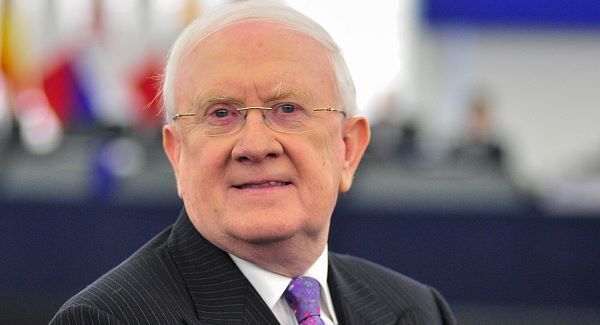
Meanwhile, Fine Gael MEP Sean Kelly and Fianna Fáil’s Pat the Cope Gallagher (pictured left) showed off their electioneering skills to the Brussels branch of the Institute of International and European Affairs.
The EU has just launched its Aid Volunteer corp and hopes to have up to 20,000 people take part over the next five years.
EU citizens aged from 18 to 75 can volunteer to help aid agencies in countries where their skills are useful — and there are lots of places for people who want to stay at home and contribute through the internet.
It has a budget of €148m and aims to pay volunteers a stipend based on the local cost of living. It will also cover basic necessities.
Unscrupulous farmers are getting away with claiming EU money they are not entitled to, according to the European Court of Auditors.
They did a few spot checks of their own and found farmers claiming to be growing valuable crops on stoney outcrops and grazing well-fed cattle on what was in fact dense forest.
The member states were not bothering to carry out checks and were just paying out, while the European Commission was accepting their word instead of following the money.
The auditors point out that with €362bn in the CAP budget for the next six years, the commission needs to beef up its oversight.
Europeans are champion drinkers, consuming twice as much alcohol as any other region in the world.
It is well-known that alcohol is a risk factor in some 60 diseases and the annual social cost is about €155bn.
But MEPs on the public health and food safety committee have again rejected the idea of labelling drinks to tell consumers what they contain.
The Corrib gas field and Rossport in Co Mayo are among the thousand entries on the Global Atlas of Environmental Justice, just published.
So many of the world’s conflicts are sparked by a grab for minerals, land, or forests by large multinationals, often with the assistance of government.
Ecological conflicts are increasing as the demand for minerals increases, but this is often to the detriment of poor, marginalised and indigenous communities, said Professor Joan Martinez- Alier, who led the team responsible for the Atlas and its amazing collection of information at www.ejatlas.org.
Science fiction books about people being grown for their organs are gruesome, but in the likes of China, some people jailed for misdemeanours are used as spare parts.
A conference asking the EU to act was hosted by the European Economic and Social Committee, Doctors Against Forced Organ Harvesting, the Taiwan Association for International Care of Organ Transplants, and Human Rights Without Frontiers.
The conference was organised to highlight the crime ahead of the first visit of Chinese President Xi Jinping (below) to Brussels in the hopes that somebody might have the courage to raise it with him.










