Phalaropes spread their wings
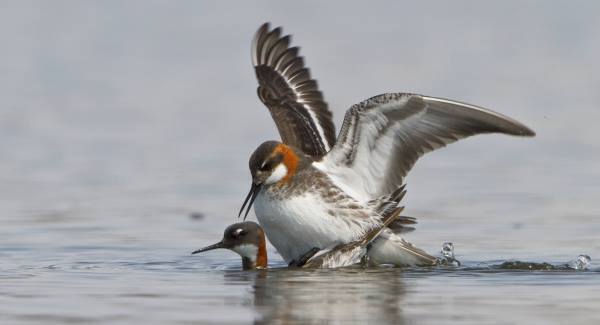

The red-necked phalarope, a sub-arctic species, bred annually in Ireland up 1971. The Irish Wildbird Conservancy, now BirdWatch Ireland, established a reserve on the Mullet Peninsula to protect what was then the bird’s most southerly regular breeding haunt. Phalaropes seldom nest here now. According to the Bird Atlas, a pair ‘possibly’ bred in Mayo in 2010 and another ‘probably’ did so in Offaly in 2011. Up to 40 pairs nest in Scotland.
Waders don’t swim but phalaropes are an exception; their toes are lobed to help them do so. They spend their winters in the sea feeding on plankton. Individuals can be extraordinarily tame; parent birds have been known to brood chicks held in the hand.
Males of most bird species are more glamorous than their mates. They secure territories, defend them against rivals and seduce females into joining them. Mammies do the lion’s share of the nest-building child-rearing and domestic chores.
With phalaropes the roles are reversed. The female is bigger than her mate and has the brighter plumage. She chooses a nest site near a pool, ‘seeing off’ rivals approaching her domain. Swimming around a prospective partner, she begs him to mate. Males being such wimps, she has to do so repeatedly; ‘faint heart never won fair lady’ is not a phalarope maxim. When the eggs have been laid, she absconds, leaving the incubation and chick-rearing entirely to him. The wayward wife may then seduce a second male, setting him up on another nest.
Phalaropes head south each autumn but, unlike our other waders they don’t seek out estuaries. Some ringed in Scandinavia moved south-eastwards, stopping off on the Black and Caspian Seas before continuing on to the Arabian Sea. None of the 300 or so birds ringed in Scotland has been recorded elsewhere. Nor has ringing in Iceland revealed the winter haunt of birds from there. It’s been suggested that some Icelandic phalaropes head westwards via Greenland and down the coast of the United States, while others travel eastwards through Europe.
In 2012, members of the Shetland Ringing Group fitted tiny ‘geo-locators’ to ten red-necked phalaropes on Fetlar in Shetland. Little harnesses secured the units, each weighing just half a gram. GPS technology enables a locator to log the individual’s movements. One of the birds has been recaptured back in Shetland. Researchers from the RSPB and the Swiss Ornithological Institute are astonished at what its geo-locator has revealed. The bird had flown westwards across the Atlantic and travelled down the eastern seabird of the United States to the Caribbean. Arriving in Mexico, it crossed to the Pacific and headed for Peru, spending the winter on the Pacific coast before returning by a similar route to Shetland in spring.
Only a handful of species cross the Atlantic on migration. Brent geese and purple sandpipers fly from Canada to Ireland in the autumn and return in the spring. Some wheatears also cross the ocean. The prevailing winds at these times of the year help the birds on their journeys. The Fetlar phalarope, however, travelled in the opposite direction, when winds are seldom favourable. No other European bird does this. Icelandic phalaropes might be forgiven for moving westwards, but that a bird from Scotland or Ireland would do such a thing is extraordinary. It suggests that our phalaropes are of American origin.
In 1938 Douglas Corrigan, of Irish descent, was refused permission to fly his ramshackle aeroplane across the Atlantic. Undaunted, he left New York, ostensibly heading for California but, claiming that his compass had malfunctioned, landed at Baldonnel Aerodrome 28 hours later. Wrong-way Corrigan’s spirit lives on in the red-necked phalarope
CONNECT WITH US TODAY



Be the first to know the latest news and updates