The corncrake: Our own ‘Abominable Snowman’
Hillary and Tenzing’s expedition of 1953 found strange footprints in the snow 6,000 metres up. Mountaineers heard weird calls which their Sherpa guides claimed were those of the notorious ‘Yeti’. No authentic hair or body samples were ever found so what could have made the tracks? Belief in the existence of the Yeti has waned but, in 2004, the editor of Nature suggested such reports deserved further study. His remarks followed the discovery of a previously unknown species of human which survived, perhaps until 12,000 years ago, on Flores Island off Indonesia. Could other ancient hominids be alive today?
A bird, not quite as mysterious as the Abominable Snowman, has been photographed and filmed by the naturalist John Young. The night parrot, yellowish green and about the size of a thrush, is one of the world’s most elusive creatures. It lives among the long spinifex grasses which cloak the arid regions of Australia. Known from about two dozen museum specimens, this secretive night worker is so elusive that it was deemed by many to be extinct. Some even doubted that it ever existed. Then, in 1990, the remains of one were found on a remote stretch of road in Queensland. The bird appeared to have been struck by a vehicle. According to BirdLife International’s fact-sheet, two other carcasses were found since then, one in Western Australia in 2005 and the other, that of a juvenile, in Diamantina National Park the following year.
Young, who describes himself as a ‘nature detective’, spent five years searching for the secretive parrot. His efforts were rewarded in 2012 when he glimpsed a pair. He couldn’t photograph the birds but he managed to record their piping call. Hearing the call again this year, he played back his recording, inducing the caller to show itself.
The parrot appeared to be deeply offended at what it thought was a rival on its territory.
DNA has been isolated from feathers it shed, confirming the identity of the bird. This time, Young managed to take photographs and a brief video sequence. Lest hordes of birdwatchers descend on the area, he is keeping the location secret, even from the scientific community. The tape recordings of the bird’s call are also being withheld.
Secretive creatures are especial fascinating. On the safari circuit, the tantalising glimpse of a leopard tightens the scalp and makes the hair stand on end. I will never forget seeing a mother tiger and her cubs after four days fruitless searching at Ranthambore in India.
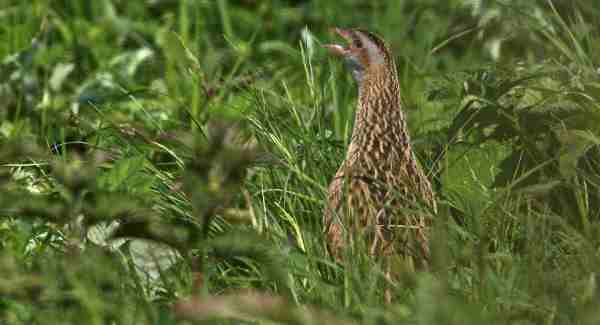
Part of our fascination with corncrakes is that these inhabitants of the long grass, like the night parrot, are so difficult to observe. Only by (illegally) playing a recording of a singing male, as Young did, can you persuade a bird to show itself. Seeing an owl or a water rail is always ‘an event’.
Visiting Cavan last month, I hoped to spot an elusive little song-bird. The garden warbler is found elsewhere but Ireland’s lake district of Cavan Roscommon and Monaghan is its stronghold. This summer-migrant from sub-Saharan Africa skulks in the undergrowth of broadleaved woods with fairly open canopies. It likes to have water nearby which may be why it favours drumlin country. Misnamed, it seldom visits gardens. The little greyish-brown warbler is not much to look at; what’s the point of dressing up if you don’t propose to show-off.
Unlike the night parrot, however, this is an accomplished singer. The song closely resembles that of the blackcap; it takes practice to tell the two apart. Irish blackcaps head south in autumn but German ones come here for the winter. You find them even in the suburbs. All of our garden warblers depart; they won’t be back until the spring. Though not in the Abominable Snowman league, this little bird has a mystique of its own, an attraction which springs, not just from the beautiful habitats it frequents, but from its elusiveness.