Banks are still behaving badly — even after we bailed them out
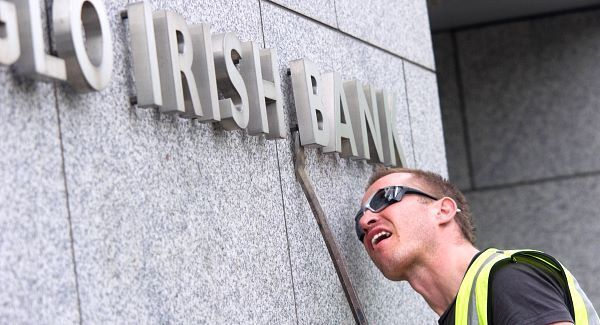
That, at least, was what Channel 4’s economics editor Faisal Islam, was told when he was researching his new book The Default Line. He was asked by one of his interviewees, the head of a European bank, the identity of the most dangerous financial product and was shocked to be told the mortgage. But here in Ireland it is the very obvious answer. Our banks were not ruined by the type of activity that almost wrecked Wall Street. Our banks simply issued far too many mortgages to ordinary customers, for amounts of money far in excess of what the properties on which the mortgages secured were worth, and at rates of interest that were too low. To make matters worse they themselves borrowed badly to fund this business.
Our banks were rescued of course. The State provided the capital to cover their losses on loans that could not be repaid, a total of €64 billion the State could ill afford. Bad loans to the developers who built all the properties were transferred to a specially established State organisation — Nama — with the intention of making it easier for the banks to re-establish themselves. The European Central Bank provided cheap funding to the banks that they could not secure for themselves on the normal financial markets to allow them stay in business. Some of the personnel at the top may have changed — and those who left got very generous pay-offs and pensions — but the banks themselves have been left to continue in business.
This is all entirely relevant to the mortgage debacle that continues to unfold.
The Irish banks, having been treated with an extraordinary degree of tolerance and generosity when it comes to writing off their debts and being given money to continue in business, have been ruthless in dealing with many of their customers, particularly mortgage holders.
Ruthlessness exhibited by the banks does not necessarily extend to wealthy individual or corporate lenders or even the developers whose loans were not big enough to transfer to Nama. Here deals are being cut all of the time. If a large corporation is in danger of going out of business then it has had a good chance of reaching a deal with its bank for the partial repayment of its debts with the balance either being placed in cold storage, with only interest repayments demanded, if at all, or being written off as a bank debt that would never be recovered.
Very few homeowners have been extended such grace. The idea of a write-off of part of a mortgage debt is considered anathema by the banks. Anyone who fails to make a repayment is treated with hostile suspicion, the belief being that they probably could make the repayment if they tried hard enough. Some apparently are engaged in a bluff called “strategic default” believing that they won’t be kicked out of their homes even if they fail to meet monthly repayments for a prolonged period. Now as it happens I imagine that among the considerable number of borrowers who are not making their monthly loan repayments – well over 100,000 at the last count — there are some who could actually afford to do so. But these exceptions are not the rule. There is genuine inability to repay, especially among those who bought at the height of the boom in the mid-2000s and who now face repaying a loan far bigger than the value of the property, even before interest is taken into account.
Companies or rich business individuals faced with such a situation know exactly what to do if faced with such a situation. They go to their banks and demand new terms and conditions on repayment and negotiate down the amount that has to be paid. They point out that the banks misjudged in advancing loans as much as they did in taking them. They show that their ability to make repayments have changed as their income is down. There is often brinksmanship involved in this and pain has to be taken by the borrower in return for a reduction of debts. But banks tend to do deals when faced with the possibility that the businessman or company will pull the plug. Pragmatism takes hold. Some of the debts are written off and often the banks get little or nothing in return.
Contrast this with the way the banks are treating many mortgage holders. The banks are demanding full repayment from people who are experiencing serious falls in net income and who have suffered the psychological impact of knowing that the property they borrowed expensively to buy might now be worth less than half of what they paid for it. Now you can argue that if the borrowers were stupid to borrow what was being made available to them then it is their responsibility to make all of the repayments as they fall due. It is what the rest of us do. But some people simply aren’t capable and the new personal insolvency rules, due to come into effect next Monday, are a pretty draconian way of dealing with things. That is, of course, if the banks play along which looks far from certain: some are making it difficult for people to engage with this process.
Greedy and stupid as many borrowers might have been the lenders were even more stupid to advance the money to ordinary people in the expectation that property values were going to continue rising. It is only equitable that they share the pain. But they won’t. They know that if they write off loans to mortgage holders, in the way that they did to land speculators and developers and corporates, they’ll go bust or will require further massive injections of capital from the State. So they will screw the ordinary person for every cent.
The banks, it appears, have behaved disgracefully. Apart from the appropriate nods as to their culpability for the mess, they act as if they are the victims of what happened, victims of the bad behaviour of their borrowers. Worse, they are behaving now as if they are the victims of the ongoing perfidy of their borrowers, those ungrateful types who simply won’t pay what they owe.
Remember the reasons why the banks were rescued in the first place. We were told it was to ensure that we had lenders available to supply money to businesses and individuals. The evidence has been that lending has become scarce and expensive. The lack of working capital provision, for example, has caused many traders to go out of business. The banks were also rescued to protect savings and to allow for the continuation of the money transmission system but there has been a major malfunction if a reason was to provide grease to the engine of the economy by way of lending.
It can be argued, with some legitimacy, that the banks cannot engage in risky lending that would incur further losses, and that with the economy on its knees the chances of not getting repayment have increased. But that’s all a bit chicken and egg isn’t it? We still have no confirmation of the details of the planned inquiry into the banking debacle of the last decade, up to and including the introduction of the infamous bank guarantee of September 2008, despite all sorts of political promises in recent months. But — judging by what we heard this week from the bank bosses who have turned up at an Oireachtas committee for questions about the ongoing mortgage crisis — an inquiry into how the banks have handled the post-guarantee period might be of far greater immediate use.
*