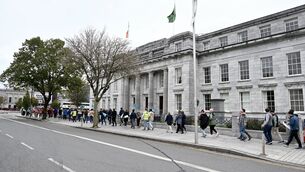
Monday’s protest - Strike plan is economic suicide
There are more than two million people unemployed in Britain.
In Northern Ireland the figure increased by 75% in the last year.
America has its highest rate of unemployment in a quarter of a century. Last month 651,000 Americans lost their jobs. It was the third consecutive month in which more than 600,000 jobs were lost — a sequence last recorded in 1939. In January 8.3% of French workers didn’t have a job. In Canada the rate reached 7.2%.
Just last week Australia announced that it was capping immigration quotas.
Dress it up any way you like that’s an awful lot of people, an awful lot of countries, chasing diminishing job opportunities. It’s also an awful lot of government agencies trying to seduce investors thinking of opening a factory or a business of any kind.
It also represents a lot of hardship, lost dignity and fear. Each of these numbers represents an individual but in many cases it represents a family facing circumstances deteriorating in ways they never imagined possible.
One of the strongest cards the IDA or any development agency has when trying to attract foreign direct investment is a quality workforce. That usually means most workers are educated and can see the bigger picture. That is why the vote by the members of the country’s largest public sector union IMPACT not to participate in next week’s “national strike” is so very welcome. The decision may suggest that there is now a wider realisation of the depth of the challenge facing us all and what represents an appropriate response.
It is also a major setback to the Irish Congress of Trade Unions. However, anyone planning to use an airport next Monday might be better off at home. SIPTU members at Dublin, Cork and Shannon plan an eight-hour work stoppage. Tens of thousands of teachers, nurses and other public workers have voted to join the protest. The Technical Engineering and Electrical Union is also expected to serve strike notice.
However, the scale of participation by private sector workers in this “day of action” remains unclear.
And there, in that simple sentence, you have the nub of our great dilemma. The great majority of those planning this strike are public or semi-state employees insulated from the tooth-and-claw realities of the market place. Like it or not, no matter how uncomfortable that makes public sector workers feel, that’s the reality.
Imagine yourself an investor considering a proposal from the IDA. Everything looks fine, the potential is real, the workers available immediately and everything has been done to smooth your path. Then, you see how a huge but protected proportion of our workforce responds to the first of many measures designed to confront this crisis — they down tools march up the hill and march back down again.
What do you do? You phone the man in Aberdeen, Gdansk or Seville and you forget about Ireland.
Nearly every section of society contributed to our current situation one way or another. Some trusted figures were dishonest and greedy beyond belief. Others were swept along in a tide of optimism and denial.
However, those who strike next Monday will do terrible damage to a country struggling to avoid bankruptcy.
Our reputation is in tatters, this protest will damage it further.
It is still not too late for sanity to prevail.
CONNECT WITH US TODAY



Be the first to know the latest news and updates