Irish Examiner view: Massacre a watershed in savage clash
Irish Examiner view: Massacre a watershed in savage clash

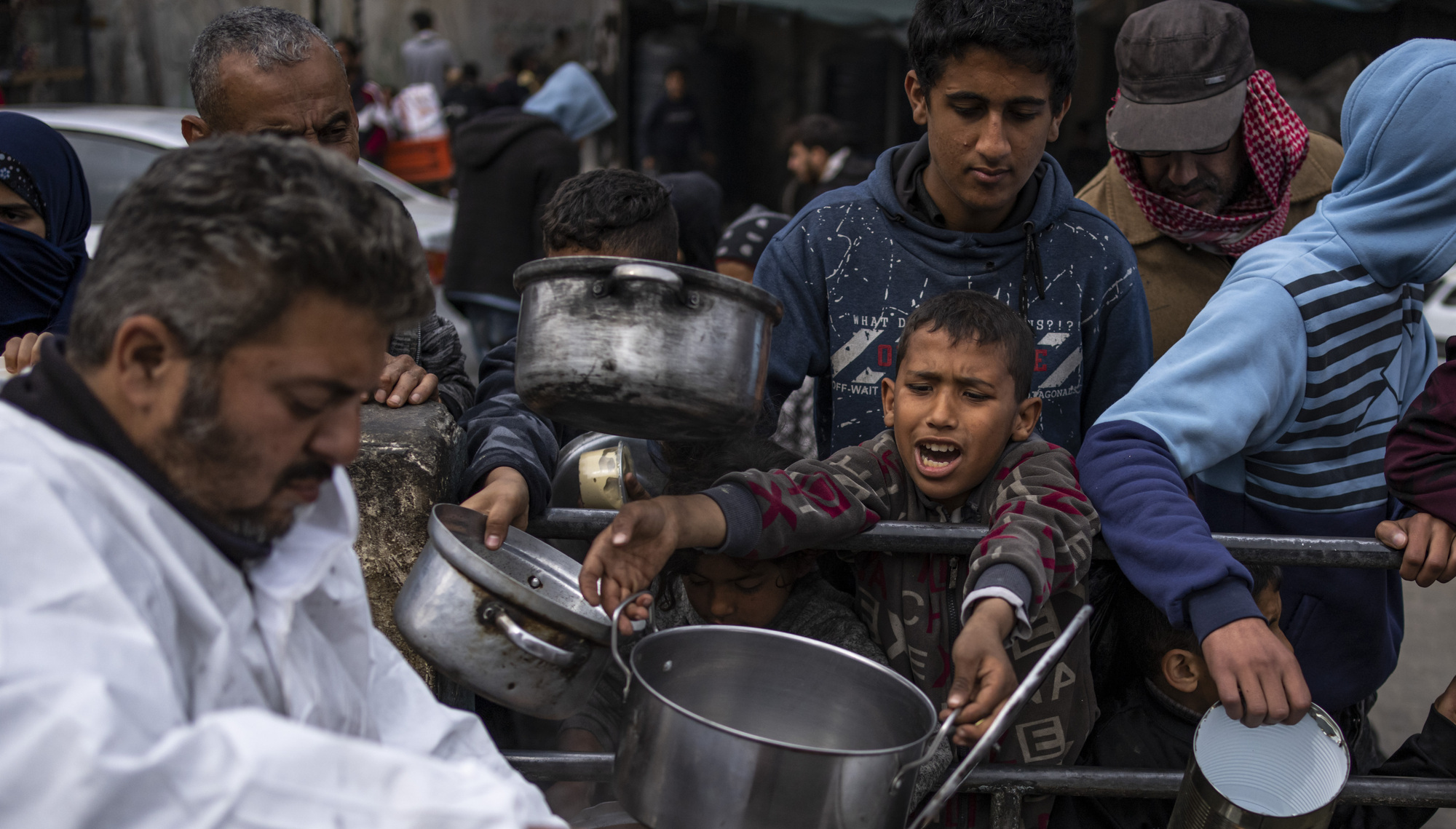
Palestinians line up for free food in Rafah last Friday, February 23, 2024. Picture: Fatima Shbair/AP

It can be difficult to pick out incidents or events in Gaza which mark an escalation or watershed in an increasingly savage conflict. The news this week that more than 30,000
Palestinians have been killed since October 7 may function as a high-water mark of sorts for some, but it cannot hold a candle to accounts of a massacre yesterday at al-Rashid St.

Hundreds of people had gathered in the area in expectation of aid trucks carrying flour when Israeli troops opened fire on them. Al Jazeera reported 112 people had been killed (at the time of going to press) and several hundred injured, adding that after opening fire Israeli tanks advanced and ran over many of the dead and injured.

Elsewhere in Gaza, the same news outlet reported that at least six children have died of malnutrition and dehydration in hospitals in the area.

There are discussions on a possible ceasefire in Gaza ongoing in Qatar, where Egyptian and Qatari mediators are understood to be moving between Israeli and Hamas delegates in an effort to hammer out some kind of agreement. It is believed that reaching common ground on the number of hostages to be released by each side is just one of the challenges in those negotiations.

Ensuring that children starve to death and that dozens of people waiting desperately for a food delivery are shot dead seem strange ways for one side to indicate a willingness to compromise. If anything they suggest an essential inhumanity, a refusal to recognise the basic entitlement of Palestinians to exist. The disbelief expressed by Belgium’s deputy prime minister, Petra Sutter, in relation to the Rashid St killings will chime with many: “Murdering people queueing for essential humanitarian aid? This is a flagrant violation of
international humanitarian law.”

An immediate ceasefire is now the highest priority. One can only wish those Egyptian and Qatari mediators well as they work to secure one.

Exit deal makes RTÉ look cheap

If timing is everything, then the case of Dean Sullivan, deputy director general of the HSE could not have arrived at a more opportune moment.

We learned this week that Mr Sullivan is to receive a redundancy package worth almost €400,000. He first began working with the HSE in 2017 but has now left “by agreement and redundancy”, according to that organisation.

HSE chief executive Bernard Gloster said the agreement was based on “a mediation process that provides for confidentiality”, the deal was “approved at all appropriate levels including the Departments of Health and Public Expenditure and Reform” and “is appropriate and compliant in every respect”.

There are no suggestions to the contrary, but the details of this deal — “appropriate and compliant in every respect” — are worth examining.

Mr Sullivan worked for the HSE for approximately six years, and it is estimated that his salary would have been about €200,000 per annum. This means that his redundancy package is worth almost two years’ salary — a substantial pay-out for his six years as deputy director general. Suffice to say that its generosity puts RTÉ in the shade, a considerable achievement in the current climate.

If the performance of the HSE had improved substantially in that period, people might not be inclined to query the terms of this redundancy package.

Readers can judge whether it has for themselves the next time they have to deal with it.

Grim road death statistics

Yesterday was National Slow Down Day, an initiative which is aimed at reminding drivers of the dangers of speeding.

Almost inevitably, a motorist was detected driving at 146kph in a 120kph zone in Co Meath just a few hours into National Slow Down Day.

A change in driving behaviour is badly needed. Three dozen people have lost their lives here so far this year. The most recent case was that of Dylan Coady Coleman, aged 10. Dylan was seriously injured when he was struck by a van in Purcell Park in Shannon, Co Clare, on Sunday and died in hospital in Dublin on Wednesday.

Since that terrible news broke, more heartbreaking details have emerged. Dylan’s younger brother Shane was born just days before he died.

A few weeks ago, Dylan’s school had hosted a talk about organ donation and he had told his parents “if anything ever happens to him, he would like to donate something or anything”, his mother Laura revealed in a social media post: As a consequence, she said, Dylan would be “saving five lives” by his organs being donated.

The grief being experienced by Dylan’s family is difficult for most of us to comprehend. In time to come they may be able to draw some crumb of comfort from his generosity: Other families who have had to live with relatives struggling with serious illness now have hope because of Dylan.

There is huge poignancy, however, in the fact that that hope has its origins in an event causing another family such unimaginable heartbreak.

In glimpsing those details of Dylan’s life in recent days many readers will feel immense sympathy for his family, naturally enough.

What we may be forgetting is that similar details apply in almost three dozen identical cases which have arisen so far this year, the 35 other road deaths since January 1.

Surely the vast grief hidden behind that bald statistic should give us all pause.And make us all slow down.

x

More in this section

Revoiced

Newsletter

Sign up to the best reads of the week from irishexaminer.com selected just for you.

Cookie Policy Privacy Policy Brand Safety FAQ Help Contact Us Terms and Conditions

© Examiner Echo Group Limited