Fergus Finlay: It’s high time hatemongers were prosecuted for inciting others
Did you ever see a baby more beautiful than Victoria Setuke, or a mother prouder and happier than Victoria’s mother Patience?
They featured on the 9 o’clock news the other night on RTÉ, and in most of the papers the following day, because Victoria was the first baby born in the new year (and the new decade) in Ireland.
Victoria was followed a few minutes later and 165 miles away in Cork when Diana Rodrigues gave birth to Aida Cheryl, and a few hours after that baby Suzanna Ptoczak also arrived in Cork.
Three little girls, all doing well, all welcomed to the world by their families and the staff who delivered them. Three more Irish citizens for us to nurture and respect and be proud of. I certainly hope so. But I can’t be sure.
There was a time when, if you were born in an Irish hospital you were an Irish citizen. It was my birth right, and the birth right of my wife and all our children. And yours too in most cases. But none of my grandchildren had that, because we took it away in 2005.
As a result, none of my grandchildren could say they were Irish simply because they were born here. They were guaranteed their citizenship because (a) they were born here and (b) their parents could also prove they were Irish. Being born in Ireland became just one of the criteria.
I don’t know if Victoria Setuke’s mum is an Irish citizen. From the television it was clear that she is of African origin. Aida’s parents are from India, and Suzanna’s parents are Polish.
If any of them want to apply for citizenship for their child — I hope they do — they will have to establish one or other of a complicated set of links to our little country. If, for example, mum or dad has been legally resident here for three of the four years immediately prior to the birth of their child, that might be enough. If either parent has formally been granted refugee status, that might do the trick too.
But on the Late Late Show on Friday night, Ryan Tubridy welcomed three more newborn citizens — and gave them each a gift of Prize Bonds (every newborn baby should be given a savings certificate by the State, in my humble opinion). One of the babies — a stunningly beautiful little girl — will go back from the hospital in which she was born to the Mosney accommodation centre, because her mum is still seeking asylum in Ireland.
It may be the case (I can’t say because I don’t know all the circumstances), that beautiful little girl’s path to Irish citizenship will be a lot more complicated. It may even happen that she will be deprived of something that every previous generation was born with. I hope that’s not so, but it’s certainly possible. Because we were all conned into thinking that we’d be overrun by “citizenship tourists” if we didn’t pass a referendum on the subject.
And even if it all works out for all of them, there are still people in Ireland who’d like to strip their citizenship away because of the colour of their skin or their original ethnic origin.
No sooner had the pictures of newborn babies appeared than social media began its usual outpouring of hate and bile. The babies were branded as part of the “great replacement”, some kind of foreign plot to destroy Irish culture and heritage.
The people behind these nonsensical theories, at least one of whom has been roundly rejected by the electorate several times, seem to believe that we are under some sort of existential threat from babies. Foreign babies, of course.
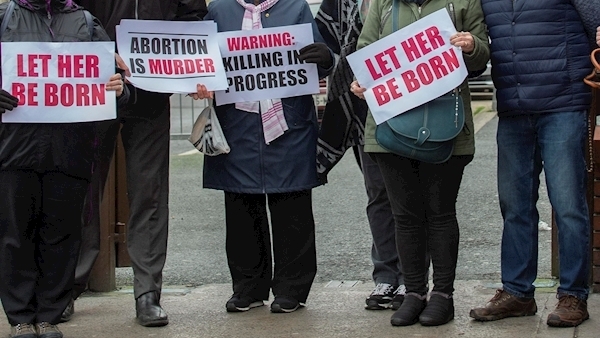
These are in many instances the same people who are running intimidatory and threatening “vigils” outside maternity hospitals that, alongside their primary function of bringing new babies into the world, also offer safe abortion services to women who need them.
And of course, if anyone objects to their levels of hatred and intolerance, they start another protest, this time in favour of free speech.
In some ways, this is the most dangerous trend of all. I don’t care about the vulgar abuse, but I really do believe that these hatemongers should be prosecuted when they incite others to hatred and violence against people whose only crime is their skin colour or religion.
I find it hard to understand why the State hasn’t acted already against these cruel ideologues who think they can say whatever they like under the banner of free speech.
They may be small in number now, and on the surface they may just seem bonkers, but we’ve been here before. Political movements have been built on hatred of the other, and we know the damage they have caused.
Even conservative, although usually sensible, polemicists like David Quinn seem to have fallen for this claptrap about free speech. He seems to spend roughly half his life writing widely-read newspaper columns and appearing on the radio, and the other half complaining about being silenced and marginalised.
Of course, he’s going to accuse me of exaggerating wildly by saying that about him. But a couple of days ago he tweeted that “the government has designs on both freedom of expression and the right to protest. In other words, it has strong and undeniable authoritarian tendencies”. Talk about wild exaggeration.
We passed a law many years ago making it illegal to demonstrate, or even to hand out leaflets, directly outside polling stations. We did so because it was seen as an interference in the democratic process, and there was some muttering about free speech then. Oddly enough, the heavens didn’t fall in.
And free speech and the right to protest wouldn’t be damaged in the slightest if we were to pass a law insisting that protests within, say, 200m of a maternity hospital (assuming they weren’t part of a properly recognised industrial dispute) would also be illegal.
The deeper issue is the intolerance and the hatred (and by the way, David Quinn doesn’t do either of those).
We have to find a way to say to the whole world that hatred and intolerance is not welcome in Ireland. We have too much history of stigmatising and marginalising anyone who belongs to the other, and it goes on still.
Maybe that’s why the newspapers reported on New Year’s Day that a lot of the parents of new-born babies didn’t want to have their names, or their babies’ names, published. In some cases a desire for privacy, perhaps, but maybe in others a fear of the hatred.
The overwhelming majority of us in Ireland rejoice at the arrival of Victoria and Aida Cheryl and Suzanna, and all the other babies from all over Ireland and beyond.
We want to see them grow up loved and nurtured and educated to be strong and independent.
We want to see the next generation of Irish citizens, whatever their skin colour or religion or place of origin, as proud or being Irish as we are, as determined to contribute as we were.
It’s the ones who hate and want to inspire hate that we don’t want here, ever again.