Judge’s interpretation a little taxing
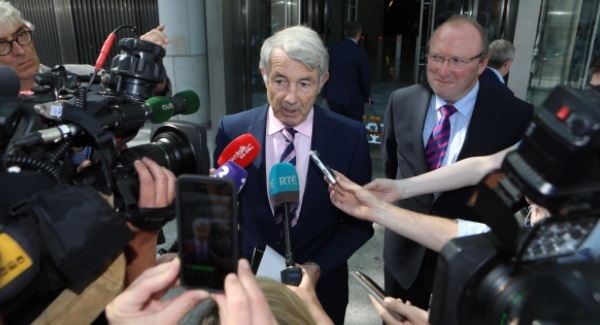
Who would have thought in December 1996, on the night he emerged from another building claiming vindication and victimhood, that he would still be a public figure today, wearing his hangdog expression, blaming everybody else for his plight?
On that December night, he had resigned from cabinet after it had been revealed in the media that renovation work worth more than €400,000 on his home had been paid for by Ben Dunne.
A thread was pulled and before long a whole heap of stuff came tumbling out that showed Lowry to be up to his neck in tax evasion and off-shore accounts.
As Lowry departed, his ministerial colleague Enda Kenny bemoaned the loss of a good man:
He is a man of the highest integrity and honour.
Some things don’t change. More than 20 years later, before Lowry departed Dublin Circuit Criminal Court on Tuesday, the presiding judge, Martin Nolan, also had nice things to say about poor, put-upon Mr Lowry.
Judge Nolan was summing up before handing down sentence for two tax offences of which Lowry had been convicted. These arose from a payment of €250,000 he made in 2002 to an Isle of Man-based company owned by businessman, Kevin Phelan.
Lowry had pleaded not guilty to four charges of filing incorrect tax returns, on dates between August 2002 and August 2007, in relation to £248,624 received by his company, Garuda, and one charge in relation to failing to keep a proper set of accounts on dates between August 28, 2002, and August 3, 2007.

He pleaded not guilty on behalf of Garuda Ltd to three similar charges in relation to the company’s tax affairs and one charge of failing to keep a proper set of accounts on the same dates.
Ultimately they were convicted of two charges each of delivering an incorrect corporation tax return and failing to keep a proper set of accounts. The jury was unable to reach a decision on four remaining charges before it.
During the case, Judge Nolan told the jury that a charge of delivering an incorrect tax return for 2002 had been withdrawn.
Lowry, the judge noted, was a “conscientious taxpayer”.
This jaw-dropping statement was delivered on the basis that the court had heard evidence that Lowry had in 2007 “put his hand in his pocket” to settle a €1.4m tax bill which had been owed by his company Garuda and dated back to 1997.
By any standards, this was a selective interpretation of the TD’s attitude to taxation.
In 1997, the tribunal chaired by Judge Brian McCracken found that while serving in cabinet Lowry was engaged in tax evasion by squirrelling money received from Dunnes Stores into off-shore accounts.
By evading tax in this way, Mr Michael Lowry made himself vulnerable to all kinds of pressures from Dunnes Stores, had they chosen to apply these pressures, McCracken reported.
“The threat to disclose the payments and the off-shore accounts could have been used by Dunnes Stores to obtain favours.” So it goes with the conscientious Mr Lowry.
Then the judge referenced Lowry’s electoral record over the last 29 years.
“Everybody is aware he has been involved in certain controversy,” Judge Nolan opined in a delightful understatement. But, Judge Nolan went on, he is a very good public representative.
“The proof of the pudding is in the eating,” the judge noted. “He has been re-elected.” That’s one assessment of Lowry’s career in politics.
Another comes from Judge McCracken:
Loss of revenue to the black economy is a serious matter for the State, and it is an appalling situation that a Government minister and chairman of a parliamentary party can be seen to have been consistently benefiting from the black economy from shortly after he was first elected to Dáil Éireann.
A more recent assessment came from another tribunal chairman, Judge Michael Moriarty, in 2011.
He investigated Lowry’s role as minister for communications in the awarding of the lucrative mobile phone licence to a Denis O’Brien company in 1995.
Moriarty found that it is “beyond doubt” that Lowry gave “substantive information to Denis O’Brien of significant value and assistance to him in securing the licence”.
The former minister’s influence on the process was “insidious and pervasive,” the judge found. That’s not exactly the kind of stuff one would hope that a good public representative would get up to.

Judge Moriarty would also have been interested in the payment at the heart of Lowry’s criminal trial.
Another payment which took the same route to the same Kevin Phelan in 2002, to the value of £65,000, was characterised by Moriarty as being paid “to ensure Mr Phelan’s participation in a choreographed exchange of untruthful correspondence, for submission to the tribunal, for the sole purpose of misleading and concealing from the tribunal” various correspondence in which the inquiry was interested.
In a High Court action in 2016, Judge John Hedigan characterised those and associated matters as “a litany of falsification and deception by Mr Lowry, including the alteration and falsification of a solicitor’s files in order to conceal certain of his dealings from the tribunal.
They include findings of perjury and bribery of a potential witness to support Mr Lowry’s false evidence. All of this was with the intention of misleading and frustrating the tribunal. As a result of this conduct by Mr Lowry, the tribunal was frustrated and misled and its work was protracted significantly.
Tribunals are a drain on the public purse. Yet, apart from the deceptions outlined by Judge Hedigan, the conscientious taxpayer Mr Lowry never told the Moriarty Tribunal about the quarter of a million he paid Mr Phelan’s offshore company.
In fact, nothing would have ever been known about it had Mr Phelan not taped a conversation between the two men and handed it to the Sunday Independent in 2013.

The decision by Judge Nolan not to impose a custodial sentence was probably the correct one. The two offences for which he was convicted hardly merited jail time. The jury couldn’t decide on other charges, and the most serious one was dropped during the trial.
But it remains a mystery why Judge Nolan felt compelled to describe in glowing terms a man who had been found in other statutory forums to have so blatantly betrayed public trust.
In doing so, he provided fodder for Mr Lowry to retreat once more into victimhood as he claimed vindication.
Earlier this month he jailed a Dublin-based doctor for 16 months for evading around €100,000 in tax.
Dr Bassam Naser, of Howth Road, Sutton pleaded guilty to the charges of evading tax in 2006 and 2007 through the use of a hidden bank account.
Judge Nolan told him he was “morally reprehensible.“He is a very intelligent man. He knew what he was doing was wrong. He created a mechanism to avoid paying his taxes,” Judge Nolan said.
The people of Tipperary are entitled to elect whomever they want to represent them. Others have different responsibilities.
There is no excuse for the Government to rely on, or provide access to, or cut an implicit deal with, a public representative who had been found by tribunals to be dishonest and corrupt.
Equally, it is disturbing when a member of the judiciary throws out platitudes for a convicted individual who has brought into disrepute another arm of government.