State wants increase in cyclists but fails to act on making roads safer
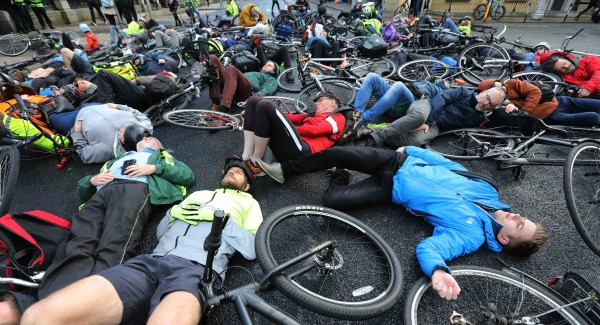

IX cyclists have been killed on our roads so far this year, five of them in collisions with motor vehicles. There may be no more deaths. Please God there won’t be.
But if the current, terrible trend were to continue — six deaths in four months; 18 in the full 12 months — this year would the worst for cycling deaths in recent decades. It would exceed by seven the number of 11 deaths per year which is the 20-year average calculated by Cycling.ie.
I wrote about cycling deaths late last year, as the total of 15 deaths of cyclists in collision with motorists became clear.
I’m writing about cycling deaths again now but this time it’s different because I knew one of this year’s fatal casualties.
In the midst of my horror and disbelief and my prayers for the family in question, I have become terrified of cycling.
I have cycled nearly all my life, apart from a brief period when I was a self-absorbed teenager. In truth, it was getting up on a bike and cycling to college to save my bus fare which helped me out of my self-absorption towards the mental and physical health I now enjoy.
So what’s with that sling you’re wearing, I hear you ask?
All right, I fell off my bike a few weeks ago and I broke my shoulder. It was my own stupid fault for hanging my bag over my handle-bars and was my first accident since the time, 40 years ago, when I fell off my kid’s bike and smashed out my teeth. But if you count up the massive health benefits I must have accrued from cycling — research on identical twins showed those who cycled only 45-minutes three times a week to be biologically nine years younger than their non-cycling twins — you’d have to say cycling was the best thing ever for me. Never mind the thousands of bus fares and parking tickets I haven’t had to pay.
But statistics don’t really help when you’re sending your beloved children out on bikes every day. Lately there’s been a screaming match at the door as I insist on helmets. I’ve been known to turn up at my eldest’s workplace with sets of lights.
I’m sending them the message that cycling is a terribly dangerous activity and they’ve got to dress it as if it were an extreme sport.
I know that I’ve shouted “mind the junction at Eglinton Road” so many times that they don’t hear me anymore. And yet how are they to navigate that junction, or any number of junctions on their way from school, in safety?
There’s the junction at which the cycling track proceeds straight across a minor road, making it the simplest thing in the world for a motorist turning left to hit my child.
There’s the spaghetti junction when the road forks and the cyclist veering right has to cycle in the middle of the road.
“Get off and walk across,” I shout. I doubt they hear me.
I shouldn’t have to shout. There should be no junctions which are dangerous for cyclists in the environs of schools and colleges.
The pedestrian and the cyclist should be the prioritised road user in cities and towns. That was stated Government policy in The National Cycling Framework (2009). Not one of its many recommendations concerning cycling safety has been acted on.
The framework’s cheery tone in its vision for 2020 sounds like it could have been written by George Orwell: “The bicycle will be the transport mode of choice for all ages. We will be a healthier, happier population, with consequent benefits for the health service. We will gain economically as cycling helps in easing congestion and providing us with a fitter and more alert workforce.”
To achieve this cycling Nirvana, the Government of the time was committing to dozens of actions which between them would undoubtedly have saved lives which have been tragically lost.
A senior cycling officer was to be retained by every local authority.
Roads around schools and colleges were to be a “strong focus” of planning for cycling. The number of heavy goods vehicles (HGVs) going through city and town centres, especially near schools and colleges, was to be reduced and there was even talk of banning them from such areas at school and college commuting times.
All roads engineers working for the State were to attend an approved course on making infrastructure bike-friendly. Large, complex junctions, roundabouts, left-only slip lanes and other so-called free-flow arrangements were to be redesigned to safeguard cyclists, except on motorways.
The layout of housing estates was to be revisited in a national retrofitting programme aimed at creating “attractive back routes” and through routes for cyclists.
Kids were to benefit from a cycling safety curriculum from primary school through to secondary school when in fact last year a grand total of only 12,000 kids availed of Cycle Right training, thanks to funding constraints.
Bus drivers were to receive special training on avoiding cyclists; in fairness to Dublin Bus, they produced their own training video.
The training of drivers of HGVs was to be reviewed to include training in cyclist safety, “given the disproportionately high number of heavy goods vehicles involved in cyclist and pedestrian accidents.” The failure to insist on such training is a particularly serious regulatory failure. The number of HGVs on our roads is climbing steadily again, thanks to welcome return of strong economic activity. But trucks pose huge dangers to pedestrians and cyclists because of their size and their blind spots.
In the UK HGV operators are not awarded major contracts unless they have completed training in bike awareness. Barney Stutter, who provides this training for the Fleet Operator Recognition Scheme, insisted when I interviewed him for an article in this newspaper last year that “Technology is not the answer. Drivers still only have one pair of eyes.” Our Road Hauliers’ Association neither provides nor insists on no such training and our Government is just not interested.
WHEN I was asked onto RTÉ’s Primetime on foot of last year’s article, it was to engage in a ding-dong between motorists and cyclists, as if poor cycling had anything to do with cyclists’ deaths.
Our treatment of cyclists in this country is nothing short of criminal. The numbers of cyclists has exploded as the Government wished — there are nearly twice as many people cycling to work now as in 2011 — but virtually nothing has been done to make them safer on the roads. Officialdom does not regard them as legitimate users of the road — not until they “grow up” and buy themselves a set of four wheels. Transport Minister Shane Ross is looking at spending 2% of our public transport allowance on cycling in the next four years, not 20% as the UN suggests.
Do this year’s six lost lives not matter? If they do, who will take up the fight to make cycling safe?
CONNECT WITH US TODAY



Be the first to know the latest news and updates