Sinn Féin’s McDonald has been a good soldier, in civilian clothes
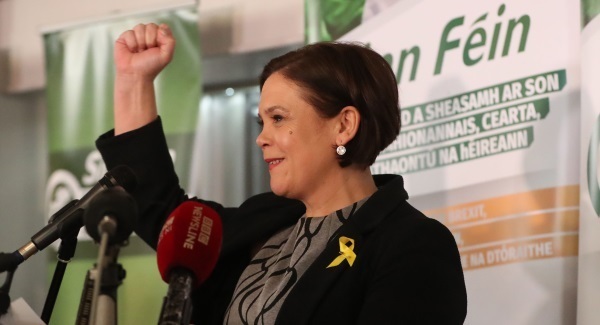
By teatime on Saturday, Mary Lou McDonald will be president of Sinn Féin. It will have been 35 years since Gerry Adams took over from Ruairí Ó Brádaigh.

Sinn Féin’s McDonald has been a good soldier, in civilian clothes

If the contrast between Ó Brádaigh and Adams was a gulf, the greater difference between the former and McDonald was unimaginable in 1983 and for a long time afterwards.

If it is a measure of progress for most, we should not forget that it is a horrifying spectacle for irredentist republicans. Progress you see, depends on perspective.

In this newspaper yesterday, Irish Examiner political reporter Elaine Loughlin gave a chapter-and-verse account of how at least 15 elected representatives have been expelled, suspended, or resigned from Sinn Féin in recent years.

Having gone from having 54 city and council seats before the 2014 local elections to 157, that is a significant toll. I should say that I think they are making fools of themselves on this.

To purposely use an exaggerated metaphor, they expect civilians to behave like soldiers. Perhaps they have some civilians who imagined they could behave like soldiers too.

Regardless, they have new recruits in elected office and, unquestionably, the grind of the reality must be a shock to some of the aspirants. That’s not to mention the ingratitude of the public, and the envy of colleagues. But that’s politics.

The peculiar factor, particular to Sinn Féin, is the highly internalised but increasingly ineffective enforced disciple. It’s Ó Brádaigh in its era. It hardly works now, except as a lighthouse for attracting trouble.

It is not just that it is 35 years later. It is that the context of that culture has changed internally and the surrounding culture outside has changed completely.

It is inured in Sinn Féin and it is one of the things that McDonald will have to change if her party is to move on.

I remember talking last year with a committed and earnest Sinn Féin officer. Allowing that he was giving me the prescribed lines regardless, this was someone who adhered the cause before it was profitable.

He explained that Sinn Féin is different. No, they didn’t leak from meetings. They sorted things out inside. Personal egotism was subject to the cause.

I didn’t know whether to laugh or cry. Leaking, like all drainage, is a form of irrigation and ultimately of control. If Sinn Féin wasn’t so tight, it would not be so uptight and some in it so stressed.

I spent a long time in politics in a previous life and, call it what you will now, it was a contact sport. One thing nobody ever thought of doing was resigning. Except if there was a reasonable chance to win a seat as an Independent.

The trick, and I learnt it from a master, was to cultivate a Dalai Lama-like capacity to absorb insolence and an elephantine memory to recall it. Social media, I suppose, is a difference now.

But if that is the talk this week, the substance of what Mary Lou is embarking on next Saturday is much more substantial. There are ongoing talks in Northern Ireland, the success or failure of which will determine the context here, in the lead-in to an election.

There are reasons for believing that now, both Arlene Foster and McDonald have an impetus to restart the devolved administration. Foster lacks a base of authority as DUP leader and authority is exercised by her colleagues at Westminster, who now have access to Whitehall.

She will want to be a leader in fact, as distinct from just a factotum at the microphone. A similar impetus applies to Michelle O’Neill. She has effectively exercised a nominal role only, and on Saturday will succeed McDonald as vice-president of Sinn Féin.

For McDonald, the stakes could not be greater. If she agrees but gets too little in return, she risks alienating the enhanced base won by her party in Northern Ireland.

Remember, she is ascending to leadership not as much because she is different from what went before, but because regardless of what went on, she toed the line. She may have been in civilian clothes, but she was a good soldier. That counts among an older and influential generation in Sinn Féin.

Now if continued stasis at Stormont leads to quagmire, there will be little upside for her. Government in Northern Ireland is a platform for government in the Republic. It is momentum.

The peace process was both the project and the platform that drove the party for a generation. It may still be a work in progress, but it is not the dynamic that will lead to further significant gains in support.

She has to bring something new to the table here. Liberalising on abortion, as Labour found out with marriage, is not a key to subsequent support in a general election.

People make different choices in an election, regardless of affinity in a referendum. Besides, the best pickings for Sinn Féin on abortion may ultimately be the blame game, if a referendum goes down.

A range of interrelated political issues may be more fertile ground. These include rural broadband, rolling major trauma centres into two or three only, the National Planning Framework, and the imminent capital plan.

Ireland hasn’t been governed in a recovery for over a decade, and I wish those charged with the duty the best of luck.

But I promise it will make managing the economic crash look like colouring with numbers, which was precisely what it was. The caveat being that we didn’t even have to calculate own numbers then.

McDonald has toredefine Sinn Féin. She has to loosen strictures in an organisation whose focus internally overshadows its affinity with the surrounding culture outside.

She has to win votes, win seats, go into government on terms that work for the party electorally when that government is over.

It may well be fantasy, but if Fine Gael has widened its five-seat advantage over Fianna Fáil after the election, coalition with Sinn Féin could be its most attractive option.

Fianna Fáil will not renew the current deal. Sinn Féin will not replicate it. There are only three parties to make a coalition of two.

What McDonald shares with Leo Varadkar is that neither is native-born politically to their party. Both parties have a culture of precision in negotiation, which Fianna Fáil, as masters of miasma, distains.

The cultural differences between Fianna Fáil and McDonald and Varadkar is greater than that which separates Sinn Féin and Fine Gael. History and culture are different things.

I recall the wet December day in 1994 when the grandeur that was Fine Gael under John Bruton embraced the recently belated Sinn Féin — The Workers Party into government, as Democratic Left.

Let’s see where it ends up. It will start next Saturday.

More in this section

Revoiced

Newsletter

Sign up to the best reads of the week from irishexaminer.com selected just for you.

Cookie Policy Privacy Policy Brand Safety FAQ Help Contact Us Terms and Conditions

© Examiner Echo Group Limited