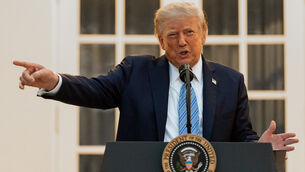
Donald Trump’s tax cut is the real star at Davos
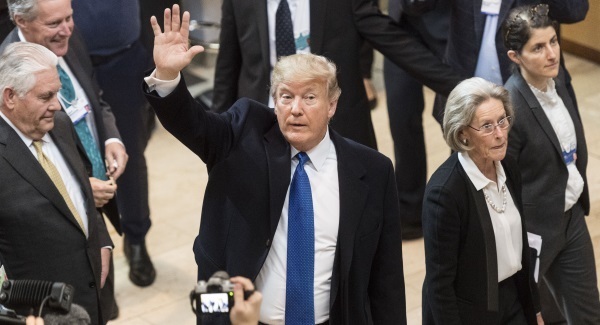

The annual Global Economic Forum in Davos — which is basically a January gathering of global economic, political and academic leaders to discuss the economic, social and political issues of the day — has been very challenging in recent years.
In the midst of a once-in-a-lifetime global economic and financial shock, with a smattering of severe political dislocation thrown in for good measure, the mood has been sombre and the problems difficult.
In contrast, the mood around this year’s event seems to be much different, and so it should be. The global economy is in a relatively sweet spot with strong growth almost everywhere; inflation remains relatively well behaved; and the potential political disasters in 2017 were by and large avoided, notwithstanding a definite weakening of Angela Merkel’s political power.
At the beginning of the week the International Monetary Fund (IMF) published its latest World Economic Outlook and it made for relatively pleasant reading and set a decent backdrop for the imminent Davos conference.
The main theme from the IMF’s latest musings is that global economic activity continues to firm up, and the growth is broad-based, with notable upside surprises in Asia and Europe. The forecast for global growth in 2018 has been revised up from 3.7% to 3.9%.
Growth projections for the eurozone have been revised up from 1.9% to 2.2%, but the growth projection for the UK has been left unchanged at 1.5%.
All in all, it reflects a solid economic backdrop and if anything, the forecast for this year could turn out to be a tad on the cautious side such is the global economic momentum at the moment.
On Wednesday morning, the latest labour market report from the UK showed the unemployment rate there in November stood at just 4.3% and the employment rate re-attained a record high of 75.3%.
Notwithstanding an easing of growth, the UK economy is still holding up pretty well and recession does not look like a side-effect of the incredible uncertainty associated with Brexit.
One aspect of the labour market report that does give cause for concern is the fact that inflation, at 3%, is well ahead of wage growth of 2.4%, and this is undermining consumer purchasing power.
The weakness of sterling over the past couple of years is driving this increase in prices by making imports more expensive. However, sterling has performed well to date this year and is gradually edging higher against the euro.
If this were to persist, then imported inflation would gradually ease and the economy would benefit.
Sterling is benefiting from the lack of any real developments on the Brexit front and the growing sense of a mood swing in the UK towards a much softer form of Brexit.
The challenge will come for sterling over the coming weeks as the second stage of Brexit negotiations get underway.
The outlook for the currency would appear to be dependent on the progress of those negotiations.
In so far as anything is ever straightforward in foreign exchange markets, it appears to me that sterling would strengthen on the back of progress towards a softer form of Brexit and would weaken if the Brexit negotiations were to move in the opposite direction.
Given the complicated politics involved, it is still very hard to call how Brexit will evolve, but the omens are somewhat better today than even six months ago.
Strong sterling would obviously be good news for Ireland on a range of different fronts.
One notable feature of the IMF’s latest forecast is the fact that it attributes half of the cumulative upward revision to global growth over 2018-2019 to the tax package that Donald Trump has recently delivered.
At the same time — and as a direct consequence — global equity markets, particularly US markets, continue to surge ahead despite all of our misgivings about the length of the current equity cycle and the challenging valuations that have been attained in the US in particular.
In Davos, the attendees are trying to decide what to worry about, but the overriding sentiment, earlier this week, revolved around the arrival of Donald Trump.
Given what is happening in his country’s economy and financial markets, he will undoubtedly have a greater swagger than usual.
CONNECT WITH US TODAY



Be the first to know the latest news and updates