Understanding our revolution - Our past asks challenging questions
FIVE years ago, Cork University Press published The Atlas of the Great Irish Famine. That the book was named the best Irish book published in 2012 gave only a hint of how comprehensive it is and how influential it was to become in our appreciation of that awful time.

Understanding our revolution - Our past asks challenging questions

That book gave witness to the tens of thousands of Irish people buried in mass graves or lost on their journey to a country — Britain, Canada, or America primarily — where they hoped they might find a kinder, less inhuman fate. Some succeeded, many did not.

That atlas may not have rescued the Famine’s victims from the obscurity the passage of time imposes — they are utterly, utterly gone now, however, it revies the tragedy in a way that gives us and perpetuates, a far better, more rounded understanding of our past. A theme, maybe the over-riding and most important one of that book was to try to understand why such a catastrophe should or could, unfold in 19th

century Europe, albeit in a colonised, bled-dry country where the majority of citizens were denied what we regard today as fundamental, inalienable rights.

The Famine and the First World War were just two of the seismic events that turned Irish aspirations around independence into something real, something that gathered an unstoppable momentum that would, sooner or later, be realised one way or another.

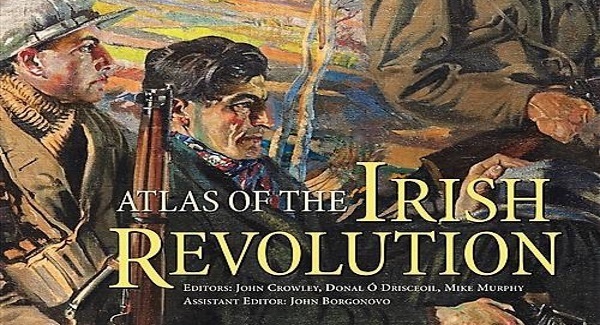
That story is told in a new, compelling and comprehensive way in The Atlas of the Irish Revolution, another Cork University Press publication. Initial reactions suggest that this book may be as influential as its Famine stablemate. It is

certainly as comprehensive. It has already proven so popular that a second print run can be anticipated.

This, of course, is well-harrowed ground. Many early accounts lacked objectivity. Almost all were subjective. Many had, literally and metaphorically, an axe to grind. Many

sustained, from one perspective or the other, a self-serving mythology and a commitment to violence that sadly resonates today. Tragically, the from-the-cradle tribalism that

silences the Stormont parliament today is a legacy, or a

continuation, as some would have it, of that conflict.

Theses publications, and their reception, suggests that we have, at last, reached a point when our past can be viewed, if not in a detached way, then in a way that does not immediately inflame. Hopefully, those who read them do so to understand rather than to confirm one or another set of inherited beliefs. As we approach the centenary of our civil war, as bloody, as hateful, and as lingering as any, this achievement should not be underestimated. As the determined efforts to take ownership of the 1916 centenary celebrations showed, history without context still pays dividends. In a society where fantasy and fact are often inseparable bedfellows those who work at this winnowing are to be cherished. This publication is a considerable contribution to that distilling, one that strengthens and honours our democracy and, despite falling a few hurdles, asks the inevitable question: Have we made good use of our long-sought, hard-won independence?

x

More in this section

Revoiced

Newsletter

Sign up to the best reads of the week from irishexaminer.com selected just for you.

Cookie Policy Privacy Policy Brand Safety FAQ Help Contact Us Terms and Conditions

© Examiner Echo Group Limited