What will the next government look like?
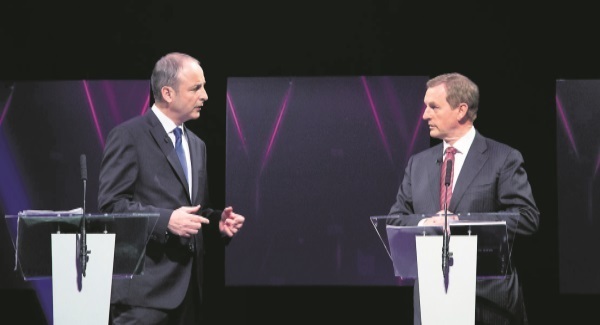

Just what will the next government look like?
You might think that is a ridiculous question to ask just 15 months into the current term of this Dáil.
Yet the never-ending uncertainty which has engulfed this eunuch of a minority government means the threat of a snap election is ever real.
It is clear that uncertainty has also engulfed the various political parties, given how many selection conventions have already taken place.
Added to this is a growing expectation that an election is likely in the first half of next year, ahead of the end of the three-year and three-budget deal struck last year between Fine Gael and Fianna Fáil.
Based on current opinion polls, however, should a snap election be held, the only thing clear is that the two old enemies are likely to advance marginally on their performances in the 2016 general election, at the expense of the myriad Independents currently in the Dáil.
The two parties who, for the first time, got less than 50% of the vote last time around, are now polling in and around the 60% mark between them.
That throws up the question I raised at the start: Just what shape will the next government take?
In recent weeks, there have been calls for the two big parties to finally unite in a ‘grand coalition’.
Interestingly, some of those calls have been coming from within Fine Gael.
Brian Hayes, a Fine Gael MEP, said the two parties have to join up following the next election.
He has suggested a grand coalition of Fine Gael and Fianna Fáil in government for five years in order to hold the centre ground and a majority in the Dáil.
Earlier this summer, speaking at the Magill Summer School, he said: “There are today three big blocks in Irish politics — Fine Gael, Fianna Fáil, and Sinn Féin.
“Whenever the next election comes, the country badly needs a government that can do things in the long-term interest of the country.
“That requires a majority in the Dáil over a five-year period.
“Both Fine Gael and Fianna Fáil under their current leadership will not enter a coalition with Sinn Féin. Without Sinn Féin, the only logical centre-ground government has to be FG/FF in a grand coalition for a five-year term.”
Not everyone in Fine Gael agrees.
In an interview with this newspaper earlier this week, new junior finance minister Michael D’Arcy said the traditionally rival parties should not form a coalition but speculated that the two old enemies could end up rotating power as part of an agreed programme.
D’Arcy said it would take “two willing partners” to make a coalition work, but that this does not exist.
The Wexford TD strongly disagreed with the comments made by his party colleague Hayes.
“The funny thing about that stance is that you have to have two willing partners and I don’t know that you would have will there at present,” he said.
“I don’t support Fine Gael and Fianna Fáil in government — we are different parties, very much so.
“I think we have different mindsets and I don’t think they will change just because the numbers suggest something.”
When pressed, D’Arcy said a grand coalition is not the only potential option, suggesting a rotating power arrangement could work.
“I don’t know if it would be better than another minority,” he said. “I don’t know that it has to be a full coalition: Another arrangement could be reached.
“There can be a confidence and supply [deal] and if the numbers are particularly close, I don’t see anything wrong with a programme in which we would implement the first half of it and then Fianna Fáil implement the second half after a change of government.”
Let’s just consider the implications of what both Hayes and D’Arcy are saying.
If you subscribe to the Hayes doctrine, Fine Gael and Fianna Fáil will return with a similar number of seats, but neither will be anywhere near the threshold for a majority.
So only between them will they have enough to form a government.
With numbers so close, it would be expected that the cabinet and junior ministry jobs will be divided up on a 50:50 basis, with the position of taoiseach being the sticking point.
Think back to when Enda Kenny was trying to form a government last year.
He made the big offer to Fianna Fáil not once, not twice, but three times. And that included the possibility of rotating the taoiseach’s position.
At that stage, Fianna Fáil under Micheál Martin said no, opting instead for the confidence and supply arrangement.
But, while the public is willing to accept that arrangement for now, will they be willing to stomach it again? I am not so sure.
If you were to take the D’Arcy doctrine through to finality, what real difference is there to what Hayes has proposed?
D’Arcy says you have another confidence and supply arrangement but on a rotating basis, with Fine Gael holding office for the first half of the term and Fianna Fáil occupying the seats of government for the second half.
Given they will have agreed a five-year programme, in reality who is actually minister will matter little enough.
The dilemma facing Martin is whether Fianna Fáil should do a deal with ‘the devil that is’ Sinn Féin, which has made it clear it is ready to serve in government, even as a junior coalition partner.
So keen is the party, there is a strong smell of desperation off it at present, so much so that it resembles the singleton in the nightclub towards the end of the night hoping for action.
This is driven by its decision in 2016 to take itself off the pitch of government formation so early into the 72-day interregnum.
Sinn Féin was, as a result, irrelevant and it is clear it doesn’t want to make the same mistake again.
There are plenty within Fianna Fáil who would much easier do a deal with Sinn Féin than with Fine Gael, and Martin needs to manage such sentiment if he is to retain control of his party and achieve his holy grail of becoming taoiseach.
Fianna Fáil, while maybe willing to consider another confidence and supply deal with Fine Gael, will in no way be willing to enter into such a deal with Sinn Féin.
Fianna Fáil knows it would have to drag Sinn Féin off the sidelines and into government to shut it up.
No longer would Sinn Féin be able to harp on from its perch of arch populism, which a confidence and supply deal would allow. In government, Sinn Féin has to grow up, be responsible, and be accountable for when things go wrong.
With Labour now largely irrelevant and the Independents likely to be squeezed, come the next election, it is for the big three parties to decide who will next govern this country.
For Fianna Fáil, it is likely to boil down to Hobson’s Choice of going with Fine Gael or Sinn Féin.

CONNECT WITH US TODAY



Be the first to know the latest news and updates