For climate change rogues we should look closer to home
ISNâT Trump a desperate man altogether for pulling out of the Paris Agreement on climate change! Youâd never hear the like of that out of one of our politicians!
Never. Except most days for the last six years.
OK, I accept the Fine Gael-led governments didnât say they wanted out of international effort on climate change. What they did, instead, was nothing.
When they took office emissions reduction was on a downwards trajectory to 14% below 1990 levels by the following year. The Environmental Protection Agency felt that half of that reduction was due to the recession and the other half was due to our own efforts, particularly the development of renewable energy.
Under EU law we need to have emissions which are 20% below 1990 levels by 2020. But now our emissions are rising steadily, some 3.7% a year since 2014.
The Draft National Climate Mitigation Plan expresses the hope that we might have cut emissions by 6% by 2020. Other climate experts say itâs going to be 4%.
Letâs split the difference and say 5%. So we have done a quarter of what we said weâd do to tackle climate change, the âglobal challenge of our generationâ, to quote our National Climate Mitigation Plan.
Would the word ârogueâ spring to mind? Particularly as our target for emissions reduction for 2030 is meant to be 40% below 1990 levels? We are one of only two European states which will not meet our EU commitment to reduce emissions by 2020.

Having wasted a decade, we will face cutting emissions by up to a third in the 10 years to 2030 unless we crash out of the EU and the Paris Agreement and paddle our own canoe into the sunset.
Which would certainly bring our emissions levels right down because we would have no economic relationships and nowhere to sell our stuff.
While it is true that Ireland is so small an economy that on our own we canât influence the climate much, it is understood by the worldâs developed and civilised nations that we are in this together or itâs game over.
Special pleading will not get us very far. Thatâs why there are EU fines for non-compliance and we may face a bill of up to âŹ5bn for our hopeless performance on cutting emissions.
Our performance on turning to renewable sources of energy is also abysmal. With a wind resource second to none which by 2011 was moving us towards the target of 16% renewables by 2020 we currently produce 9% of our energy from renewables, one of only four EU countries which will not meet its 2020 target.
The supports are just not here. I have met several top-level entrepreneurs with money to invest in renewables who have now left this country, bringing their smarts and their money with them.
The âfeed-inâ tariff which paid customers who had excess self-generated electricity from renewables to feed into the national grid was abolished in 2014 and there is a total lack of incentive for indigenous solar energy companies. The infrastructure for electric cars is so appalling it is the progress of the true pilgrim to own one.
Our performance on transport has been particularly poor with emissions now increasing 6% a year and expected to show an increase by 2020 of up to 16% since 2014.
âThis reflectsâ, argues our National Mitigation Plan, âboth our reduced investment capacity over the period of the economic downturn as well as the fact that the target itself was misinformed.â
How about saying it reflects poor political decision-making? And who was making those transport decisions?
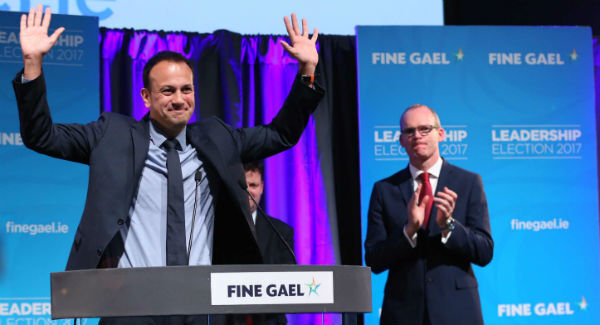
Why, it was next weekâs Taoiseach, Leo Varadkar!
We should have been investing heavily in public transport during the recession, when construction workers badly needed jobs.
We could have built Dublinâs Metro North between 2012 and had it up and running this year, a project which had planning permission and âŹ500m in funding from the European Investment Bank and had been interrogated more than any plan in the history of the State.
Leo Varadkar cancelled it. His government had a huge majority and a rare opportunity to change this countryâs direction towards its agreed target of 80% to 95% emissions reduction by 2050 and it failed utterly.

Transport was perhaps the biggest casualty. Luas cross-city connection Dublinâs Red and Green Lines should be the icing on the cake, not the only bun on the plate.
There is no public transport initiative for Cork, Galway or Limerick. The only public transport project name-checked in Taoiseach-elect Varadkarâs mission statement was Metro North which was finally revived last year by Public Expenditure Minister Paschal Donohoe. Otherwise, it was roads, roads, roads.
Varadkarâs rival for the top job, Simon Coveney, knows how to spell âclimate changeâ and his election as Taoiseach might have inspired more hope in the breasts of environmentalists.
However,the sector of which he was Minister, agriculture, is the second most disappointing sector from the point of view of emissions reduction, with emissions now rising again and expected to have gone up 6% or 7% between 2014 and 2020.
Admittedly, itâs the sector which is toughest to fix. But Coveney invested a vast amount of time and energy highlighting emissions reductions from individual animals, without stressing the fact that this doesnât help if the number of animals increases accordingly.
Nobody has dared spell out to the farming community what our emissions reduction targets will mean for them. How will we go from having 5,000 hectares of forestry to 20,000 by 2030, for instance, when this land has to come from agriculture?

Some experts say we will need a radical âland use planâ which will mean paying farmers for leaving their land idle as a carbon sink and a flood mitigation measure. Irish people are still groping in the dark when it comes to the economic and societal transformation they must make. There is no leadership from government.
And most of the blame for the last two governments appalling record on climate change must lie with its leader, one Enda Kenny, who is currently doing his lap of honour.
He has got away with it. No resume of his career has concerned itself with âthe global challenge of our generation.â The Sunday Business Post did a 30-point evaluation of his tenure as Taoiseach and didnât even mention the environmental challenge.
By the time insults are being traded as to who is responsible for our failure to cut emissions â and who is responsible for those massive fines we have to pay from resources which we need such as health and education â no one will name-check Enda Kenny.
But Leo Varadkar will still be a young man. If he wants a positive legacy he needs to stand up as our new Taoiseach next week and declare that Ireland is not going rogue but is going back on track towards a carbon emissions-free future.
Who was making those transport decisions? Next weekâs Taoiseach Leo Varadkar