Hope and history rhyme for Prince Charles' visit
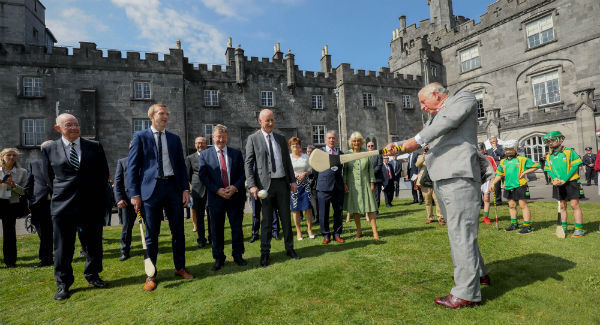
But that was the joyful scene that greeted thousands of onlookers yesterday in the grounds of Kilkenny Castle when he and his wife, Camilla, visited the city, the first by a British royal since 1904.
Lucky for him that he had the coaching talents of Kilkenny hurling manager Brian Cody and All-star Henry Shefflin to hand. Lucky for us and for Anglo-Irish relations that the prince is even more sure-footed as a roving ambassador than he is as a hurler.
The recurring visits by Charles to Ireland is evidence of the quiet resolve and determination exhibited by Britain’s future king to cement the growing bonds of friendship between Ireland and the United Kingdom. It was part of a four-day trip to the North and the Republic, the first since the UK’s referendum vote to leave the European Union last June.
The prince spoke of his desire to keep coming to Ireland, a trip that has taken place every May for the last three years.
“I hope and pray that, during the rest of my life, before I drop dead, I might have the chance to visit as many of the counties as possible in this great country,” he said.
Given his record so far, that is unlikely to be an empty promise by the heir to the throne who — in all likelihood — will become king within the next decade.
Like his mother, Queen Elizabeth II, did in Dublin Castle in 2011, Charles used a phrase in Irish in both his opening and closing remarks at a function hosted by President Michael D Higgins and his wife in Áras an Uachtaráin on Wednesday.
Prince Charles said that it would be too much of a tragedy if all the hard work of reconciliation by the UK and Ireland was weakened in any way, a view echoed by President Higgins.
While in the North, the royal couple toured a visitor centre dedicated to the memory of late Nobel Laureate poet Seamus Heaney, reminding us of his poem ‘The Cure At Troy’:
Charles’s visit is a timely reminder that he may be the British monarch either during Brexit or during its extended fallout, when his nation seeks to redefine a role in the world, the shape of which currently appears uncertain. Indeed, his arrival on Wednesday coincided with the primetime broadcast of Charles III, Mike Bartlett’s award-winning blank verse play, which speculated on what can happen when the old cement of society becomes friable and disappears.
In what might prove a poignant metaphor for our post- Brexit neighbours, Bartlett’s Charles says: