How Trump-era immigration policies are reshaping daily life in Minneapolis and St Paul
The International Institute of Minnesota cost $15m to build. In a way, Donald Trump helped pay for it. But not in a way you would imagine he’ll have liked.
“We did a huge fundraising campaign under the first Trump administration and I was thinking, ‘What terrible timing to be doing this’, given all he was saying,” said Jane Graupman, the executive director of the centre.
“But it was actually great timing, given all the support we had from the community.
"It was a lot of money to raise.
"So, we had a lot of people giving us donations to build this space and here we are now.”
Here, Somalis — who Trump has labelled as human “garbage” — and those from other immigrant backgrounds take courses in English, hospitality, and pre-nursing to progress to college and work in the state’s care homes and hospitals.

When the visited the centre in the twin cities of Minneapolis-St Paul this week, the classrooms were empty and many of the staff weren’t on the premises. Its large hall was full of dozens of Aldi bags with food, toiletries, and other household essentials ready to be delivered directly to people’s homes.
“Half of our staff just can’t come to work because they’re immigrants and they don’t feel safe,” said Graupman. “I just had a conversation with one of our staff who did come to work today and she’s an immigrant from Europe.
"The few of us in the office are mostly white staff as we have less challenge from ICE (Immigration and Customs Enforcement). But it doesn’t mean we’re immune either.”
It is a fear that permeated the mostly empty streets of Minneapolis this week, as children stayed home from school, adults didn’t go to work, and those who did venture outside kept looking over their shoulder.
And it isn’t the cold, although temperatures hit the crippling freezing of –30C early Friday morning, but the ICE. The group is eight weeks into a campaign of terror on the streets of Minneapolis and St Paul.
In early December as winter began to bite, Operation Metro Surge was put into action. In what the Department of Homeland Security described as the “largest operation ever”, over 2,000 ICE agents arrived in Minneapolis tasked with finding and deporting illegal immigrants.
They outnumber the police in the city by five to one and have been a law unto themselves. Multiple videos have gone viral showing men, women, and children being apprehended by ICE: Pulled out of their cars, taken from their beds, and abducted near places of worship and schools.
Just this week, US outlets reported on an ICE memo where immigration officers said they had sweeping powers to enter homes even without a warrant.
Meanwhile, images went viral of a five-year-old boy, Liam Ramos, with a Spiderman schoolbag being detained by ICE. Vice president JD Vance defended it while the Trump administration said they were only keeping the boy safe after his “illegal alien” father ran away.
After Renee Good was shot in the face earlier this month and subsequently labelled a “domestic terrorist” — with not a shred of evidence — no one here is buying what they’re selling anymore.
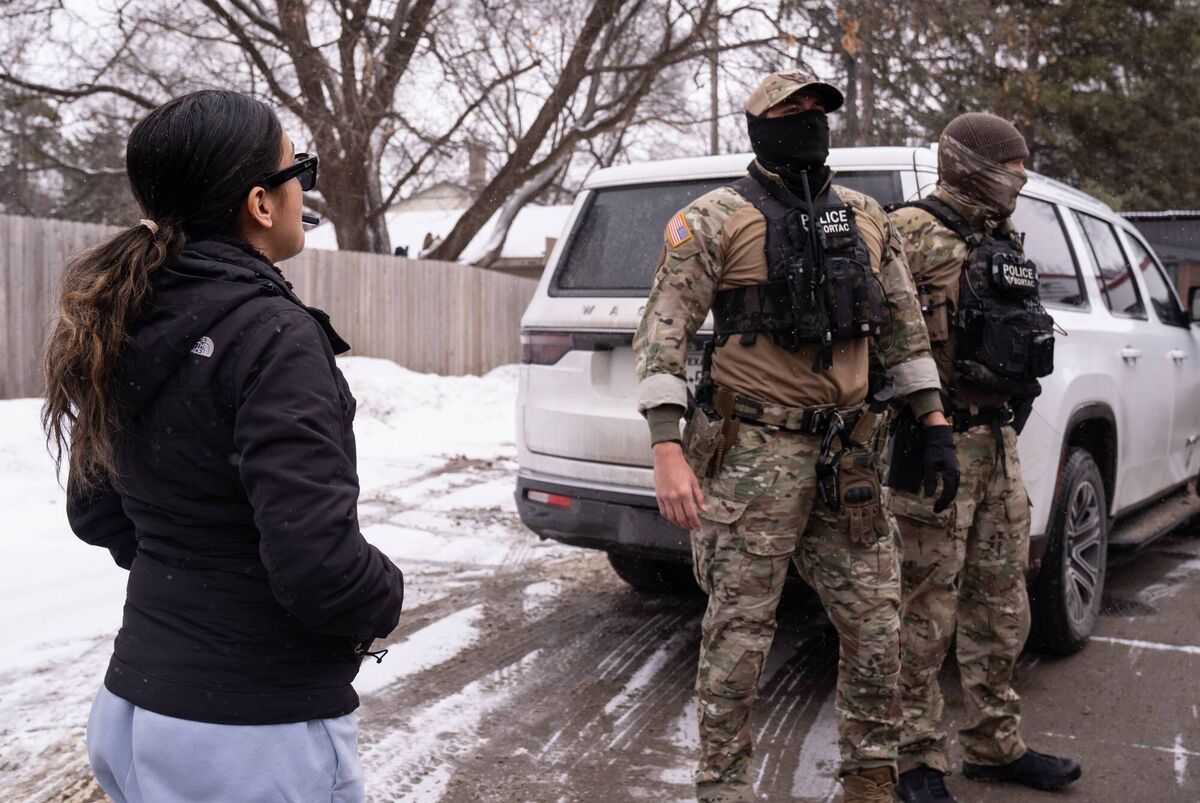
The proportion of immigrants here are lower than other major US cities. Apart from a well-publicised case involving fraud committed by Somalians, the number of crimes committed by immigrants here is nowhere near a level to warrant the indiscriminate actions being seen.
This city, still reeling from the aftermath of the murder of George Floyd in 2020, has become the frontline for a war on civil liberties, due process, racial profiling, and constitutional rights.
Even American citizens, or those with a legal permission to be here, have found themselves being targeted for harassment. They have taken to “carrying their papers” with them wherever they go in case they have a run-in with ICE. Most are staying at home.
“Our food shelf [food bank] would normally be packed with people every day,” said Monique Hernandez, development director of Communities Advancing Prosperity for Immigrants.
“I was there this morning and maybe six people came, and people are just scared to come out of their homes. We’ve had to develop you’d call it a kind of covert network of volunteers who can deliver these groceries and hygiene items to people who are afraid of what will happen to them if they go outside.”
Community activists try to monitor ICE, driving around their neighbourhoods and responding when there are reports of agents in the area. Everyone carries whistles, a rudimentary but effective way of letting people know that ICE may be around.
It’s three short, sharp whistles if you see ICE in the area to warn others. It’s three long whistles if somebody is in trouble.
Uber drivers carry them. One centre is 3D printing them by the hundreds to distribute to locals.
Small acts of resistance had been gathering pace, but the dam effectively burst after the killing of Good, a mother of three, by an ICE agent.
“You need moments to try to smile throughout,” said Hernandez. “You see so many forms of resistance.
“Some people say ‘I don't feel comfortable protesting, but I will deliver groceries, or I will do this’, you know, kind of those moments. You see people patrolling up and down the street. You'll see those people with brightly coloured vests.
“There's a Spanish school not too far up the street, and you'll see as it gets closer to school, people just standing guard and watching. So, it feels like people have each other's backs in a different way than it has in the past.”
At the Celtic Junction Arts Centre, located in the “Midway” between St Paul and Minneapolis, it would have been easy for people to keep their head down and ride out the storm.
It offers a range of classes and acts as a community space for the Irish-American population of the Twin Cities. With a diaspora that’s overwhelmingly white, and not the kinds of people ICE is primarily targeting, the Irish could hope to remain relatively immune from what’s been happening.
But lying low and doing nothing was never an option for Celtic Junction executive director Natalie Nugent O’Shea and her husband and centre co-founder Cormac Ó Sé (incidentally, the young kids and adults learning Irish dancing are in good hands as Ó Sé is one of the original cast members of ).
In the last week alone, they’ve held events in the centre mingling Irish and West African music, as well as a fundraiser for the Minnesota branch of the American civil liberties union.
They’ve also held food drives that will be delivered direct to families. It closed its doors on Friday in solidarity with the planned general strike from the people of Minneapolis and St Paul.
“It’s desperate, absolutely desperate. I am devastated at what is happening,” said Nugent O’Shea.
There have been mass protests in recent weeks, but the general strike on Friday was on everyone’s lips all week in the twin cities as being the “big one”.
There had been fears among organisers that the cold — authorities have issued an “extreme cold warning” — may keep people away but huge numbers were still expected to stay home from work, school, and shopping as part of the general strike.
“It is time to suspend the normal order of business to demand immediate cessation of ICE actions in MN, accountability for federal agents who have caused loss of life and abuse to Minnesota residents, and call for congress to immediately intervene,” said organisers.
The move was also backed by elected Democrat officials in the state, as well as union and faith leaders.
“There’s an expression about us — ‘Minnesota nice not Minnesota ice’,” said Graupman. “I feel like the protests have been peaceful but people are asking why these terrible things are happening. How can you expect people to be restrained?
“Literally every day I wake up and I’m like, ‘Is this really happening?’. I think all of us are feeling this way.”
CONNECT WITH US TODAY



Be the first to know the latest news and updates