An ill wind: How Storm Éowyn uncovered ancient Irish burial sites after 1,300 years
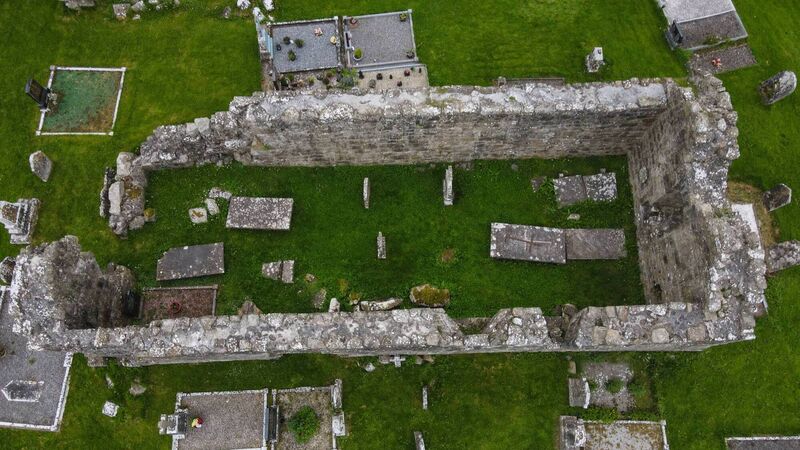
An aerial view of St Manchan's church at the ancient monastic site at Lemanaghan, Co Offaly. Picture: Annie Holland
The timing would give you pause for thought.
When Storm Éowyn ripped through the ancient monastic site at the Lemanaghan bog in Offaly last year, it uprooted four mature trees, exposing a number of previously-unknown early medieval burials enmeshed in their root-balls.
The fact that it happened on January 24, the very day that Manchán — the saint who founded the monastery — is commemorated is a remarkable coincidence.
But there’s more.
As the local community prepared to mark St Manchán’s feast day at the weekend, it did so with the recently released results of scientific analysis which show one of the burials may date to the time the saint was alive.
HISTORY HUB
If you are interested in this article then no doubt you will enjoy exploring the various history collections and content in our history hub. Check it out HERE and happy reading
Radiocarbon dating results, confirmed earlier this month, puts the human remains in the early medieval period.
One of the burials dates to between AD662-817, which means the person was alive around the same time as monastery founder St Manchán, who is said to have died in 664.

Other remains date to between AD707-939, revealing that the enclosure around St Mella’s Cell — the oratory named after the saint’s mother — was once used as a burial ground.
At least four Christian burials, including at least one of a child, were identified; two in the roots of one of the fallen trees and two in another.
Project osteoarchaeologist Annamaria Diana said all skeletal remains were now being analysed to assess biological profiles and possible pathological conditions, as well as to establish the minimum number of individuals represented.
She said: “Based on preliminary observations carried out so far, the assemblage clearly includes more than the four articulated burials and contains individuals of different ages, with identified juvenile teeth confirming the presence of children in the burial ground.”
The excavation itself was challenging and complex, says archaeologist and director of the Irish Heritage School Denis Shine.
The storm damage “resulted in extremely precariously held together burials that were severely disturbed by roots. However, we were lucky to have a very experienced team who deserve our thanks, as do Offaly County Council and the National Monuments Service for funding the dig.”
He said it was an important find, and it’s one that casts new light on a rich archaeological landscape.
The enclosure where the remains were found was not known as a burial site, at least not within living memory, but it is now clear that it was an early medieval graveyard.

While analysis of the bones is not complete, the sample excavated included women and children but no men.
The bones will yield more definite information in time but, for local woman Aoife Phelan, the significance of their discovery is clear.
She says, rather poetically, that it feels like a message from our ancestors:
“It has made it clear to us that Lemanaghan is sacred historic land, and that it must be protected, preserved, and respected.”
On this day last year, when the storm had passed, Aoife — accompanied by her sons, nieces, and nephews — first noticed the uprooted trees within the enclosure at St Mella’s Cell.
The following day, local man Séamus Corcoran recognised that an exposed skull at the site was likely to be human, triggering the chain of events that led to a full archaeological investigation, facilitated by the Heritage Office in Offaly County Council, the National Monuments Service, and the National Museum.
“For many locally,” she says, “the timing of events has been deeply moving, with the burials revealed on the saint’s day, discovered by children walking the pilgrimage route, and dating to the precise period when St Manchán was alive.”
It’s not just an emotive response.

As a member of the Lemanaghan Bog Heritage and Conservation Group, Ms Phelan, along with a team of other local people, have long campaigned to stop Bord na Móna and SSE Electricity proposals to build a windfarm on what has been described as one of the richest wetland archaeological sites in Europe.
Bord na Móna and SSE Electricity have said they are “currently preparing an environmental impact assessment report for the proposed Lemanaghan windfarm, which will be submitted in due course for scrutiny and assessment as part of a planning application to An Coimisiún Pleanála”.
Unlike Clonmacnoise nearby, Lemanaghan’s rich heritage might not be well known in the popular consciousness. However, in archaeological circles, it is considered exceptional.
Griffin Murray, a senior lecturer at the department of archaeology at University College Cork and co-author of a book on St Manchán’s shrine, offers this insight: “Lemanaghan and its surrounding bogland represents one of the richest archaeological landscapes in Ireland.”
The early medieval monastic complex — founded by St Manchán probably in the seventh century — includes an early ecclesiastical enclosure, an important collection of early carved stones, a Romanesque church, a holy well, bullaun stones, and an early medieval roadway, he said.

“The site is unique in Ireland in still retaining the relics of its saint, which are contained in a magnificent early 12th-century shrine probably commissioned by the high king of Ireland, Turlough O’Conor,” he said.
“This is preserved in the parish church, and represents an unbroken tradition of Christian worship in this area since the early medieval times.
“The location where the human remains were discovered appears to be an early medieval nunnery attached to the main monastery.
“Very few early-medieval nunneries have been archaeologically identified in Ireland. The small church here, known as St Mella’s Cell, dates from the 10th or 11th century.
“What is exciting about the discovery and scientific dating of the human remains is that it proves that not only was the site at St Mella’s Cell a place of early medieval burial, but it also demonstrates that this part of the site is much older than we originally thought.”
The presence of children in the burial record is also very interesting, he said, adding that it makes us think about who lived in early medieval monasteries and who was allowed to be buried in them.

He also made the point that the bogs around the monastic site are part of the rich archaeological landscape — not something separate from it.
One of the most important finds from Lemanaghan bog was an early medieval crosier, dating from the 10th or 11th century.
Part of it was discovered when it was caught up in a peat-harvesting machine in 1977. It was then acquired by the National Museum of Ireland.
Incredibly, another part of the crosier was discovered, decades later, in 1991 by another worker who spotted it lying on the surface of the bog.
“There are still pieces missing, and these are either still out there in the bog or else long destroyed,” says Mr Murray.

The most recent finds illustrate the possibility of further archaeological discoveries and also how our view of the past changes over time.
As Offaly heritage officer Amanda Pedlow said: “The importance of this monastic site is central to the community who take extraordinary care of it.
“Some 20 years [after the Lemanaghan conservation plan was commissioned by the Heritage Council in 2001], new evidence has come to light which changes the interpretation of the history again.”
The feast day of St Manchán, however, remains the same. Last Saturday, Fr Brendan O’Sullivan was joined by the local community to commemorate him at a Mass in St Mary’s — the church in Pullough, Offaly — renowned for its Harry Clarke stained-glass windows and its bog oak altar.
Read More
Check out the Irish Examiner's WEATHER CENTRE for regularly updated short and long range forecasts wherever you are.