Mason O’Connell Conway: A caring four-year-old whose life was stolen by abuse
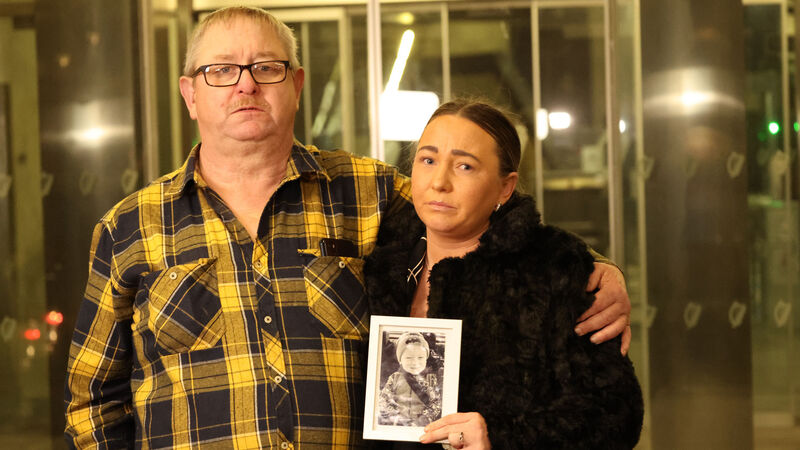
Elizabeth Conway and her father Tony Conway after Tegan McGhee was sentenced to life in prison for the murder of her son Mason O’Connell Conway in Limerick in March 2021. Picture: Collins Courts
A "caring" little boy with the "biggest brown eyes" was robbed of his life and will never get to hit "his milestones", his heartbroken mother said.
Earlier this week, one of the most harrowing stories of child abuse in recent living memory was laid bare in an Irish court.

Limerick woman Tegan McGhee, aged 32, was jailed for life at the Central Criminal Court for the murder of four-year-old Mason O’Connell Conway.
The little boy, who has been described as a “loving, caring, clever little child” died on March 16, 2021, after suffering severe head and liver injuries.
Outside the courthouse on Wednesday, his mother Elizabeth Conway held tight onto her statement as she fought through tears.
Standing by her side, her father Tony held a framed black-and-white picture of a beaming Mason, wearing his Batman beanie and the look of a happy boy with his whole life ahead of him.
“Nothing will ever bring Mason back. The last five years have been a living hell,” Ms Conway said.
Throughout the trial, Ms Conway heard what her son faced in the “days, weeks, months” leading up to his death.
“ I have never heard so much evil in all my life. It's every parent's worst nightmare, only mine came true in the worst way possible,” she said.

She said her little Mason was an “innocent baby” who was robbed of his life by “two very evil people, Tegan McGhee and Paul O’Connell”.
As she was visibly shaking, Ms Conway told the press how Mason brought “so much love and happiness” to the family.
She remembered his “biggest brown eyes” and him smiling “from ear to ear”.
A “typical” four-year-old boy, Mason was fond of cars, bikes, school, playing with his siblings and friends, and loved going to his nanny’s house.
“I couldn't wait to watch Mason grow up, hitting his milestones, but unfortunately, I'll never see my son alive again,” Ms Conway said.
While the trial was ongoing, reporting restrictions were in place — meaning those charged in relation to Mason’s death were not to be identified.
The restrictions order was lifted on certain conditions by the judge, Mr Justice Paul McDermott, following an application made by RTÉ and Mediahuis Ireland.
McGhee, aged 32, a Limerick native with no fixed abode, was sentenced to life imprisonment for the murder of Mason O’Connell Conway. She pleaded guilty to his murder on the fourth day of her trial in November.
The little boy died at a house McGhee and the boy’s father were renting in Rathbane, Limerick City.
The boy’s father, John Paul O’Connell, aged 36, was previously sentenced to seven years in prison after a guilty plea to endangerment, neglect, and impeding McGhee’s apprehension or prosecution — knowing or believing she had murdered his child.
The little boy was found with serious injuries at the Rathbane home, and was pronounced dead three days later.
McGhee was also sentenced to four years and six months for two counts of child cruelty in the weeks and months leading up to Mason’s murder. The child cruelty sentences will run concurrently with the life sentence.
The trial heard how O’Connell called emergency services, claiming his son had fallen from the top bunk of his bed and could not be roused. Confined to his bedroom, the child was only allowed to leave it for food or to use the bathroom.

When paramedics arrived on the scene, they found Mason, who was unresponsive, lying on his bedroom floor.
He was rushed to hospital but despite intervention and surgery, he did not recover from his injuries.
Medical professionals noted 17 bruises of various ages all over his face, head, torso and legs. Bruises which were indicative of “classic signs of physical abuse”, according to Dr Stephen O’Riordan, who reviewed the child’s case.
His father, O’Connell, had justified the injuries, saying his son was the “clumsiest child ever”, and had run into a door or been hurt while playing football.
However, McGhee’s trial heard the boy had been subjected to physical abuse for weeks, and spent four days grounded in his room before she shook him, and struck his head off the floor.
The defendant claimed the boy was “bold” and “cheeky”, and often had to be grounded. When grounded, he could not leave his room or go into his bed, and instead, had to sit on the floor.
The court heard how laceration on the boy’s liver, which would normally be associated with a car crash, would have been caused by “extreme force”.
The trial heard the little boy died of a traumatic head injury, combined with blunt-force trauma to the abdomen.
The lifting of the reporting restrictions was welcomed by Mason’s family, who said they wanted him to be remembered, but also believed “systemic Tusla failures” contributed to his “suffering and death”.
About six months before he was murdered, the boy was placed in the care of his father and stepmother.
Earlier this week, Mason’s mother recalled in her statement how he would make everyone else laugh when playing peekaboo with his sister.
“When he potty trained himself at just 18 months, he felt he was a 'little man' and would insist on walking instead of going in his buggy. He adored his younger siblings and would insist on helping to care for them and would kiss and cuddle them, she recalled.
The court heard how Mason was a “caring little boy”, who asked his mother to give a homeless man a pizza and later expressed worry about whether or not the man would be ok.
After receiving the “worst phone call” of her life, Ms Conway had to make the “hardest decision a mother could make” to turn Mason’s life support off.
At the time, O'Connell and McGhee asked to be left alone with Mason in the hospital room.
"I can only imagine what they were saying to my poor child's lifeless body," said Ms Conway.
After the machine was switched off, she watched her child “heartbeat go down and down”, until he flatlined.
“Pure evil” robbed Mason of his life, a life taken by someone he “loved and trusted”.