Meet Ireland’s new search and rescue dogs trained to find missing people on land and water
A volunteer team and their dogs are pioneering Ireland’s first water search capability for missing persons and recovery operations
Meet Ireland’s new search and rescue dogs trained to find missing people on land and water

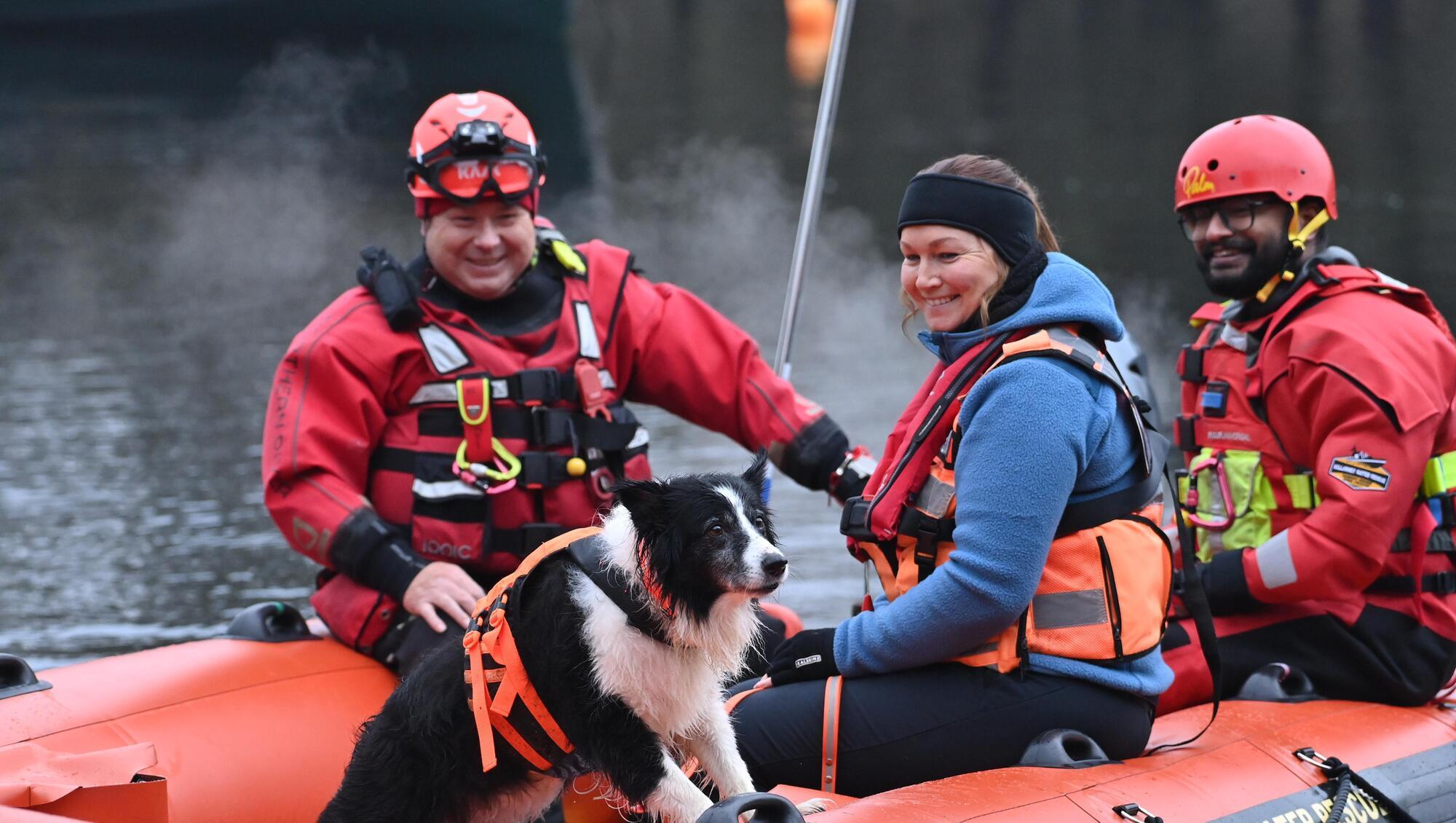
Members of the Killarney Water Rescue Search and Recovery Team with members of ISSARD at Loch Léin, Killarney National Park: Kieran Caulfield, Ajay Tom George, and Éadaoin O'Gorman with Murphy. Picture: Dan Linehan

Meet the new highly trained team of search and rescue dogs, helping to save lives on land and sea by doing the vital work that no machine can do.

These 13 dogs are part of Ireland’s first water search training programme and have been going through extraordinary drills with their handlers for the past three years.

They will soon be tackling all types of missing persons cases across the country.

The dogs showed off their remarkable skills to the Irish Examiner in Killarney National Park recently with their training officer Éadaoin O’Gorman, who will launch the country’s first dedicated cadaver/human remains detection water search dog training programme on January 25.

“Our programme is a collaboration between Hounds and Helis in Cork, Ireland’s Specialist Search and Rescue Dogs [ISSARD], and Killarney Water Rescue Search and Recovery,” said Ms O’Gorman.

Killarney Water Rescue Search and Recovery Team and ISSARD members training at Loch Léin, Killarney: Beccie Jeffers with Pepper, Claire Tangney, Donal Dux O'Donoghue, Kieran Caulfield, Lorraine O'Sullivan, Kathryn O'Callaghan with Rylec, Donna Weiner, Ajay Tom George, and Éadaoin O'Gorman with Murphy during their training at Lough Léin, Killarney. Picture: Dan Linehan

“It will focus on developing specialist dogs trained to detect human remains in water environments, an area of search capability that is increasingly in demand in Ireland.

“We work with most breeds; there is no one breed suitable. 

"Right now, we have Labradors, springer spaniels, collies, and Australian shepherds, and they work with their handlers, who are also their owners.

“People come to us with their dogs, and we know pretty early on if they are suitable to be trained. We train their owners too to become their handlers. Our current dogs have been training for the past three years.”

The dogs — Yogi, Fidget, Pongo, Fern, and Chieftain — are all schooled in “man-trailing”, following a person’s unique scent trail to find them.

Skyla, Lando, Coco, and Scout specialise in air scent by using their noses to detect the smell of human scent particles carried on the wind, working off the lead to cover large areas quickly to find missing people.

Murphy, one of ISSARD’s specialist search and rescue dogs, hard at work with Killarney Water Rescue Search and Recovery during training in 'man-trailing' and cadaver work at Loch Léin, Killarney National Park. 	Pictures: Dan Linehan
Murphy, one of ISSARD’s specialist search and rescue dogs, hard at work with Killarney Water Rescue Search and Recovery during training in 'man-trailing' and cadaver work at Loch Léin, Killarney National Park. Pictures: Dan Linehan

The air-scent dogs identify any human scent, not a specific individual, by sniffing the air and zigzagging across terrain — making them vital for finding unresponsive or lost people in vast outdoor environments like forests or mountains.

Cadaver dogs trained to find remains

Pepper, Murphy, Rosie, Biddy, and Rylee are cadaver dogs — also known as human remains detection dogs.

They are specially trained to use their powerful sense of smell to locate human decomposition scent and play a crucial role in helping the gardaí and forensic experts to find missing people.

Cadaver dogs are highly skilled and can detect airborne scent particles and play a crucial role in providing evidence and closure for families.

Ms O’Gorman, who runs Hounds and Helis in Cork, set up the training unit after working with dogs for the past 15 years, first starting out in pharma before moving to Autism Assistance Dogs Ireland.

“I began working as the puppy programme supervisor for Munster,” she said. 

"The organisation had mainly Labradors and golden retriever puppies in training with volunteer foster families. Then I set up Hounds and Helis in 2021, where I teach search and rescue dog training to pet dogs and operational search dogs.

Killarney Water Rescue Search and Recovery member Lorraine O’Sullivan taking to the water as part of the team’s training session. All members are volunteers who are ready at a moment’s notice to respond to a call to action. 	Picture: Dan Linehan
Killarney Water Rescue Search and Recovery member Lorraine O’Sullivan taking to the water as part of the team’s training session. All members are volunteers who are ready at a moment’s notice to respond to a call to action. Picture: Dan Linehan

“Throughout the years, even when I worked in pharma, I was involved with search and rescue dogs.

“Traditionally, all we had in Ireland were air-scent dogs for missing person searches. 

"Air-scent dogs are ideal in the mountains as they work to search remote areas to find the missing person. But in recent years, searches have become more and more complex. 

We need dogs that can work in urban and populated areas to find a missing person.

“We do a lot of lowland and urban work with the dogs. Man-trailing dogs are vital in urban search and rescue and they can track an elderly person missing from home or follow a trail of a person who left a pub the night before but never made it home. No other resource, no machine or drone, can do that.”

During a search, the man-trailing dogs help look for missing people when they get the scent of the person who may have walked from their home and got lost, often by using a piece of their clothing.

Donal Dux O'Donoghue and his partner Claire Tangney, who are members of the Killarney Water Rescue Search and Recovery team, during the specialist training at Lough Léin, Killarney. Picture: Dan Linehan

“Many of our team’s dogs got started through Hounds and Helis,” said Ms O’Gorman. “They came along to a man-trailing introduction workshop with their dog for fun and got hooked. Some loved it so much that they wanted to use their dog to help their community, to find a missing person.

“It just grew from there.

“I began training the dogs and the team and holding seminars about the work we want to do.”

Rescue or recovery

The searches sadly don’t always result in finding someone alive.

“Sometimes you reach the stage where you just know it’s a recovery mission, that’s when you need a cadaver dog to find the person,” said Ms O’Gorman.

“You can train any dog, they see it as a sport, but you can find extra special dogs with extra grit, and you just know they are going to be successful.

“I know by now what dogs will work. They are fantastic, so intelligent. People really enjoy it. They have their handlers, and they just go to work.”

Éadaoin O'Gorman with her dog Murphy during the specialist search and rescue, 'man-trailing', and cadaver detection training at Loch Léin, Killarney National Park. Picture: Dan Linehan 

ISSARD has cadaver dogs, and the unit works on a voluntary basis.

Each member is in full-time employment elsewhere.

“We are always on call, and sometimes you have to drop things and just go,” said Ms O’Gorman. “It is very interesting work, and it is a privilege to be able to use our skills with the dogs.”

Ms O’Gorman has been training the current handlers for three years due to the specialist work involved.

She said: “It takes a very long time to prepare the dog, and the handler — they work together and live together — you are always learning new skills.”

Vital volunteers

With the current lack of a specialist dog unit for the State to conduct this work, Ms O’Gorman said there are simply not enough of these canines in the voluntary sector available to gardaí and forensic teams.

The group of 24 volunteers has a rescue phone number and receives calls from the public, gardaí, or other search teams about missing people.

They have also begun building connections with gardaí across Ireland to help forge relationships with them.

Ms O’Gorman said: “We invite gardaí to our training sessions and seminars, and have received great support from local inspectors here in Cork. We are big believers in transparency, and we are very clear about the work we do.

“Our day is a varied one — sometimes it’s just about keeping on top of our training. We have training logbooks and assessments for both the handlers and dogs.”

The latest project, involving the Killarney Water Rescue Search and Recovery Unit, focuses on water-based searches. Unit chairman Kieran Caulfield said they joined forces to create an initiative that will “lead to successful outcomes”.

“I have worked in river rescue for years. There was a gap there for cadaver dogs at sea and inland waterways,” said Mr Caulfield.

“They have the capability to pick up the scent of a deceased person under the water. 

"Training the dogs for this will involve being in a very tight-knit group. The dog will come out on the boat with its handler, and the driver of the boat will be there too. They all must know each other well to be involved in something as close as this type of search.”

He described the a major “challenge to doing that” because most dogs are trained on a lead.

“They simply drag you to the direction you need to go to,” he said.

In the boat, they can’t do that, so it is crucial that the dog handler and person driving the boat are able to interpret the dog’s indications and follow those. 

The handler’s role is critical when it comes to communication, while the person driving the boat needs to understand the handler.

Mr Caulfield said: “The advantage of this is, we could be on a search for a person missing for a week, and we are searching by putting divers down, but we don’t know where to start.

“The assistance of the dog indicates an area of interest, and we can refer the divers there. They pick up the scent from decomposition.

The 24 volunteers of Killarney Water Rescue Search and Recovery Team receives calls from the public, gardaí, or other search teams about missing people. Picture: Dan Linehan

"That is a vital clue in finding a person and returning them to their family, which we have been able to do in the past. We dealt with one man whose brother had been missing for three months.

“We hand over our work and step back, but it is hugely important to be able to return a body to a family.”

The work that goes into the training process involves an expert in the US who is assisting the group: “It is so complex and technical, it takes longer to train these dogs, but nobody can do what these dogs can do.”

Mr Caulfield, who has been working with Killarney Water Rescue since 1995, joined the Royal National Lifeboat Institution (RNLI) in 2019, and went on to lead the Killarney organisation.

“We are a community-based voluntary group solely funded by the generosity of the public. 

We receive no State funding unless we apply for grants.

“We are still looking for a permanent place to store our equipment and to hold meetings. Right now, all equipment is in my home.”

Formal training of the dogs will get underway later this month and they will be brought out on boats to familiarise themselves with the mechanics of their mission on water, ahead of their official launch.

“The target training starts in the middle of the month,” he said. “We will be placing the scent item in the water and observing the dogs’ responses.”

 Kieran Caulfield and Donna Weiner getting ready to take to the water at Lough Léin. Both members of Killarney Water Rescue Search and Recovery Team. Picture: Dan Linehan
Kieran Caulfield and Donna Weiner getting ready to take to the water at Lough Léin. Both members of Killarney Water Rescue Search and Recovery Team. Picture: Dan Linehan

He urged walkers and swimmers to always let loved ones know the location, duration, and times of their activities: “Good communication is key if you are going out anywhere, and is helpful in cases where things go wrong.

“Those pieces of information are vital when you have to go and search. We can begin to draw up an idea of where that person can be.”

Often there are unforeseen challenges in water-based searches: Fallen trees, submerged fence lines, and environmental hazards.

“Communication is key,” he said.

“We are all dog lovers and from an operational point of view, they bring something no machine can bring to the job.”

Mr Caulfield said he is always looking for volunteers who are willing to commit to their rescue and recovery: “We would encourage anyone interested in working with us, whether it’s on admin, social media, or with the dogs, there is a whole range of voluntary work there.”

  • ISSARD’s emergency rescue number is 051 267671 

More in this section

Lunchtime News

Newsletter

Keep up with stories of the day with our lunchtime news wrap and important breaking news alerts.

Cookie Policy Privacy Policy Brand Safety FAQ Help Contact Us Terms and Conditions

© Examiner Echo Group Limited