Coimisiún na Meán is investigating social media firms. We found out how and why
Given his very public and unique persona cultivated over the years, subtle and guarded reactions are not what we’ve come to expect from the world’s richest man.
However, when the European Commission levied a fine of €120m on X, formerly Twitter, at the beginning of December,
Elon Musk called for nothing less than the dismantling of the European Union.
He also retweeted a post comparing the EU to fascism and he was firmly backed by the Trump administration as US secretary of state Marco Rubio called it an attack “on all American tech platforms and the American people” and that “the days of censoring Americans online are over”.

The actual investigation and fine dished out were not about “censorship” at all — but about “deceptive” blue checkmarks, advert transparency, and not giving researchers public data — but it fit in with prevailing view of Europe among those who now run the US.
On the same day that the fine was issued, Europe was digesting the new US national security policy that told the continent it is facing “civilisational erasure” and that America should help Europe “correct its current trajectory”.
The regulation of big tech is just one of the fronts that America is at loggerheads with Europe on.
And — given that so many of those big companies run by men who lined up to attend Trump’s inauguration are based in Ireland — we again occupy an outsized space in these geopolitical wrangles.

Already, the likes of X are facing probes by Ireland’s media regulator Coimisiún na Meán for suspected breaches of European digital safety laws.
With several more investigations set to be announced in the months to come, Ireland may well be in the crosshairs as these battles continue.
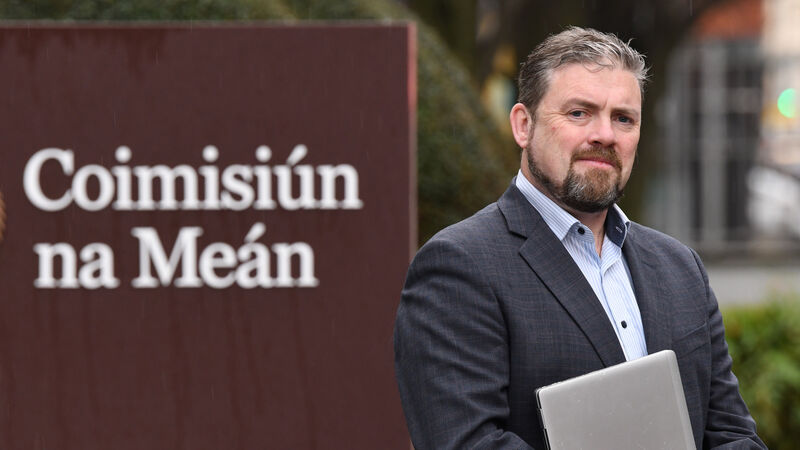
John Evans is digital services commissioner at the Irish regulator.
He told the that Coimisiún na Meán is certainly feeling “pushback” as it aims to regulate the sector.
“The regulations strike this balance between innovation and efficiency with the protection of fundamental rights and other harms,” he said.
“In Europe, we’ve struck this balance and now we have legislation.”
It has already successfully defended judicial reviews in the High Court. In recent months, X has filed two more and he said “we’ll see what happens with those”.
More broadly, there was engagement with the platforms and co-ordination across Europe to move together before the European Digital Services Act, as the big players tried to shape and influence what was being done.
“But then the rubber starts to hit the road, and making some of the changes to come into compliance are expensive,” he said.
“They don’t like doing that. It becomes a cost centre for them.
"In a sense, the geopolitical issues are kind of above my head and all we can do is work the legislative system as it is and do the job as best we can.
“Sometimes it will become uncomfortable for people but, you know, you still got to do it.”
Coimisiún na Meán got its full suite of legislative powers during the summer, with the Irish Online Safety Code now complementing European legislation in the area.
Since then, it has launched its first ever investigations into X, Tiktok, and Linkedin for suspected breaches of the laws.
“Towards the latter end of the year, we’ve opened up a number of investigations, and we’ll be working through those,” he said. “My pipeline is producing now. So, it’s that next stage.
“We’ll need to work through those investigations and bring them to a conclusion. Others will follow, and, you know, the pipeline moves on.”
This will be the first time the regulator has conducted these probes and Mr Evans likened their work in 2024 to “building the plane as you’re flying it”. But, in 2025, the pieces began to fall into place as they finally acted on taking the platforms to ask.
“The investigations team now carry out their work, they collect information, and analyse the evidence that comes back,” he said.
“There’ll probably be multiple rounds and potentially interviews with individuals involved.
"You’ll see from the X case [announced by the European Commission] with a €120m fine. There’s a lot of stake.”
Mr Evans stressed that the steps taken must be airtight and by the book to ensure the sanction can be followed through upon and defended in the courts if required.
“It’s hard to give a timeline,” he said. “It takes as long as it takes to get it right.
“Doing things for the first time is harder, but I would expect there will be significant periods of time required to get these things right.”
It won’t all be fines and High Court battles, and the regulator does hope that by working with these companies they can bring about change using carrots rather than the stick — although whether that will consistently be effective remains to be seen.
“I think maybe a point to get across is that investigations and enforcement findings and fines are not the only way to get change,” Mr Evans said.
“Those changes that happened on X around age gating their service. That happened without any enforcement and that’s the law in place.
“They’ve chosen to come into compliance.
"Of course, we need to assess the effectiveness of that, and that will determine whether or not they’re compliant. But they’ve definitely taken steps.”
Any regular user of social media will be familiar with the bile and abuse that gets thrown around so casually and so often across a range of platforms and, while that hasn’t changed, Mr Evans believes there have been some visible changes that have been of benefit to users in Ireland.
“I would say that the experience is different across the different sort of harm areas,” he said. “Does the public always see what’s going on in the background?
“An example I’d point to is when Tiktok was launching a new product in Europe called Tiktok Lite.”
He pointed to concerns raised that it had certain features that “could potentially encourage addictive behaviour” and prolong the amount of time children would spend on it.

The launch of that product was delayed after Ireland’s regulator and some of our European counterparts got involved so that changes could be made.
“That’s something that would go under the radar for the normal person because you just don’t see that kind of thing. But it shows that the regulation is working in the sense that changes are being made even before they get to market.”
The first investigations it has launched, into X, Linkedin and Tiktok, are because Coimisiún Na Meán suspects them of having breached the European Digital Services Act.
This is the same act under which the European Commission fined X €120m early in December.
Mr Evans conceded there is a “degree of confusion” over what the regulator does and doesn’t look at here: It’s not about one specific bit of content that is horrendously abusive and remains up on the site despite being reported.
“[It also causes] a degree of disappointment in that when you’re tackling systemic issues, you’re looking at the systems and the mechanisms at the platforms to ensure people’s rights are upheld,” he said.
“All of it is intended to tip the balance back in favour of the user and give them a bit of agency when they’re dealing with platforms which they hadn’t really had before the Digital Services Act.
Whenever he and colleagues appear before an Oireachtas committee, politicians line up to describe the vile abuse that’s directed at them online along with a general question, ‘what are you doing about it’, directed at the regulator.
A major source of frustration that is often aired is the approach recommended by Coimisiún na Meán — reporting it to the platform first, appealing the decision if necessary, and then contacting the regulator if action isn’t taken.
At this stage, the cat may be out of the bag in terms of the person being exposed to abuse or similar online. Mr Evans acknowledged that, and said it was a concern.
“We talked to a sample of politicians who went in the general elections and then in the local elections, and it is quite worrying what comes back,” he said.
“A significant proportion, around 20%, were receiving content that is not just negative but actually threats to life or harm to them and family members.”
Mr Evans said that, apart from the individuals being harmed, it is a concern as it may put people off putting themselves forward for public office in the future. He called it a “chilling effect”.
However, he stressed that some of the investigations they have already started into platforms have arisen out of these methods of reaching out to the platform to report illegal content — with an eventual view of making them much better at taking down content that is reported to them.
“Generally, are those mechanisms working well and in the way they should? So that’s how we’re attacking it from a system point of view.”
Children’s ability to access pornography is another topic that frequently crops up: As it was widely available on X and its European headquarters is in Ireland, Coimisiún na Meán could tell it to introduce age verification measures and it did so during the summer.
On websites specifically for pornography, Europe is moving together.
“The advantage of, say, tackling the porn issue with the Digital Services Act is you’ll get the same result for the whole of Europe, right?
“So, the four cases that were opened [by the European Commission] during the summer include Pornhub,” Mr Evans said.
“The outcome of that will eventually be appropriate age gating for those services. Article 28 [of the DSA] is pretty clear that needs to be the case.
“The guidelines elaborate what needs to be done to come into compliance, and so we will see the outcome of those investigations in due course. And I think that’s a better outcome, rather than having individual member states trying to make this happen on their own.
“There’s a lot of advantages from tackling these companies as a region.”
Ireland’s media regulator has been up and running several years now and has finally progressed to formal investigations into the big firms that are based here.
With so many big firms based here, and the wider political context around it, it faces a massive task going forward.
And, as the Government considers other moves, it is closely watching developments from elsewhere.
For instance, Australia’s move to ban under-16s from having social media accounts.
Mr Evans said it was an “interesting experiment” but it would ultimately be a decision for Government here.
The move certainly provoked the tech companies who all decried the move from the Australian government and said it wouldn’t protect children from online harms.
But it appeared no coincidence that, the week before it took effect, Ireland’s and Australia’s regulators in this area signed a “memorandum of understanding” to co-operate in this field.
“We’re very interested to see what happens with that,” he added.