'People are sad and broken inside. They don’t have the spirit to celebrate Christmas'
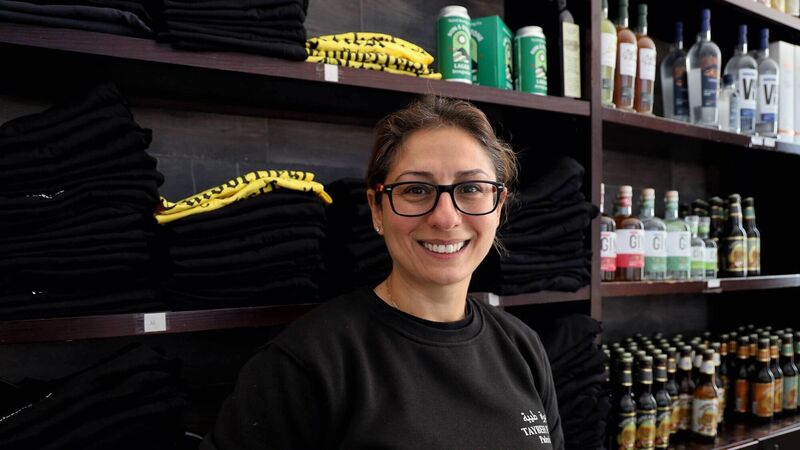
Madees Khoury in the Taybeh Brewery in the occupied West Bank. Picture: Hannah McCarthy
In the small Christian Palestinian village of Taybeh, Madees Khoury is busy bottling beers at her family’s microbrewery when the visits.
Decorations and tinsels mark the entrance to the small factory, but there is little sign of Christmas elsewhere in Taybeh, one of the world’s oldest Christian communities.

“People are very sad and broken inside. They don’t have the spirit to celebrate,” says Khoury, a rare Palestinian female brewer.
Khoury was born in Boston in the US, but her family’s roots go back at least 600 years in Taybeh, the West Bank’s last entirely Christian village.
“I moved here in 1995 when my family started the business,” says Khoury.
“I was the first from my generation to come back after college and work full-time with the family.”

In the aftermath of the Oslo Accords brokered in the 1990s between Israel and the Palestinian Liberation Organisation led by Yasser Arafat, thousands of Palestinians like Khoury’s family returned from abroad to the West Bank, when a Palestinian state seemed possible in the not-too-distant future.
Three decades later, Palestinians are facing daily violence across the West Bank, with more than 1,000 killed by Israeli soldiers and settlers since October 2023.
The around 1,000 residents of Taybeh have seen a sharp increase this year in attacks by settlers who during the summer lit fires by the centuries old Byzantine church in the village.
“People should come to Palestine and see what we actually go through,” says Khoury.
“We’ve been getting settler attacks almost daily since July.
“They burn cars, block us from our olive groves, and drive into the village trying to provoke people,” she says, noting that the settlers are typically armed.
In the aftermath of the October 7 attack, Israel’s far-right national security minister, Itamar Ben Gvir provided assault rifles en-mass to settlers in the occupied West Bank.
The Israeli settlers have attacked the water spring which supplies 14 Palestinian towns including Taybeh multiple times — damaging pipelines, destroying systems, and blocking Palestinians from fixing them.

On one occasion, an Israeli settler began ploughing the land of Khoury's family around Taybeh.
“We were too scared to approach him because you can get shot — and they walk free,” she says.
“After October 7, they don’t care anymore — everything is on camera, documented, and still there’s no accountability.”
When the war on Gaza began after the October 7 attack by Hamas, the Israeli military imposed a harsh regime of restrictions and increased raids on the occupied West Bank.
“Over 200,000 Palestinians who used to work in Israel are now unemployed,” says Khoury.
Following the onset of the war on Gaza and crackdown on Palestinians in the West Bank by the Israeli military, sales for Taybeh beer have decreased by 70%, says Khoury.
“Beer in Palestine is considered a luxury product. People don’t have the money anymore to spend on beer or to have fun. They’re saving for necessities.”
As well as a drop in demand for beer from the Palestinian Christian community (who consume more alcohol than the majority Palestinian Muslim community) and tourists, Taybeh Brewery has also faced increased charges for exporting its products abroad to France, Norway, Denmark, Switzerland, and the UK (Khoury hopes to find an importer in Ireland in the future).

“We don’t have our own borders. Everything has to go through Israel,” says Khoury. “We can’t export without permits, checkpoints, security checks, and now extra ‘manual security checks’ we have to pay for.”
She says: “Sending beer to [Haifa] port should take an hour and a half — for us it takes three days.”
With settlers acting with impunity — often on camera — across the West Bank, Khoury says:
“The next best thing is to hurt them economically — through boycotts, sanctions, and divestment.”
“Our Palestinian voices are very low,” says the Palestinian brewer. “It’s important that the international community speaks up.”