Former Defence Forces officers say Ireland is under threat and may be at the mercy of drones
Ireland has been left scrambling to catch up amid the heated geopolitical situation and the emergence of 'hybrid warfare'
Former Defence Forces officers say Ireland is under threat and may be at the mercy of drones

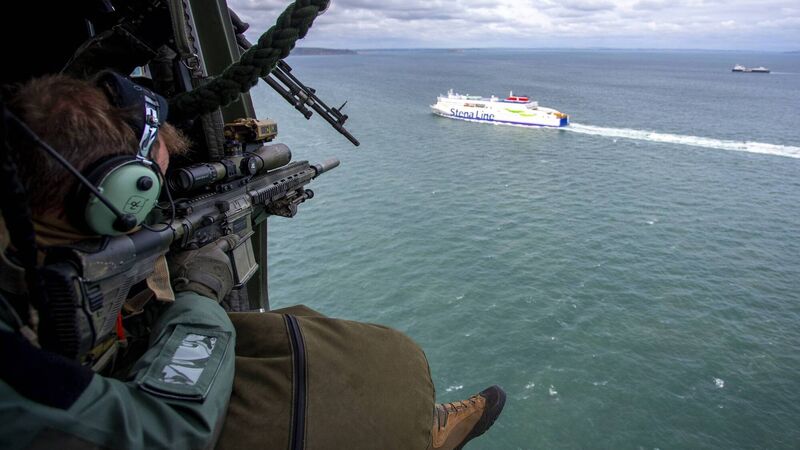
File photo of members of Óglaigh na hÉireann conducting a maritime counter-terrorism exercise near Dublin Port. The exercise included members of the Army Ranger Wing, the Air Corps, and the Naval Service. Picture: Óglaigh na hÉireann


Drones observed by the Irish navy hovering by the flight path of Ukrainian president Volodymyr Zelenskyy during a recent State visit uncovered some serious fault lines in Ireland’s security and defence.

It has also highlighted a lack of clarity in Ireland’s chain of command in responding to potential security threats.

It served as a reminder of the need to re-examine the State’s rules of engagement — which were last updated in the 1980s, before rapid and seismic technological changes fundamentally altered the theatre of war and the nature of hybrid warfare.

Hybrid warfare — which uses tactics such as disinformation, cyber attacks, and drone incursions to weaken an adversary without engaging in overt warfare — has become an increasingly common, cheap, and powerful way to destabilise enemy regimes.

Drones during Zelenskyy visit 

On December 1, Ukraine's president Volodymyr Zelenskyy flew into Ireland for a State visit slightly ahead of schedule.

However, at the time his plane should have been crossing the final few miles of sea before reaching land in Dublin Airport at around 11pm, a naval ship which had been secretly stationed under the flight path for the visit noticed up to five drones in the sky at the time his plane was expected.

The drones then flew over the naval vessel — the LÉ William Butler Yeats — the same warship involved in the successful interdiction of the MV Matthew drug trafficking ship off the Cork coast in September 2023.

A no-fly zone for drones around Dublin had been initiated by the Irish Aviation Authority for Mr Zelenskyy’s visit.

It is a criminal offence to operate an unmanned aircraft system within a temporary no-fly zone without specific Garda permission. Gardaí are now investigating the incident.

Russian president Vladimir Putin at an exhibition of Orlan-10 military drones in St Petersburg. Security sources suspect the drones in the flight path of Ukrainian president Volodymyr Zelenskyy during his Dublin visit were Russian. 	Picture: Contributor/Getty
Russian president Vladimir Putin at an exhibition of Orlan-10 military drones in St Petersburg. Security sources suspect the drones in the flight path of Ukrainian president Volodymyr Zelenskyy during his Dublin visit were Russian. Picture: Contributor/Getty

Gardaí are the primary response force on land and in Irish territorial waters.

Some commentators are now calling for legislation to make the navy the primary authority at sea.

Cathal Berry, a medical doctor, retired Army Ranger Wing officer, and former TD, said the ship was 13 nautical miles off the Irish coast, quietly patrolling the arrival of Mr Zelenskyy at the time.

Irish territorial waters run to 12 nautical miles from the shore, so the incident appeared to have occurred just outside Irish territorial waters and airspace, Mr Berry said.

Medical doctor, retired Army Ranger Wing officer, and former TD, Cathal Berry. Picture: cathalberry.com

“Ireland has no authority to shoot anything down out there unless there’s a direct threat to the ship itself,” he said.

“There was no direct threat to the ship, so normal rules of engagement apply. 

"Anyone is entitled to fly helicopters or aircraft around in international waters, international airspace. 

"And the main mission had already been achieved — president Zelenskyy has safely landed in Dublin Airport.”

'We lack capacity to neutralise drones'

But even if the LÉ William Butler Yeats had wanted or needed to neutralise the drones, they lacked the capacity to do so safely, Mr Berry said.

“There’s no soft kill option on the naval ship.”

Soft kill options could include lasers, frequency jammers, and counter drones to ram the suspicious drones with.

“The weapons on board are over 50 years old. They’re all second-hand, and most of the sighting systems are WW2 vintage,” Mr Berry said.

“So the only option they have is to pump a big load of lead up into the sky into the flight path and the approach route into Dublin Airport, which would be absolutely ridiculous and irresponsible.”

Any use of the weapons on board would have significantly increased the chance of collateral damage — with hundreds of civilians travelling on commercial aircraft overhead.

Pulverising drones with powerful lead shots from the sea would also destroy any chance of tracking them back to where they originated from, he said, thereby losing the potential for vital intelligence.

Additionally, no technology could detect the drones aboard, Mr Berry said.

“If it wasn’t for the human lookouts on the deck of the LÉ William Butler Yeats, we wouldn’t know any of this,” he said.

Where exactly the military-grade drones went or came from is unknown. 

But it is strongly suspected that the drones were Russian.

€1.7bn capital spend on Defence Forces 

In July, capital funding of €1.7bn was allocated to defence in the National Development Plan for the period 2026-2030. 

Defence minister Helen McEntee announced major investment in anti-drone technology this week.

 Defence and foreign affairs minister Helen McEntee arriving at Curragh Camp on Thursday for the launch of the National Development Plan sectoral plan for the Defence Forces. Picture: Eamonn Farrell/RollingNrews
Defence and foreign affairs minister Helen McEntee arriving at Curragh Camp on Thursday for the launch of the National Development Plan sectoral plan for the Defence Forces. Picture: Eamonn Farrell/RollingNrews

Some €19m is to be rapidly invested in anti-drone technology with the capacity to both identify and neutralise suspicious drones, she said.

It is to be in place when Ireland takes over the EU presidency in July and a full radar system will be in place by 2028, Ms McEntee said.

Mr Berry believes Ireland will be able to secure the military airport at Baldonnel, Co Dublin, for visiting heads of state during the EU presidency next year.

But the approach routes are much less easily secured, he said, adding: “We have no capability, and we will not have any capability in seven months’ time either [for that]. 

"You can’t create this overnight. 

"It’s like learning a language. It takes years of dedication and the pursuit of excellence before you get that capability. And so we’ve left it way too late.

“They’ll be able to secure the perimeter there with the new equipment they’re buying. But it’s the approach that we saw from Zelenskyy’s visit.

“What’s going to happen out in the Irish Sea? 

"We will have to seek assistance from another country to basically secure the airspace over your capital city, and in the approach to the main international airport.

“And if the war in Ukraine continues, which is highly likely, then we should expect significant interference.”

Commercial airports are not getting this new anti-drone technology under the plan, he said: 

Shannon’s getting nothing, and Cork’s getting nothing, and Dublin Airport’s getting nothing. 

Every airport should now have anti-drone defences, Mr Berry said.

But civilian airports have civilian authorities to make such decisions, he said: “Airports have scanners, they have airport police. As naturally as having running water and electricity in your airport, you should have an anti-drone system. It’s that basic.

“You’ve got a perimeter fence around an airport to provide physical security.

“Now we need a drone fence, if you like, a virtual fence around as well to make sure there’s no drone interference.

“And not only to detect a drone, but to be able to disable and neutralise it as well.”

Europol warning  

Recent wars, including Russia’s invasion of Ukraine, sparked fast innovation in unmanned systems like drones, advances which are now being capitalised on by nefarious forces, EU law enforcement agency Europol said in a report this week.

Such advances have been further boosted by developments in supporting technology, such as 3D printing for modifications, cryptocurrency for anonymous trade, and encrypted communications to evade detection.

'The Cube', the fact-checking unit of broadcaster Euronews, found that drone-related disruptions at European airports quadrupled between January 2024 and November 2025.

Cathal Berry says Ireland's military had an air defence system, with radar on the backs of vehicles and surface-to-air missiles which could secure certain areas, up to 2012.

But this was disbanded in cutbacks during the austerity years.

“So the capacity we had has been deliberately, and by choice, wound down by successive parliaments. We’ve no one to blame but ourselves,” Mr Berry said.

"We’ve had almost four years of war in Ukraine. 

"We’ve had the drones for the last six months, and airspace incursions all over Europe, but no action was taken, and now we’re living with the consequences. 

'Cold War level of threat' 

Geopolitical threats have recently ramped back up to Cold War levels, with hybrid warfare a significant concern, the retiring head of the navy Commodore Michael Malone recently told the 'Irish Examiner'.

Throughout most of his 44-year career, threats were “fairly benign”, he said. But now, they again resemble the threat level during the Cold War between the Soviet Union and Western Europe.

Commodore Michael Malone conducting a final inspection during his stand down parade last week at Haulbowline Naval Base, Cork Harbour. See links at the foot of this article. Picture: Jim Coughlan 

“The reality is that we’re now in these new changing times and we have to deal with that. And we now need to employ the right technologies to deal with that,” he said.

In the changing geopolitical situation, it is essential that Ireland has proper maritime awareness and can secure its critical subsea infrastructure, including data cables, power interconnectors, and gas pipelines, he said.

Defence Forces upping its strength 

Ireland is beefing up its naval technological power in response to the changing threats, with new towed array sonar being procured. 

This will allow the navy to monitor sound in the ocean, including submarine activity.

Earlier this year, the air corps took possession of the third Airbus C-295 aircraft to be delivered in the last two years.

The Defence Forces told the Irish Examiner: “The investment of approximately €300m in these three C-295 aircraft represents the largest equipment acquisition project ever undertaken for the Defence Forces. 

Defence minister Helen McEntee speaking at the launch of the National Development Plan sectoral plan for the Defence Forces at Curragh Camp on Thursday. Picture: Eamonn Farrell/RollingNrews

"Next week, the air corps will take possession of a new Dassault Falcon 6X strategic reach aircraft, which, together with the C-295 aircraft, represents a significant enhancement of the State’s transport, airlift, and medical capabilities.”

Investments are being made, and recruitment in the navy in particular is increasing. 

However, Ireland’s rules of engagement have not been updated since the 1980s, Mr Berry said. He added: 

There’s no clear guidance. 

"The rules of engagement haven’t been updated since the 1980s. The rules of engagement have to do with internal security, like taking on the IRA, taking on criminals,” he said.

“There’s nothing really to do with state-on-state sovereign attack on Ireland, per se. So the rules of engagement need to be clarified.”

Lack of a national security strategy

Another major problem is the continued lack of the national security strategy, which has been promised for about five years, he said, adding: “The national security strategy should contain three particular things.

“First of all, clear demarcations between the various state agencies — gardaí and defence forces and where responsibilities lie.

Members of the Defence Forces engaging in an exercise. File picture: Brian Lawless/PA

“Number two, it should have very, very clear rules and guidelines.

“Number three, it should have the protocols in relation to liaison and decision making, which is completely absent as well.

“The public submissions to the national security strategy were requested five years ago. It’s actually still up on the website and people, in good faith, put in their submissions. But still, not only is there no strategy published, there’s not even a strategy designed. And that is just a 30-page document. Every country has one. So there’s no overall coordinating document to clarify all these things, and that’s what the issue was [during Mr Zelenskyy’s visit].”

Mr Berry said when gardaí have an investigation underway, they have a press conference and appeal for witnesses. But the State had no such response to the drone incursion.

“They say it’s for reasons of national security but it’s not. It’s for reasons of national humiliation,” he said. “They’ve been underinvesting in our Defence Forces for so long.”

The Defence Forces said in a statement to the Irish Examiner that “for operational security reasons, Óglaigh na hÉireann does not discuss the specifics of operations, capabilities, the air corps’ fleet disposition, or publicly disclose rules of engagement”.

“However, Óglaigh na hÉireann successfully deployed multiple supporting capabilities to the recent security operation, led by An Garda Síochána.”

x

More in this section

Lunchtime News

Newsletter

Keep up with stories of the day with our lunchtime news wrap and important breaking news alerts.

Cookie Policy Privacy Policy Brand Safety FAQ Help Contact Us Terms and Conditions

© Examiner Echo Group Limited